
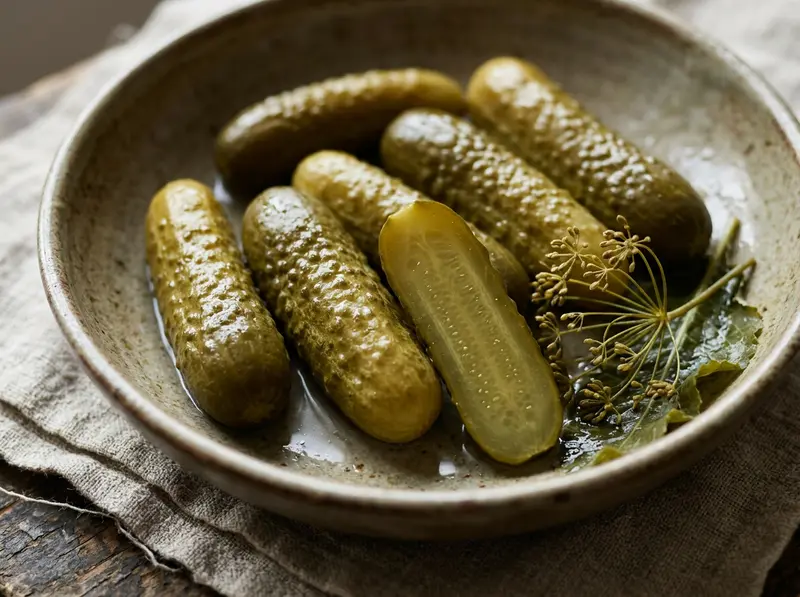
Russian Fermented Pickles (Solyonye Ogurtsy)
Solyonye ogurtsy (солёные огурцы) are Russian sour pickles: small whole cucumbers fermented in a cold salt brine with dill, garlic and horseradish, blackcurrant and cherry leaves, and no vinegar. Russians call this the cold method, kholodny zasol, and pickles made this way in wooden barrels are called bochkovye ogurtsy, barrel pickles. This version fits one 3-litre jar. They are not malosolnye ogurtsy, the lightly salted cucumbers eaten within hours or days while still green, and not marinovannye ogurtsy, which get their sourness from vinegar. Here the acid is made by the ferment itself. This is the Russian home method: about a week in the warm, then the cold. It is shorter than the fermented pickle process tested in the United States, which runs 3 to 4 weeks at 21 to 24 °C, and US food safety services advise against the shorter one; the note below explains what that means and who should not eat these pickles. The hands-on work is about 40 minutes. The rest is waiting: 3 hours of soaking, 5 to 7 days of fermenting at room temperature and 4 weeks in the fridge, about 5 weeks in all. The jar is kept cold from the day the bubbling stops and is never stored in a cupboard.
What are solyonye ogurtsy?
Solyonye ogurtsy are cucumbers preserved by salt and fermentation and nothing else. The Soviet state standard for them, GOST 7180-73, defines the product as fresh cucumbers with seasonings, covered with a salt solution and put through lactic fermentation. The same standard lists what goes in: fresh dill, horseradish leaves and root, garlic and hot pepper, with blackcurrant, cherry and oak leaves to improve the taste and smell.
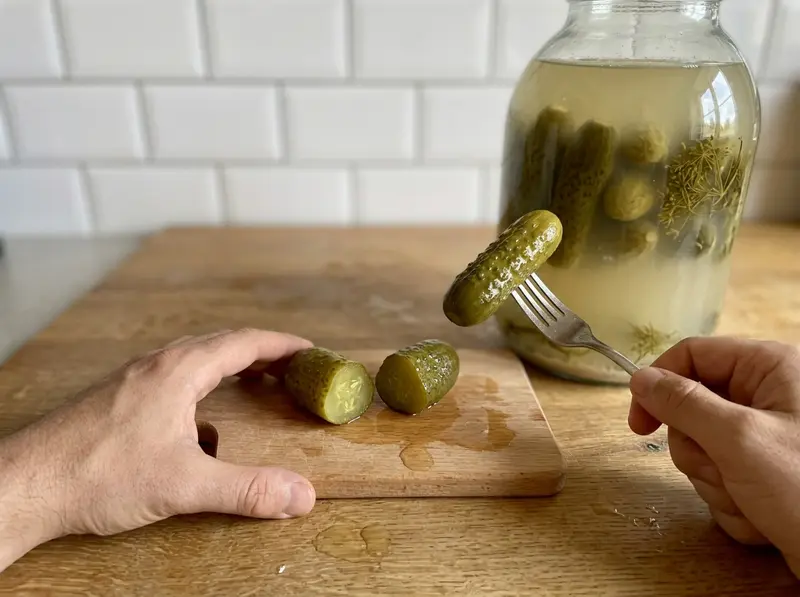
They were traditionally made in wooden barrels, oak or birch, which is where the name bochkovye ogurtsy, barrel pickles, comes from. A 3-litre glass jar does the same job at home. A finished pickle is olive green, firm and crunchy, salty and sour at once, and it sits in a slightly cloudy brine that tastes a little sharper than the cucumber itself.
Solyonye, malosolnye and marinovannye ogurtsy: three different pickles
Russian has separate words for three things that English calls pickles. Malosolnye ogurtsy, lightly salted, are eaten within hours or days and stay green. Solyonye ogurtsy are the same cucumbers left to ferment, 5 to 7 days in the warm and then 4 weeks in the cold in this recipe, until they turn olive and sour. Marinovannye ogurtsy have vinegar in the brine and are not fermented at all. Tomatoes are split the same way: solyonye pomidory are fermented in salt brine, and marinovannye pomidory are made with vinegar.
German Salzgurken are a close relative. So is the American fermented dill pickle, though the tested US recipe adds a quarter cup of vinegar to 8 cups of water and ferments at 21 to 24 °C for 3 to 4 weeks.
How to serve solyonye ogurtsy
Eat them straight from the jar, cold, whole or cut lengthwise. In Russia they count as a zakuska, a cold appetizer, and they sit well next to potatoes, stewed meat or herring with onions and potatoes.
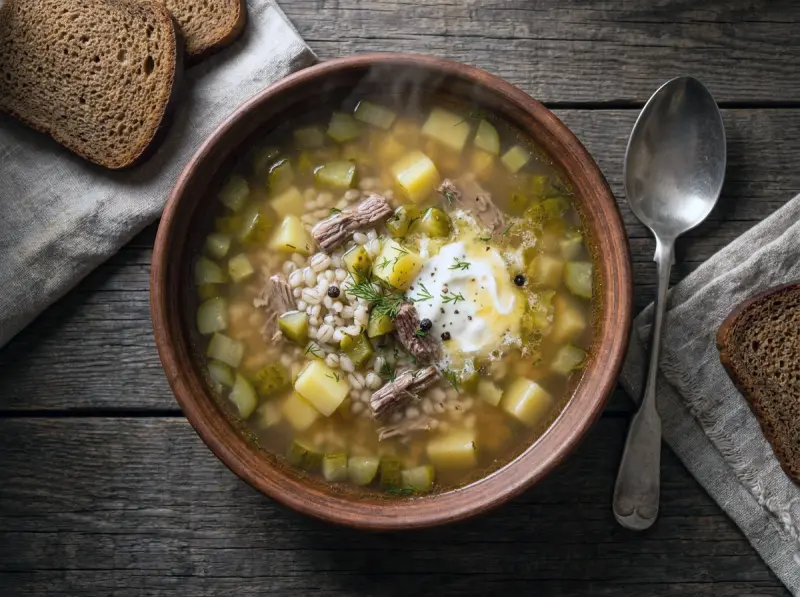
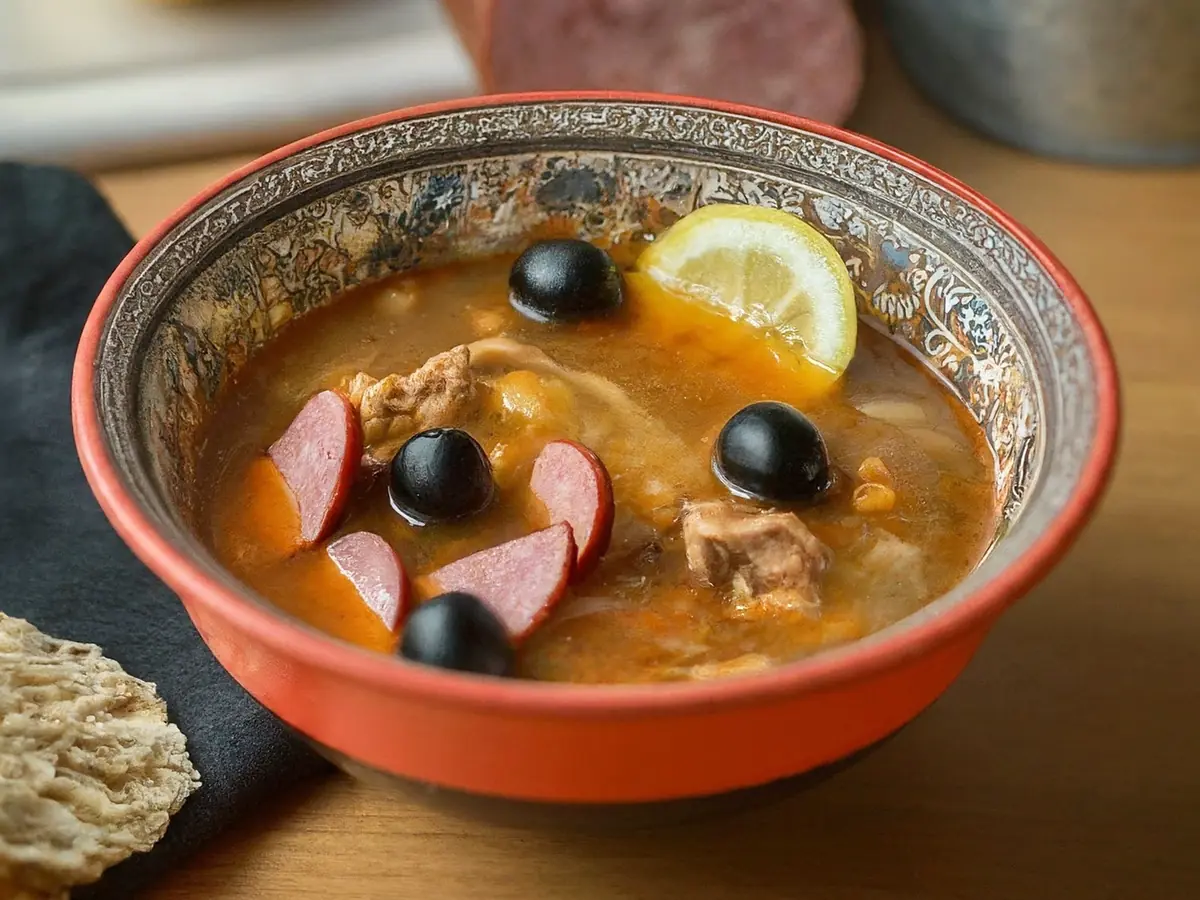
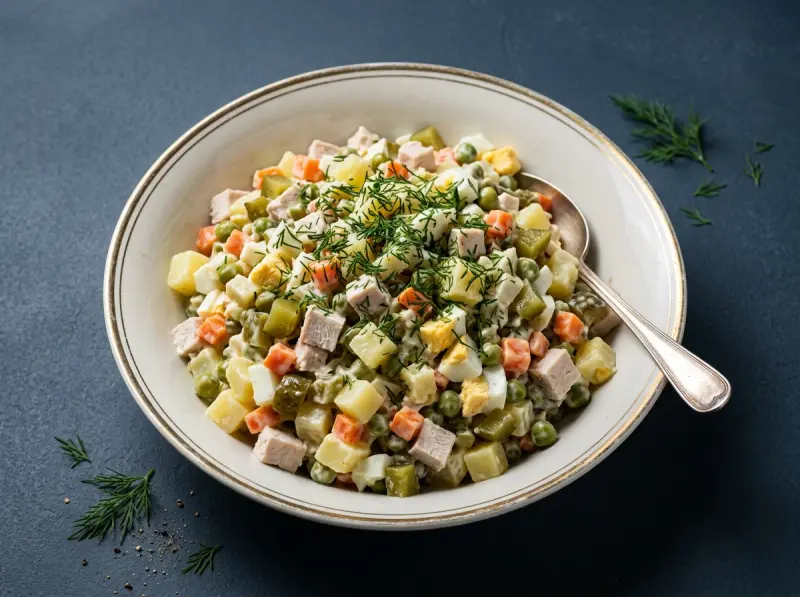
They are also a cooking ingredient. Diced pickles go into Olivier salad and vinegret. Both the pickles and their brine go into rassolnik, and the pickles go into solyanka. Save the brine when the jar is empty, because rassolnik needs it.
Ingredients
- 1.5 kgcucumber
- 1.5 lwater
- 105 gsalt
- 4 headdill
- 2 horseradish leaves
- 4 clovegarlic
- 6 blackcurrant leaves
- 6 cherry leaves
Method
- Sort and soak the cucumbers. You need 1.5 kg of small pickling cucumbers, 9 to 11 cm long, firm and bumpy. Throw out any that are soft, yellow or damaged. Wash the rest under cold running water without scrubbing them hard, then cover them with cold water in a large bowl and leave them for 3 hours. Any that float in the water are usually hollow inside, so take those out. Russian cooks soak shop-bought cucumbers so they firm up again and come out hard and squeaky; cucumbers picked the same day can skip the soak. Drain them and slice 2 mm off both ends of each one. The blossom end can carry an enzyme that softens pickles, so do not skip the trimming.
- Wash the jar and get the leaves ready. Wash a 3-litre glass jar and its plastic lid in hot soapy water and rinse them well with very hot water, until the glass squeaks and no soap film is left. Dip the lid in boiling water for 30 seconds. Rinse the 4 heads of dill, the 2 horseradish leaves, the 6 blackcurrant leaves and the 6 cherry leaves in cold water and shake them dry. Peel the 4 cloves of garlic and cut each one in half. Use only fresh, clean garlic and leaves, because mouldy ones are a known cause of soft pickles.
- Pack the jar. Put 2 heads of dill, 1 horseradish leaf torn into pieces, all the garlic, 3 blackcurrant leaves and 3 cherry leaves on the bottom. Stand the cucumbers upright on top of them, as tightly as they will go, in two tiers. Tuck the other 3 blackcurrant leaves, 3 cherry leaves and 2 heads of dill between the cucumbers and over them, then fold the second horseradish leaf over the top like a cap. The jar is packed well when nothing shifts as you tilt it and the top sits 2 to 3 cm below the rim. Tight packing and the leaf on top stop the cucumbers from floating up out of the brine.
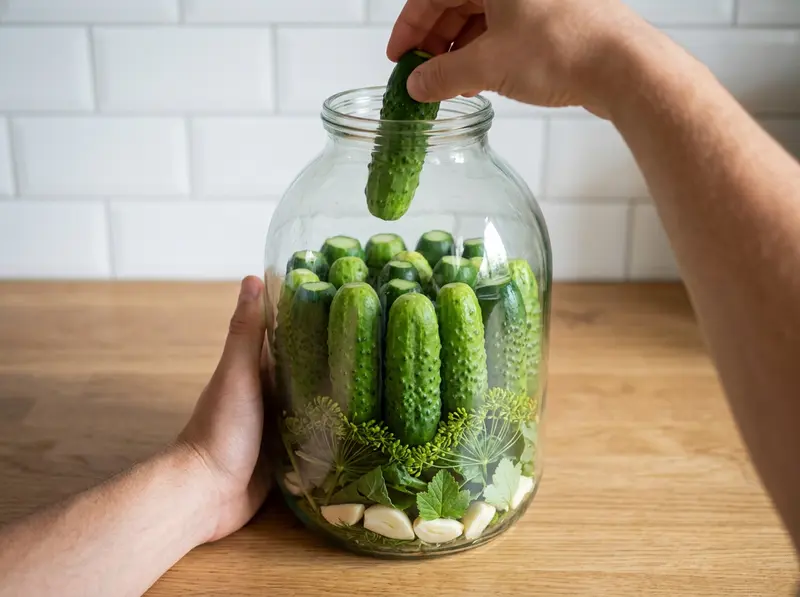
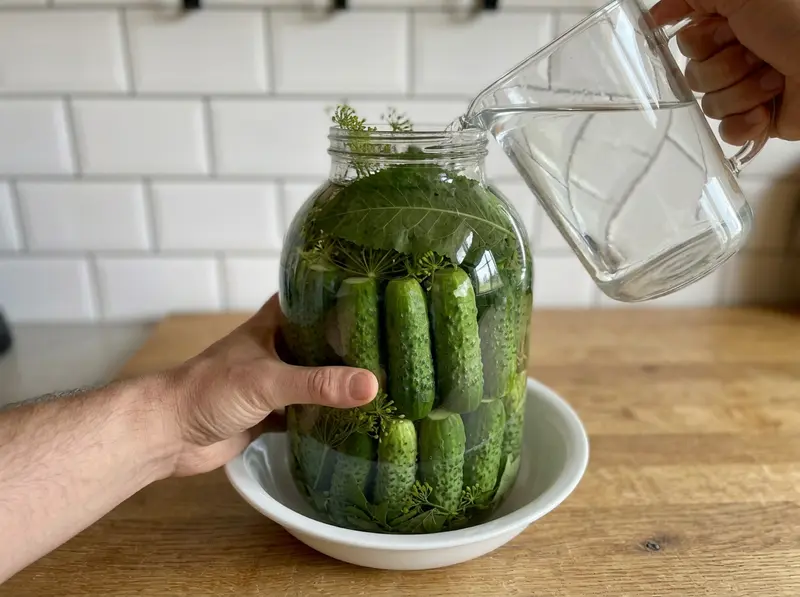
- Make the cold brine and fill the jar. Weigh 105 g of coarse salt with no iodine in it and stir it into 1.5 l of cold drinking water, filtered or bottled and not boiled, until the water is clear again. That is 70 g of salt per litre. Weigh it, because spoonfuls of coarse salt vary too much, and do not use less: the salt is what keeps the wrong bacteria out while the cucumbers ferment. Let the brine stand for 2 to 3 minutes so any grit settles. Stand the jar on a deep plate and pour the brine in right up to the brim, leaving the sediment behind. About 1.3 l goes in. Every cucumber and leaf should be under the liquid. Keep the remaining 200 ml or so of brine in a small covered jar in the fridge for topping up.
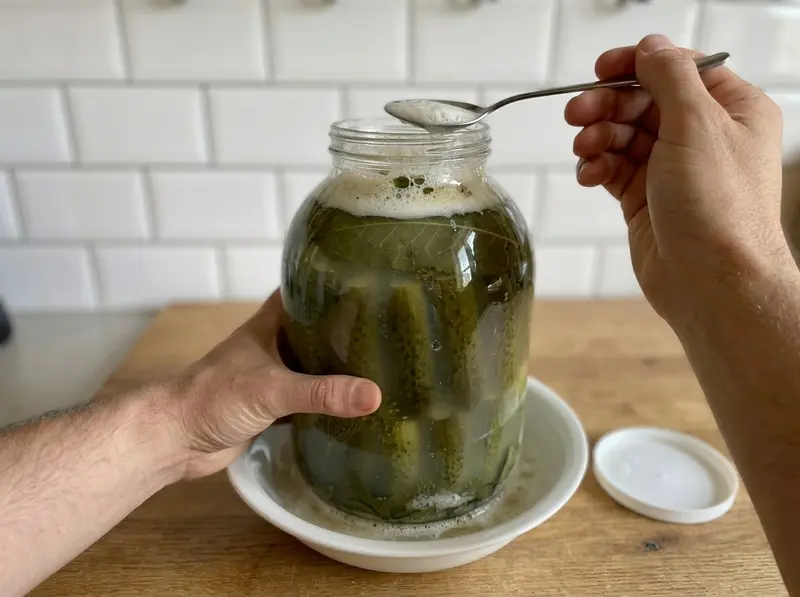
- Ferment at room temperature for 5 to 7 days. Rest the lid on the jar without pressing it down, so gas can get out, and leave the jar on its plate at 20 to 24 °C, away from direct sun. Never let it sit above 27 °C, or the cucumbers turn soft. Below 16 °C the fermentation hardly starts. Within a day or two the brine goes cloudy, small bubbles rise, foam collects at the top and some brine spills onto the plate. It smells sour and garlicky, and the cucumbers change from bright green to olive. All of that is normal. Once a day, skim off the foam and any white film with a clean spoon, top up with the spare brine so nothing sticks out of the liquid, and empty the plate. If a cucumber works loose and floats up, push it back under the horseradish leaf with the clean spoon. The warm stage is over when no new foam forms, no bubbles rise and every cucumber is olive. If bubbles are still rising on day 7, leave the jar in the warm, keep skimming and topping up, and look again every 1 to 2 days. If you have pH test strips, dip one into the brine: it should read 4.6 or lower before the jar goes into the cold. If it reads higher, wait and test again every 1 to 2 days. The acid made by the fermentation is what protects the pickles, so do not cut this stage short.
- Check the jar and move it to the cold. The brine should be cloudy and smell pleasantly sour, and the cucumbers should feel firm. If the cucumbers are soft or slimy, if the smell is foul, or if you see fuzzy or coloured mould, throw the whole jar out without tasting anything. If all is well, top the jar up to the brim, press the lid on, wipe the glass and put the jar in the fridge, or in a cellar that stays at 0 to 4 °C. The cold slows the fermentation down before the pickles turn too sour. Left in the warm they would go on fermenting and spoil.
- Wait 4 weeks before you taste them. The salt and the acid need that long to reach the middle of each cucumber. A finished pickle is olive and evenly translucent right through when you cut it, with no white raw core, and it snaps when you bend it. A layer of white sediment on the bottom of the jar is normal. Take pickles out with a clean fork, keep the rest under the brine with the lid on, and keep the jar at 0 to 4 °C the whole time. Look at the jar each time you open it. Skim off any white film; if the pickles turn soft or slimy, smell foul, or fuzzy or coloured mould appears, throw the jar out without tasting. Eat them within 4 to 6 months. Because this method is shorter than the tested one, do not serve these pickles to anyone very young, very old, pregnant or chronically ill.
FAQ
Soft pickles usually come from one of four things: brine weaker than 70 g of salt per litre, a room warmer than 24 °C during the fermentation, cucumbers that poked out of the brine, or blossom ends that were not trimmed off. Soft and slippery pickles are not safe to eat and the jar should be thrown out. Hollow pickles are a different story and are safe. They happen when the cucumbers were too large, when more than 24 hours passed between picking and brining, or when the cucumber grew hollow in the first place; those ones float when you wash them, which is why step 1 tells you to remove floaters. Pickles that are firm and smell clean but have lost some crunch are fine cooked: dice them into rassolnik, the Russian pickle soup.
Cloudy brine is normal and expected. The Soviet standard GOST 7180-73 describes the brine of a good product as slightly cloudy, and the cucumbers as greenish olive. Foam and a thin white film during the 5 to 7 warm days are normal too, as long as you skim them off every day, and so is white sediment on the bottom of the jar. Throw the whole jar out, without tasting, if the cucumbers are soft or slimy, if the smell is foul and not sour, or if fuzzy or coloured mould grows on top. If you own pH strips, the brine should read 4.6 or lower before the jar goes into the cold.
Kept at 0 to 4 °C, under their brine and with the lid on, they are good for 4 to 6 months, as long as you skim off any white film and nothing has turned soft, slimy or mouldy. Do not store them in a cupboard: the Soviet standard GOST 7180-73 gave unpasteurised salted cucumbers in glass jars only 7 days at up to 18 °C. On safety, the plain answer is that this is a traditional method and not a tested one. US extension services advise against pickles that spend only a week in the warm before the fridge, which is what the Russian home method does, and the process they have tested runs 3 to 4 weeks at 21 to 24 °C. If you cook for someone very young, very old, pregnant or chronically ill, use that full fermentation. Some Russian recipes boil the brine, pour it back three times and seal the jar with a metal lid, but I have found no food safety source that backs that method, so it is not part of this recipe. The one tested way to make fermented pickles shelf-stable is boiling-water canning of fully fermented pickles, and the published times cover only pint and quart jars, 10 and 15 minutes, not a 3-litre jar.
Solyonye ogurtsy are fermented: 5 to 7 days in the warm and 4 weeks in the cold, until they are olive, sour and salty all the way through. Malosolnye ogurtsy are the same cucumbers taken early, within hours or days, while they are still bright green and taste mostly of fresh cucumber. Marinovannye ogurtsy, like American quick-process dill pickles, get their sourness from vinegar and are not fermented. Even the fermented dill pickle recipe tested in the United States adds a quarter cup of vinegar to 8 cups of water, which the Russian one does not. That recipe also ferments for 3 to 4 weeks at 21 to 24 °C, much longer than the Russian week in the warm. In Russian cooking the fermented kind is the one that goes into Olivier salad and vinegret.
Swap the 6 blackcurrant and 6 cherry leaves for 4 to 6 grape leaves. Oregon State University's extension service notes that grape leaves contain tannins that can inhibit the enzymes that soften pickles. They will not give the blackcurrant and cherry flavour, but the pickles will still be the same kind. Oak leaves are also traditional in Russia; add 3 if you have a clean tree nearby. I know of no stand-in for horseradish leaves, so if you cannot get them, leave them out and fold a grape leaf over the top of the jar as the cap. The dill heads and the garlic are the part you should not drop.
Rate this
Recipes by email
One letter a week: a recipe picked for your taste, plus whatever is new on the site. Unsubscribe in one click.
Welcome gift: Sergei's cookbook (e-book).
By subscribing you agree to the privacy policy.
Tell us what you like to cook (30 seconds) →Keep browsing
More dishes from the Russian archive — picked by overlap with what you're cooking now.
Join the conversation
Comments
No comments yet — be the first!