
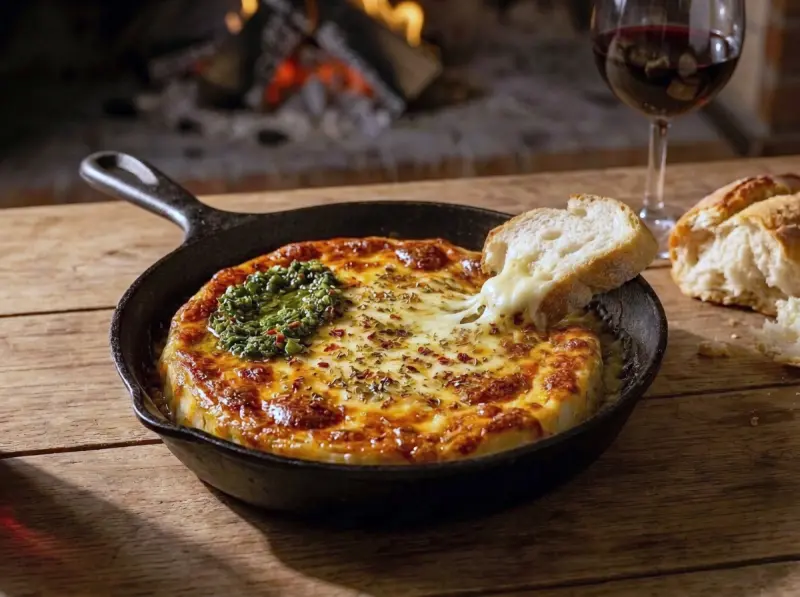
Provoleta (Argentine Grilled Provolone)
Provoleta is what opens an Argentine asado: a thick disc of provolone seared in a small cast iron pan until the outside forms a golden crust and the middle turns molten. Dried oregano and chili flakes go on before it hits the heat, and chimichurri goes over the top after. There's nothing complicated about it — the whole art is in getting a crust to form before the cheese collapses, and eating it straight from the pan with torn bread.
Ingredients
- 400 gprovolone
- 2 tspdried oregano
- 1 tspchili flakes
- 4 tbspolive oil
- 1 bunchparsley
- 3 clovesgarlic
- 2 tbspred wine vinegar
- 1 pcscrusty bread
Method
- Cut the provolone into a thick disc, about 1.5–2 cm. Leave it uncovered on a plate for an hour or two so the surface dries — this is what lets a crust form instead of the cheese just spreading.
- Make the chimichurri: finely chop the parsley and garlic, mix with the red wine vinegar, most of the olive oil, half the oregano, a pinch of the chili flakes, and salt. Set aside to macerate.
- Press the remaining dried oregano and chili flakes firmly onto both faces of the cheese so they stick.
- Heat a small cast iron skillet, barely bigger than the cheese, over medium-high heat until properly hot, then add a little olive oil.
- Lay in the cheese and cook without moving it for 3–4 minutes, until the underside forms a deep golden crust and the edges start to bubble.
- Flip carefully with a wide spatula and cook the second side 2–3 minutes, until crusted outside and molten in the middle. Don't let it go too far or it turns to a puddle of oil.
- Spoon the chimichurri over the top and serve immediately, straight from the pan, with torn crusty bread for scooping.
FAQ
Provoleta is a semi-hard Argentine cheese developed around the 1940s specifically for grilling — it holds its shape under heat instead of running everywhere. Outside Argentina it's hard to find, but a thick slice of aged, sharp provolone, cut from a log at a deli counter, is the standard and very good substitute. Ask for slices about 1.5–2 cm thick. Younger, milder provolone melts much faster and is harder to control.
Three things help. Cut it thick, at least 1.5 cm, so it has body. Let the cut surfaces air-dry on a plate for an hour or two, which helps a skin form. And use a small, properly preheated cast iron pan so the crust sets fast and the cheese is contained rather than spreading thin. Cook it briefly and hot rather than slowly — the goal is a crust outside while the centre only just goes molten.
No, but the pan matters. Traditionally provoleta is cooked in a provoletera, a small shallow cast iron dish sized to the cheese, set over coals. At home, a small cast iron skillet barely wider than the cheese works just as well, since cast iron holds and spreads heat evenly. A grill pan or any small ovenproof pan will do. What you want to avoid is a large pan, where the cheese spreads out and burns before the middle melts.
Chimichurri is the classic Argentine herb sauce: finely chopped parsley and garlic with oregano, chili flakes, red wine vinegar, and olive oil. Its acidity and sharpness cut straight through the richness of the melted cheese, which is why the pairing is so standard. It isn't strictly required — provoleta seasoned only with oregano and chili is perfectly traditional — but a spoonful of chimichurri or salsa criolla makes the dish far more balanced.
It's served immediately, straight from the hot pan, as the opening course of an asado while the meat is still grilling. Crusty bread is the essential partner, torn and used to scoop up the molten cheese. Salsa criolla, grilled bread, roasted peppers, or a drizzle of honey are common additions. It's rich, so a small piece per person goes a long way, and a glass of Malbec is the traditional accompaniment.
Rate this
Recipes by email
One letter a week: a recipe picked for your taste, plus whatever is new on the site. Unsubscribe in one click.
Welcome gift: Sergei's cookbook (e-book).
By subscribing you agree to the privacy policy.
Tell us what you like to cook (30 seconds) →Keep browsing
More dishes from the Argentinian archive — picked by overlap with what you're cooking now.


Join the conversation
Comments
No comments yet — be the first!