


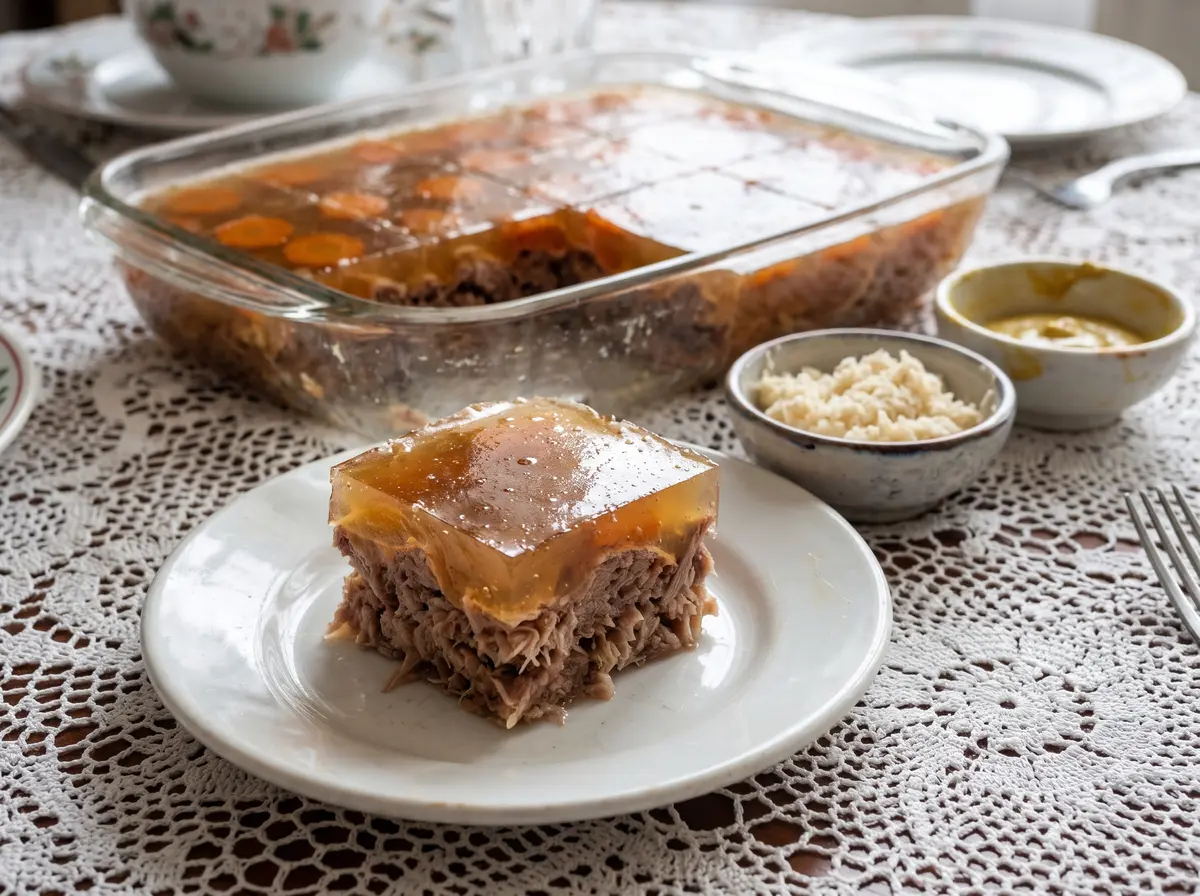
Kholodets (Russian Meat Jelly)
Kholodets (холодец, also called студень, and spelled Cholodez in German) is a Russian cold dish of meat, usually pork, often with beef, simmered for hours, picked off the bone and set in its own broth. The broth turns to jelly by itself, from the collagen in the trotters, skin and cartilage, so no gelatine goes in. It soaks for 3 hours, simmers for about 7 hours and needs at least 4 hours in the fridge to set, so it is usually made the day before. It comes to the table cold and sliced, with horseradish and mustard.
What kholodets is
Kholodets (холодец) and studen (студень) are two names for the same dish: pieces of meat in a firm jelly made from their own broth. Studen is the more common word in the north and northwest of Russia, kholodets in the south and southeast, and in Ukraine it is холодець. The jelly holds because collagen from bones, joints, cartilage, connective tissue and skin dissolves into the broth over a long simmer. A properly cooked kholodets needs no gelatine.
It is a cold appetizer for the festive table, served with horseradish or mustard. For many Russian families New Year isn't complete without it, and they cook it the day before so it has time to set for the party.
Kholodets, zalivnoe and Sülze
Russian cooks keep kholodets apart from zalivnoe, meat or fish in a jelly set with gelatine or agar. German Sülze is closer, but its broth is clarified, seasoned with white wine or vinegar and topped up with gelatine when needed. Kholodets has none of these. Its flavour comes from the meat, a few spices, salt and raw garlic.
Neighbouring cuisines have their own versions, such as Georgian mužuži and Moldovan răsol, which is made from a rooster.
Ingredients
- 1 kgpork trotters
- 1 kgpork hock
- 500 gbeef shank
- 3 lwater
- 1 onion
- 1 carrot
- 2 bay leaf
- 10 black peppercorns
- 5 allspice berries
- 1 tbspsalt
- 1 tspsalt
- 5 clovesgarlic
- 100 ghorseradish
- 100 gmustard
Method
- You need 2 pork trotters, about 1 kg in all, and 1 pork hock of about 1 kg. Ask the butcher to chop the trotters into pieces, since that is hard to do neatly at home. The hock should be fresh, not cured or smoked. Rinse the trotters, the hock and the 500 g beef shank, put them in a large bowl, cover with cold water and leave them in the fridge for at least 3 hours or overnight. Soaking draws out the blood, which would otherwise colour the broth. Some Russian recipes leave the meat to soak at room temperature. We use the fridge, because raw meat shouldn't sit at room temperature for more than 2 hours.
- Drain the meat. Scrape the skin of the trotters and the hock with a knife until it is smooth, and singe off any bristles over a gas flame or with a kitchen torch. Put all the meat in a 7 to 8 litre pot with a heavy base, cover it with cold water and bring to the boil over high heat. Boil for 5 minutes, then drain it in the sink, rinse the meat and wash the pot. The first water carries away the grey foam, the clotted blood and some of the fat, and the jelly comes out clearer.
- Put the meat back in the clean pot and pour in 3 litres of cold water. That is 1.2 litres per kg of meat, so if your meat weighs more or less than 2.5 kg, scale the water to match. It should cover the meat by about 2 cm. If it doesn't, add just enough water to cover, and expect a slightly softer jelly. Bring it to the boil over medium-high heat with the lid off and skim off the foam as it rises. Then turn the heat down to the lowest setting, so the surface only shivers, with a bubble here and there. Keep skimming for 30 minutes, then put the lid on, slightly ajar. A rolling boil breaks the proteins into tiny particles and clouds the broth. With the lid ajar, less water boils off, so the amount of broth, and with it the strength of the jelly, stays predictable.
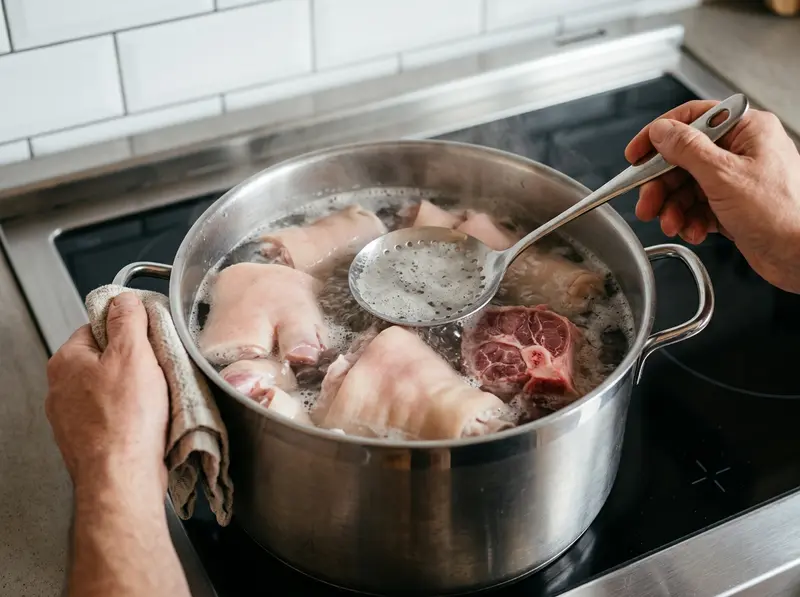
- Simmer for about 7 hours in all (6 to 8), counting from the moment the water came back to the boil. Look in once an hour, and if the liquid has dropped below the meat, add boiling water, only enough to cover it. After 5½ hours, before anything else goes into the pot, check the meat and the broth. The meat should come away from the bone easily, and the skin and cartilage should look translucent. Let a spoonful of broth cool a little, dip your thumb and forefinger in it and press them together: they should stick. Then drip a little broth onto a cold plate. Within 1 to 2 minutes it should start to set into a thin film. If the meat or the broth isn't there yet, simmer on and check again every 30 minutes. Every extra half hour pushes the whole next step later by the same amount, up to 8 hours in all.
- Once both tests pass, add the whole onion in its skin and the whole peeled carrot. From here the pot needs 1½ hours more. The onion skin turns the broth golden. After 30 minutes, add 2 bay leaves, 10 black peppercorns and 5 allspice berries. After another 30 minutes, stir in 1 tbsp salt and simmer for the last 30 minutes. The salt goes in last because water keeps evaporating, and a broth salted at the start can end up too salty. Turn off the heat. Lift the meat, carrot and onion onto a tray, and throw away the onion and bay leaves. Strain the broth through a sieve lined with 3 to 4 layers of cheesecloth into a clean pot. Stand the pot in a sink of cold water, with ice if you have it, change the water once it gets warm, and skim the fat off the top with a ladle. Taste it: warm, it should taste slightly too salty, because cold mutes salt. Add up to 1 tsp salt if it needs it.
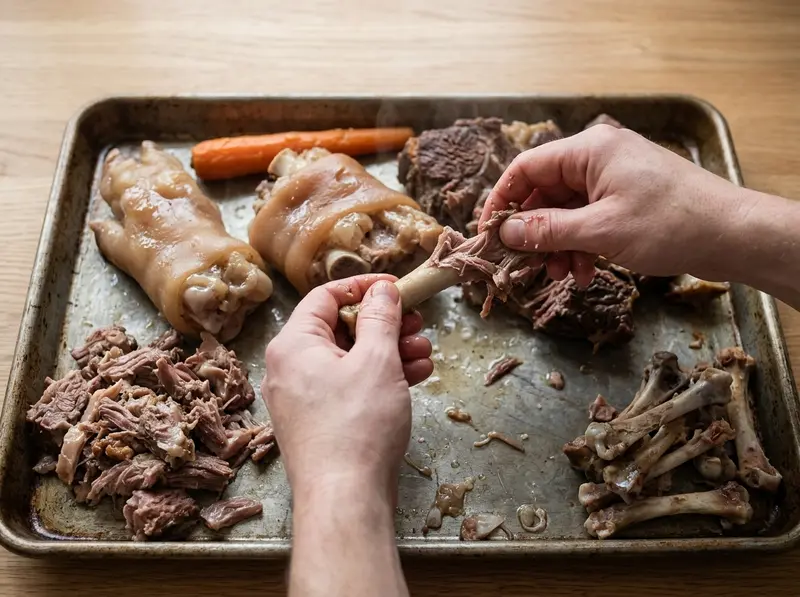
- When the meat is cool enough to handle, after about 20 minutes, pick it off the bones with your hands. Throw away the bones and chop the meat, skin and soft cartilage into small pieces. The skin makes the kholodets more tender. Slice the carrot into rounds and lay them on the bottom of 2 glass or ceramic dishes, about 20 × 25 cm each. Spread the meat over them in an even layer and crush 5 garlic cloves over the top. The garlic goes in raw, because heat dulls its smell and bite.
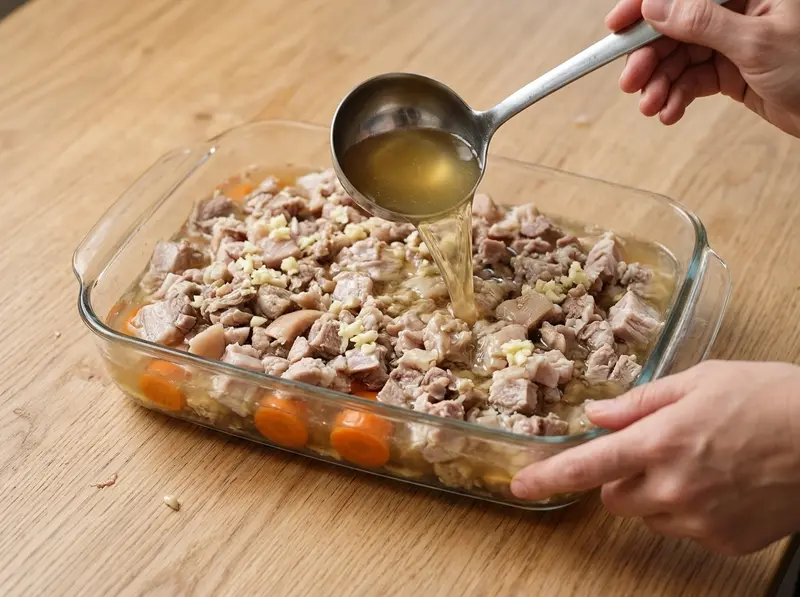
- Ladle the broth over the meat until it is covered, about 3.2 cm deep in each dish. Cover the dishes with cling film and put them in the fridge no later than 2 hours after you took the pot off the heat. That is why the broth cools in cold water and goes into shallow dishes. Many Russian recipes let it cool to room temperature first, and we don't. Leave it for at least 4 hours, better overnight, until the kholodets is firm all the way through and holds its shape when you cut it.
- Before serving, lift off any white fat that has set on top. Slice the kholodets in the dish or turn it out onto a plate, and serve it cold with 100 g horseradish and 100 g mustard. Keep it covered in the fridge and eat it within 3 days, and don't leave it out at room temperature for more than 2 hours. Russia's sanitary rules for food production, storage and sale (SanPiN 2.3.2.1324-03) give jellied meat only 12 hours at 4 ± 2 °C in shops and catering. If the smell, colour or taste changes, throw it out.
Cooked it? Rate the recipe
FAQ
Kholodets is a Russian cold dish of meat set in its own broth. It is also called studen: studen is the more common word in the north and northwest of Russia, kholodets in the south and southeast. The jelly comes from the collagen in trotters, skin and cartilage, which dissolves into the broth during the long simmer, and no gelatine is added. German Sülze is similar, but its broth is clarified, seasoned with white wine or vinegar and topped up with gelatine when it needs it. Meat in a jelly set with gelatine or agar has its own Russian name, zalivnoe, and is not counted as kholodets.
Usually there weren't enough trotters, skin and cartilage in the pot, or there was too much water, which thins the collagen. That is why this recipe uses 2 trotters and a hock with only 3 litres of water. Kholodets takes 2 to 4 hours to set on average, so give it the whole night before you worry. If it is still liquid, pour the liquid off into a pan and heat it until it steams but doesn't boil. Stir in 20 g gelatine per litre, soaked first as the packet says, until it dissolves, pour it back over the meat and get the dishes into the fridge within 2 hours. Strictly speaking that makes it zalivnoe, but it will set. A kholodets that has gone soft on the table sets again if it goes back into the fridge within 2 hours.
Most of it is decided before the long simmer starts. Soak the meat for at least 3 hours in cold water to draw out the blood, then boil it for 5 minutes in fresh water, drain and rinse it, and wash the pot. Start again with 3 litres of cold water and skim the foam for the first 30 minutes. After that the broth should barely move, because a rolling boil breaks the proteins into tiny particles that cloud the jelly. Strain it through 3 to 4 layers of cheesecloth and skim off the fat before you pour it over the meat.
Keep it covered in the fridge and eat it within 3 days. The USDA gives cooked meat 3 to 4 days, and we go with the shorter figure because the meat is picked over by hand. Get the dishes into the fridge within 2 hours of taking the pot off the heat, and don't leave kholodets on the table at room temperature for more than 2 hours. Russia's sanitary rules for food production, storage and sale (SanPiN 2.3.2.1324-03) allow jellied meat only 12 hours at 4 ± 2 °C in shops and catering. If the smell, colour or taste changes, throw it out.
Kholodets is served cold and sliced, with horseradish and mustard, about 10 g of each per person in this recipe. Black bread and pickles go well with it, for example Russian fermented pickles. In Ukraine it often stands on the New Year table next to Olivier salad. There is no flour in it and almost no carbohydrate, and the little there is comes from the horseradish and mustard, so it suits a keto or gluten-free diet. Check the labels on your mustard and horseradish all the same.
Keep browsing
More dishes from the Russian archive — picked by overlap with what you're cooking now.




Recipes by email
One letter a week: a recipe picked for your taste, plus whatever is new on the site. You can stop the letters in one click.
Welcome gift: Sergei's cookbook (e-book).
By signing up for the newsletter you agree to the privacy policy.
Tell us what you like to cook (30 seconds) →
Join the conversation
Comments
No comments yet — be the first!