USA · Flour and Confectionery Products
Sourdough Bread
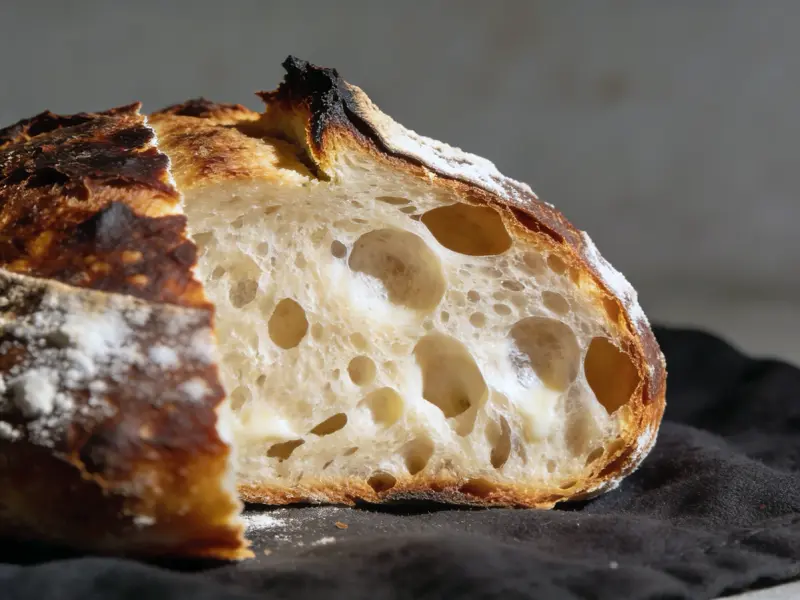
Real sourdough bread: four ingredients — bread flour, water, salt, active starter — and two to three days of patient fermentation.
Ingredients
- bread flour450 g
- whole wheat flour50 g
- water350 ml
- fine sea salt10 g
- active sourdough starter100 g
Method
- 1Autolyse. Mix the bread flour, whole wheat flour, and 320 ml of water in a large bowl until no dry flour remains. The dough will be shaggy and rough — this is correct. Cover and rest at room temperature for 1 hour. This rest allows gluten to develop passively without kneading. If your starter is not yet ready (peaked and doubled), let the autolyse rest longer — it is forgiving.
- 2Add starter and salt. Sprinkle the salt over the autolysed dough and pour the reserved 30 ml of water on top. Add the active starter. Using wet hands, pinch and fold everything together for 3 to 5 minutes until fully incorporated and the dough feels cohesive. Transfer to a clean large bowl or container. This is the start of bulk fermentation.
- 3Bulk fermentation with stretch-and-folds. Cover the dough and let it ferment at room temperature (24–26°C / 75–79°F) for 4 to 5 hours. During the first 2 hours, perform 4 sets of stretch-and-folds, each 30 minutes apart: wet your hand, grab one side of the dough, stretch it up as high as it will go without tearing, and fold it over the center. Rotate the bowl 90° and repeat three more times, completing one full set. The dough is ready when it has grown 50 to 75%, feels airy and jiggly, and the surface shows visible bubbles.
- 4Shape and cold proof. Turn the dough onto an unfloured surface. Fold the edges toward the center, flip it seam-side-down, and drag it toward you to build surface tension — the dough should feel taut. Let it rest 20 minutes uncovered (bench rest). Shape again into a tight boule or batard. Place seam-side-up in a well-floured banneton (proofing basket) or a bowl lined with a well-floured cloth. Cover with a plastic bag and refrigerate 8 to 16 hours. The cold retard slows fermentation and develops flavor.
- 5Bake. One hour before baking, place a covered Dutch oven (4–5 liter) in the oven and preheat to 250°C (480°F). Cut a piece of baking paper larger than the loaf. Remove the cold dough from the fridge, flip it onto the baking paper, and score the surface decisively with a sharp lame or razor blade — at least 5 mm deep, at 30 to 45 degrees. Lift the dough on the paper into the screaming-hot Dutch oven. Cover and bake 20 minutes. Remove the lid, reduce to 230°C (445°F) and bake 25 more minutes until deeply caramel-brown. The crust must be dark — a pale loaf will have a dense crumb. Cool on a wire rack at least 1 hour before cutting. Cutting early releases steam and produces a gummy crumb.