
Sourdough Bread
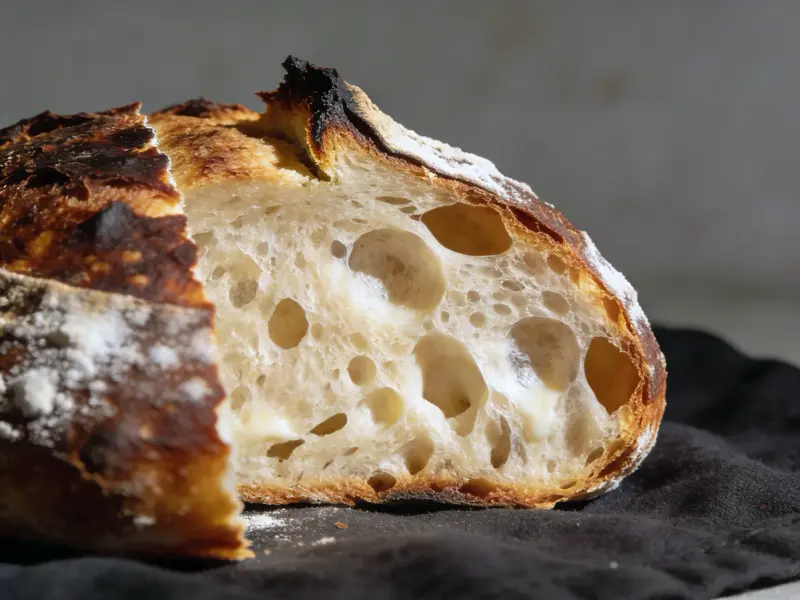
Real sourdough bread: four ingredients — bread flour, water, salt, active starter — and two to three days of patient fermentation. No yeast, no additives. The starter (a living culture of wild yeast and lactic acid bacteria) leavens the dough while simultaneously producing the organic acids that give sourdough its characteristic tang and dense, chewy crumb. The signature is the crust: baked inside a covered Dutch oven, it shatters when you cut it. The open crumb — an irregular network of large and small holes visible when sliced — comes from strong gluten development through stretch-and-folds and a long cold proof that slows fermentation and develops flavor. One of the most technically demanding home bakes; also one of the most rewarding.
Ingredients
- 450 gbread flour
- 50 gwhole wheat flour
- 350 mlwater
- 10 gfine sea salt
- 100 gactive sourdough starter
Method
- Autolyse. Mix the bread flour, whole wheat flour, and 320 ml of water in a large bowl until no dry flour remains. The dough will be shaggy and rough — this is correct. Cover and rest at room temperature for 1 hour. This rest allows gluten to develop passively without kneading. If your starter is not yet ready (peaked and doubled), let the autolyse rest longer — it is forgiving.
- Add starter and salt. Sprinkle the salt over the autolysed dough and pour the reserved 30 ml of water on top. Add the active starter. Using wet hands, pinch and fold everything together for 3 to 5 minutes until fully incorporated and the dough feels cohesive. Transfer to a clean large bowl or container. This is the start of bulk fermentation.
- Bulk fermentation with stretch-and-folds. Cover the dough and let it ferment at room temperature (24–26°C / 75–79°F) for 4 to 5 hours. During the first 2 hours, perform 4 sets of stretch-and-folds, each 30 minutes apart: wet your hand, grab one side of the dough, stretch it up as high as it will go without tearing, and fold it over the center. Rotate the bowl 90° and repeat three more times, completing one full set. The dough is ready when it has grown 50 to 75%, feels airy and jiggly, and the surface shows visible bubbles.
- Shape and cold proof. Turn the dough onto an unfloured surface. Fold the edges toward the center, flip it seam-side-down, and drag it toward you to build surface tension — the dough should feel taut. Let it rest 20 minutes uncovered (bench rest). Shape again into a tight boule or batard. Place seam-side-up in a well-floured banneton (proofing basket) or a bowl lined with a well-floured cloth. Cover with a plastic bag and refrigerate 8 to 16 hours. The cold retard slows fermentation and develops flavor.
- Bake. One hour before baking, place a covered Dutch oven (4–5 liter) in the oven and preheat to 250°C (480°F). Cut a piece of baking paper larger than the loaf. Remove the cold dough from the fridge, flip it onto the baking paper, and score the surface decisively with a sharp lame or razor blade — at least 5 mm deep, at 30 to 45 degrees. Lift the dough on the paper into the screaming-hot Dutch oven. Cover and bake 20 minutes. Remove the lid, reduce to 230°C (445°F) and bake 25 more minutes until deeply caramel-brown. The crust must be dark — a pale loaf will have a dense crumb. Cool on a wire rack at least 1 hour before cutting. Cutting early releases steam and produces a gummy crumb.
FAQ
A sourdough starter is a live fermented culture of wild yeast and lactic acid bacteria sustained by regular feedings of flour and water. The wild yeast produces CO2 that leavens the bread; the bacteria produce lactic and acetic acids that create flavor and tang. A starter is ready to bake with when it has doubled or tripled in volume since its last feeding, has visible bubbles throughout, smells pleasantly sour and yeasty (not sharp or alcoholic), and passes the float test: a spoonful dropped in water floats. This peak activity window lasts 2 to 4 hours depending on temperature — bake within this window.
Dense, gummy crumb almost always indicates one of three problems. First: under-fermentation — the dough did not ferment long enough during bulk and the gluten structure is not strong enough to hold the bubbles. Second: weak starter — the starter did not have enough active yeast to properly leaven the dough. Third: cutting the bread too soon after baking — the crumb needs at least 1 hour to set after coming out of the oven; cutting earlier releases steam and produces exactly this gummy texture. An over-proofed loaf can also collapse and produce a dense, flat result — over-proofing is harder to reverse than under-proofing.
A stretch-and-fold is a gentle handling technique used to develop gluten in wet sourdough doughs without the degassing that conventional kneading causes. You wet your hand, grab one side of the dough, stretch it up until it resists, fold it over the center, rotate the bowl 90 degrees, and repeat — this is one set. Each set, done every 30 minutes for the first 2 hours of bulk fermentation, progressively builds gluten strength. Kneading a wet, sticky sourdough dough is ineffective — the dough tears rather than develops — and adds excess flour from the counter. The rest periods between fold sets allow the gluten to relax and realign, then the next fold tightens it further.
You can, but the crust and oven spring will be noticeably different. The Dutch oven's function is to trap steam from the dough in the first 20 minutes of baking, keeping the crust pliable long enough for the loaf to fully expand before the crust sets. Without a Dutch oven: place a baking stone or heavy sheet pan in the oven to preheat. Put a metal roasting pan on the bottom shelf. When you load the bread, pour 240 ml of boiling water into the roasting pan to create steam, then bake as normal. Remove the steam source after 20 minutes. Results are acceptable but the crust will be thinner and the oven spring slightly reduced.
The natural acids in sourdough act as a mild preservative, giving it much longer shelf life than commercial yeast bread. Store cut-side-down on a wooden board or in a cloth bread bag at room temperature — never in a plastic bag, which traps moisture and softens the crust within hours. A sourdough loaf keeps well for 3 to 4 days at room temperature. For longer storage: slice the entire loaf and freeze it. Individual frozen slices can be toasted directly from frozen. Refresh a stale whole loaf by running it briefly under cold water to wet the crust, then baking at 180°C for 10 to 15 minutes — the crust re-crisps and the crumb steams back to freshness.
Keep browsing
More dishes from the American archive — picked by overlap with what you're cooking now.
Recipes by email
One letter a week: a recipe picked for your taste, plus whatever is new on the site. Unsubscribe in one click.
Welcome gift: Sergei's cookbook (e-book).
By subscribing you agree to the privacy policy.
Tell us what you like to cook (30 seconds) →
Join the conversation
Comments
No comments yet — be the first!