Germany · Flour and Confectionery Products
Spritzgebäck (German Piped Butter Cookies)
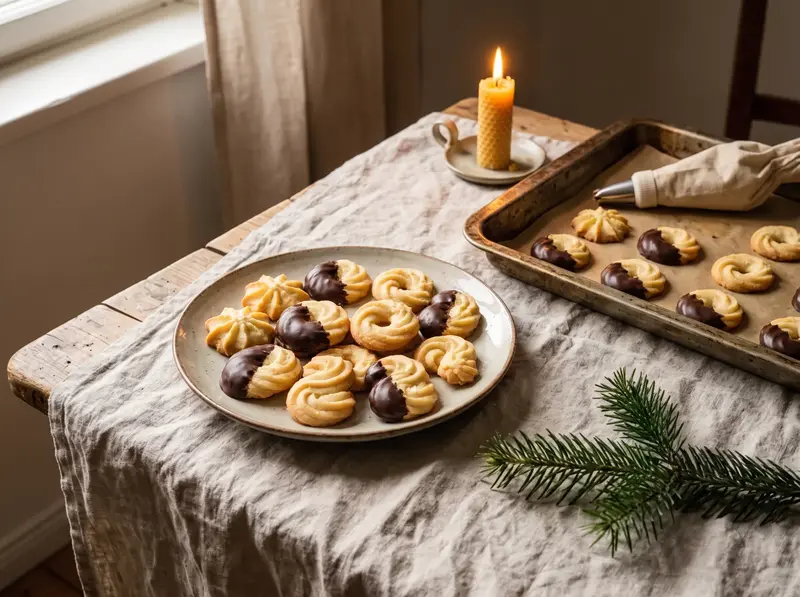
Spritzgebäck (spritz cookies in English, also called Butter-Spritzgebäck) is a German butter cookie: a soft dough of butter, powdered sugar, egg, flour and vanilla that is piped through a star nozzle into rings…
Ingredients
- butter220 g
- powdered sugar90 g
- vanilla sugar8 g
- salt1 pinch
- organic lemon zest1 tsp
- egg1
- egg yolk1
- wheat flour300 g
- milk2 tbsp
- dark chocolate couverture150 g
Method
- 1Take the butter out of the fridge 1 to 2 hours ahead. It is ready when a finger leaves a dent but the block still holds its shape, neither shiny nor greasy. Line two baking trays with baking paper. Beat the butter with the powdered sugar, vanilla sugar, salt and lemon zest for about 3 minutes, until pale and fluffy. Stop there: longer beating warms the butter, and dough made from warm butter spreads in the oven and loses its pattern.
- 2Beat in the egg and the egg yolk, 30 seconds each; the mixture may look slightly curdled, which does not matter. Sift the flour over it and stir with a wooden spoon, or on the lowest speed of the mixer, only until no dry flour is left. The dough should be soft and glossy and slide off the spoon slowly, in a thick dollop that keeps a soft peak. If it is too stiff to squeeze through a nozzle, stir in milk 1 teaspoon at a time, up to 2 tablespoons in all. Longer stirring toughens the cookies.
- 3Fit a piping bag with a star nozzle (8 to 10 mm opening; a large star such as a 1M also works) and fill it with half of the dough, no more, because the warmth of your hand softens the butter while you pipe. Push the dough down toward the nozzle and twist the bag closed above it. Leave the second half in the bowl, covered, in a cool spot.
- 4Hold the bag upright just above the baking paper, squeeze out a rosette about 4 cm across, a ring or an S-shape, stop squeezing and lift away. Leave 2 cm between the cookies; about 20 fit on a tray. Pipe a test cookie first: sharp ridges mean the dough is right. If you cannot squeeze it, stir a little milk into the dough; if the ridges look smooth and slumped, chill the bag and the dough for 15 minutes and stir in 1 tablespoon of flour. Then fill the bag with the rest and pipe the second tray.
- 5Put both trays in the fridge for 30 minutes. Meanwhile heat the oven to 180°C top and bottom heat (160°C fan) with the rack in the middle. The cold butter keeps the ridges sharp until the edges of the cookie have set in the heat.
- 6Bake one tray at a time for 12 to 14 minutes, until the edges are golden and the bottoms light brown; the tops stay pale. Look at 12 minutes, because thin edges go from golden to bitter fast. Slide the paper with the cookies onto a wire rack and let them cool completely: they are fragile while warm and turn crisp as they cool.
- 7Chop the chocolate and melt it in a heatproof bowl over a pan of barely simmering water, the bottom of the bowl not touching the water, stirring until smooth. Water or steam in the chocolate makes it grainy. Dip each cooled cookie halfway, wipe the excess on the rim of the bowl and set it on baking paper; the chocolate sets in about 1 hour at cool room temperature. Store in a tin with baking paper between the layers: plain cookies keep up to 4 weeks, with chocolate 2 to 3 weeks.