
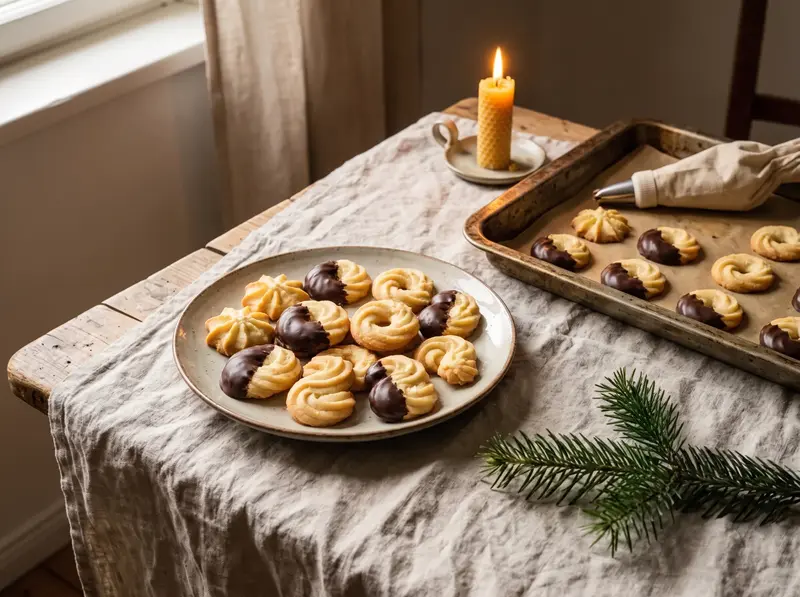
Spritzgebäck (German Piped Butter Cookies)
Spritzgebäck (spritz cookies in English, also called Butter-Spritzgebäck) is a German butter cookie: a soft dough of butter, powdered sugar, egg, flour and vanilla that is piped through a star nozzle into rings, S-shapes or rosettes instead of being rolled and cut. Cream the butter, mix in the flour, pipe, chill the trays 30 minutes, bake at 180°C for 12 to 14 minutes and dip half of each cookie in dark chocolate; the batch makes about 40 cookies, 5 per serving. The dough has to be soft enough to leave the nozzle but firm enough to keep its ridges, and most of the method below is about getting that balance. The time counts hands-on work and the oven; the 30-minute chill and the hour the chocolate needs to set come on top.
Ingredients
- 220 gbutter
- 90 gpowdered sugar
- 8 gvanilla sugar
- 1 pinchsalt
- 1 tsporganic lemon zest
- 1 egg
- 1 egg yolk
- 300 gwheat flour
- 2 tbspmilk
- 150 gdark chocolate couverture
Method
- Take the butter out of the fridge 1 to 2 hours ahead. It is ready when a finger leaves a dent but the block still holds its shape, neither shiny nor greasy. Line two baking trays with baking paper. Beat the butter with the powdered sugar, vanilla sugar, salt and lemon zest for about 3 minutes, until pale and fluffy. Stop there: longer beating warms the butter, and dough made from warm butter spreads in the oven and loses its pattern.
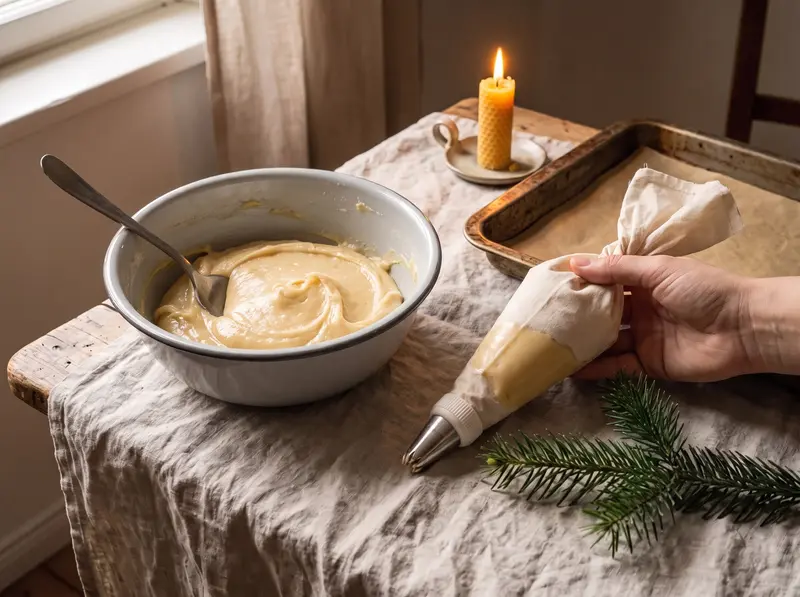
- Beat in the egg and the egg yolk, 30 seconds each; the mixture may look slightly curdled, which does not matter. Sift the flour over it and stir with a wooden spoon, or on the lowest speed of the mixer, only until no dry flour is left. The dough should be soft and glossy and slide off the spoon slowly, in a thick dollop that keeps a soft peak. If it is too stiff to squeeze through a nozzle, stir in milk 1 teaspoon at a time, up to 2 tablespoons in all. Longer stirring toughens the cookies.
- Fit a piping bag with a star nozzle (8 to 10 mm opening; a large star such as a 1M also works) and fill it with half of the dough, no more, because the warmth of your hand softens the butter while you pipe. Push the dough down toward the nozzle and twist the bag closed above it. Leave the second half in the bowl, covered, in a cool spot.
- Hold the bag upright just above the baking paper, squeeze out a rosette about 4 cm across, a ring or an S-shape, stop squeezing and lift away. Leave 2 cm between the cookies; about 20 fit on a tray. Pipe a test cookie first: sharp ridges mean the dough is right. If you cannot squeeze it, stir a little milk into the dough; if the ridges look smooth and slumped, chill the bag and the dough for 15 minutes and stir in 1 tablespoon of flour. Then fill the bag with the rest and pipe the second tray.
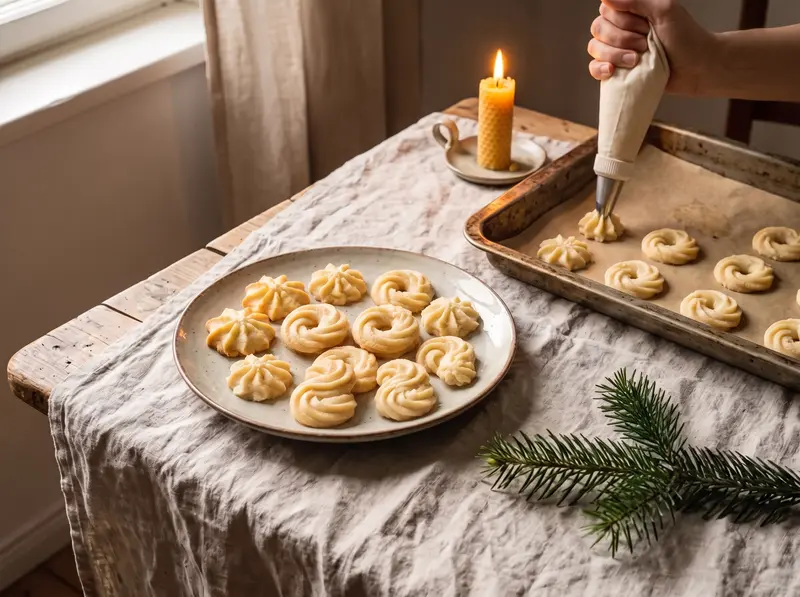
- Put both trays in the fridge for 30 minutes. Meanwhile heat the oven to 180°C top and bottom heat (160°C fan) with the rack in the middle. The cold butter keeps the ridges sharp until the edges of the cookie have set in the heat.
- Bake one tray at a time for 12 to 14 minutes, until the edges are golden and the bottoms light brown; the tops stay pale. Look at 12 minutes, because thin edges go from golden to bitter fast. Slide the paper with the cookies onto a wire rack and let them cool completely: they are fragile while warm and turn crisp as they cool.
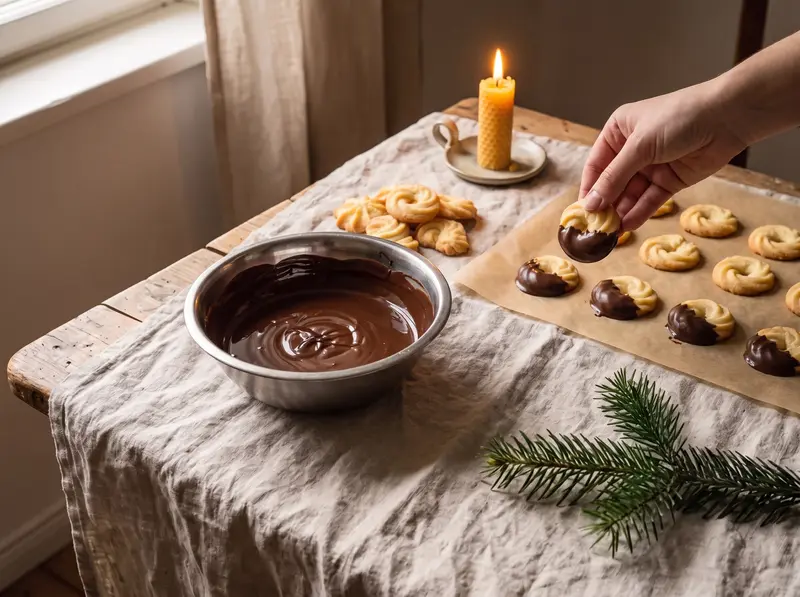
- Chop the chocolate and melt it in a heatproof bowl over a pan of barely simmering water, the bottom of the bowl not touching the water, stirring until smooth. Water or steam in the chocolate makes it grainy. Dip each cooled cookie halfway, wipe the excess on the rim of the bowl and set it on baking paper; the chocolate sets in about 1 hour at cool room temperature. Store in a tin with baking paper between the layers: plain cookies keep up to 4 weeks, with chocolate 2 to 3 weeks.
FAQ
Almost always the butter was still too cold, or a little too much flour went in. Do not add more butter: stir in milk 1 teaspoon at a time, up to 2 tablespoons for this batch, until the dough slides off the spoon slowly. Knead a lump of dough in your warm hand for a minute and you will feel it soften. Next time take the butter out of the fridge 1 to 2 hours ahead.
The dough was too warm or too soft: butter beaten too long, a bag warmed in your hands, or a tray still warm from the previous batch. Chill the piped trays for 30 minutes before baking, as in step 5, and bake at the full 180°C (160°C fan); in a cooler oven the butter melts before the edges set. If a test cookie still slumps, stir 1 tablespoon of flour into the dough and try again. Pipe only onto cold baking paper.
Plain Spritzgebäck keeps about 4 weeks in an airtight tin at room temperature, with chocolate about 2 to 3 weeks. Let the cookies and the chocolate cool and set completely, then layer them with baking paper so the chocolate does not stick. Keep the tin in a cool place away from the radiator. Do not close them in while still lukewarm: the steam softens them.
This recipe uses one whole egg and one yolk, so one white is left. Freeze it in a small covered container and collect until you have 3, then bake Kokosmakronen or Zimtsterne, which take 3 egg whites each. Thaw the whites overnight in the fridge before whisking. If you want to use it up at once, whisk it with 100 g of powdered sugar into an icing and drizzle thin lines over the cooled cookies instead of chocolate.
Yes. A freezer bag with a corner cut off works, but a plain hole gives smooth sticks without ridges, so they end up closer to an ordinary butter cookie. A set of star nozzles and a reusable bag costs little and is worth it for this dough. If you have neither, make cut-out cookies instead: the rolled dough of Butterplätzchen needs only a rolling pin and a cutter. Do not roll this Spritzgebäck dough, it is too soft.
Rate this
Recipes by email
One letter a week: a recipe picked for your taste, plus whatever is new on the site. Unsubscribe in one click.
Welcome gift: Sergei's cookbook (e-book).
By subscribing you agree to the privacy policy.
Tell us what you like to cook (30 seconds) →Keep browsing
More dishes from the German archive — picked by overlap with what you're cooking now.

Join the conversation
Comments
No comments yet — be the first!