
Butterplätzchen (German Cut-Out Christmas Cookies)
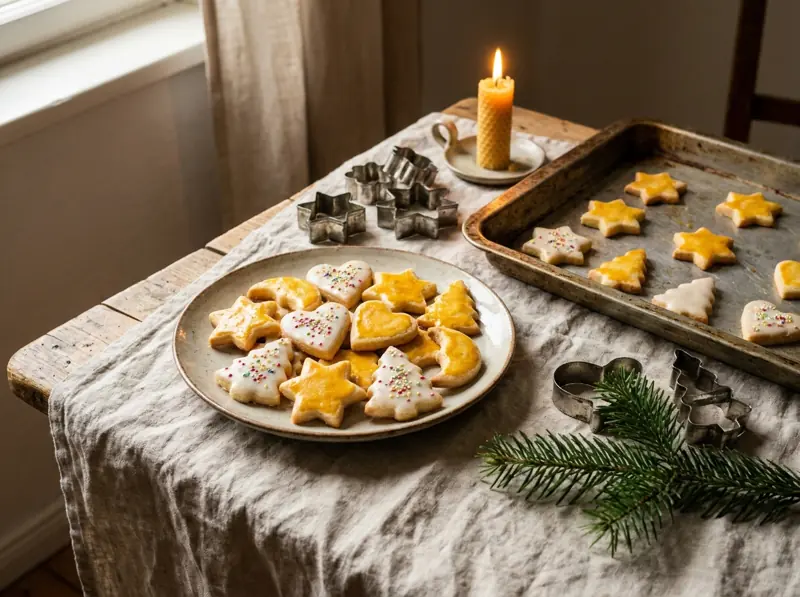
Butterplätzchen, also called Ausstechplätzchen or simply Buttergebäck, are Germany's classic Christmas cut-out cookies: a butter shortcrust dough rolled thin, stamped into stars, bells and trees, and finished with icing, sprinkles or a golden egg-yolk glaze. The dough follows the country's standard Mürbeteig ratio of three parts flour to two parts butter to one part sugar, bound with a single egg yolk and flavored with vanilla and lemon zest. Cold butter is what makes that ratio work: it stays in small, distinct pieces through mixing and rolling instead of melting into the flour, so the baked cookie turns out short and sandy instead of greasy or tough. The dough needs about an hour in the fridge before it rolls cleanly, and the cut shapes get another ten minutes chilled on the tray so their points and curves stay sharp once they hit the oven. This is the cookie German children help stamp out every Advent, and the one that fills half of every Bunter Teller, the mixed Christmas cookie plate. Makes about 45 cookies, five to a serving.
Ingredients
- 300 gplain flour
- 200 gcold unsalted butter
- 100 gcaster sugar
- 1 egg yolk
- 2 tsplemon zest
- 8 gvanilla sugar (1 packet)
- 1 pinchsalt
- 1 egg yolk (for the glaze)
- 1 tbspmilk
- 100 gicing sugar
- 2 tbsplemon juice
- 20 gsprinkles
Method
- Rub the cold butter into the dry ingredients. Cut the butter into small cubes and add it to a bowl with the flour, caster sugar, lemon zest, vanilla sugar and salt. Work everything together with your fingertips or the paddle of a mixer until the mixture looks like coarse, buttery crumbs and no dry flour is visible at the bottom of the bowl.
- Bring the dough together fast. Add the egg yolk and knead briefly, by hand or on low speed, only until the dough just holds in one piece, 2 to 3 minutes at most. The longer you knead, the more the friction warms the butter, and warm butter gives a greasy dough that spreads flat in the oven instead of holding its cut shape.

- Chill the dough. Flatten it into one or two discs about 2 cm thick, wrap tightly and refrigerate for at least 1 hour, or overnight. Cold, firm dough rolls out cleanly without sticking to the pin, and the rest also relaxes the gluten in the flour so the cut shapes do not shrink back once you lift them off the mat.
- Roll and cut. Heat the oven to 180°C top and bottom heat (160°C fan). Place the dough between two sheets of baking paper and roll it to an even 3 to 4 mm, working in one portion at a time and keeping the rest in the fridge. Rolling between paper instead of on a floured surface keeps the dough from picking up extra flour, which would otherwise toughen the crumb and blunt your cutters. Stamp out shapes close together to limit the scraps, and lift them onto lined trays with a thin spatula.

- Chill the cut shapes. Once a tray is full, put it in the fridge for 10 minutes before it goes in the oven. This short second chill is what keeps a star's points and a bell's curves crisp and defined; skip it and the same shapes soften and blur in the first minutes of heat.
- Glaze half the tray, if using. Whisk the second egg yolk with the milk and brush it thinly over some of the cookies for a deep golden shine after baking; leave the rest of the shapes plain if you plan to ice them later, since icing needs a bare surface to stick to.
- Bake one tray at a time on the middle rack for 8 to 10 minutes. The cookies are done when only the edges turn light gold and the centers are still pale; a fully golden or browned cookie has crossed into a bitter, over-baked shortbread taste. Cool completely on a rack before handling, since warm cookies are fragile and the glaze needs time to set.
- Ice the plain cookies. Whisk the icing sugar with the lemon juice to a thick paste that falls off the whisk in a slow ribbon, adding the juice a few drops at a time so it does not turn runny. Spread or pipe it onto the cooled cookies, scatter sprinkles over the wet icing so they stick, and let everything set at room temperature for at least 4 hours before stacking the cookies in a tin with baking paper between the layers.

FAQ
Two causes, opposite fixes. If the dough crumbles into sandy pieces when you try to roll it, it's usually still too cold, straight from an overnight fridge stay: let it sit at room temperature for 5 to 10 minutes and it will turn pliable again. If it crumbles even at room temperature, the ratio is off, most often too little egg yolk or too much flour worked in while rolling; add a teaspoon of cold water or milk and knead briefly, just until it holds. Working in flour with every reroll of the scraps is the more common mistake: after the second reroll, the dough has picked up so much extra flour that it turns short and dry, so limit yourself to two rerolls per batch.
Yes, the dough is a good make-ahead: flatten it into a disc or two, wrap tightly in plastic and freeze for up to 3 months. Thaw it overnight in the fridge, then let it stand another 10 minutes at room temperature until it gives slightly when pressed before rolling; rolling it while still hard cracks the edges. Baked cookies, undecorated, freeze equally well for up to 2 months in an airtight container; add the egg-yolk glaze or the icing only after they've thawed and returned to room temperature, or the icing sugar melts.
In a well-sealed tin at room temperature, plain or egg-glazed Butterplätzchen keep for 3 to 4 weeks and taste better after the first two or three days, once the butter flavor settles. Iced cookies need the icing fully set, at least 4 hours at room temperature, before stacking, or the layers stick together. Keep them separate from spiced or nut-based cookies like Zimtsterne or Vanillekipferl: butter shortbread picks up their spice or almond aroma within a few days and loses its own clean vanilla-lemon flavor.
Yes, more than most German Christmas cookies, because the dough is forgiving and the shapes are the entire point. Let the dough warm up for 10 minutes past fridge-cold before handing over the rolling pin; dough that's too firm frustrates small hands and dough that's too soft sticks to everything. Give children the simple round or star cutters and let an adult handle the more fragile shapes with thin points, like snowflakes, which snap when small hands press too hard. Sprinkles are the safest decorating job for young children, since egg-yolk glazing needs a light, even hand with the brush.
Egg-yolk glaze, a beaten yolk thinned with a tablespoon of milk and brushed on before the oven, bakes into a deep golden shine and a slightly firmer surface; it's the classic finish for cookies meant to look burnished, not white. Zuckerguss, icing sugar whisked with lemon juice to a thick paste and spread on once the cookies are fully cool, sets to a matte white or pastel finish and holds sprinkles or dragées that would just slide off warm butter. You can't do both on the same cookie, since the icing needs a bare cooled surface to stick, but splitting one batch of dough between the two finishes is standard practice and gives a Christmas plate real variety.
Rate this
Recipes by email
One letter a week: a recipe picked for your taste, plus whatever is new on the site. Unsubscribe in one click.
Welcome gift: Sergei's cookbook (e-book).
By subscribing you agree to the privacy policy.
Tell us what you like to cook (30 seconds) →Keep browsing
More dishes from the German archive — picked by overlap with what you're cooking now.
Join the conversation
Comments
No comments yet — be the first!