
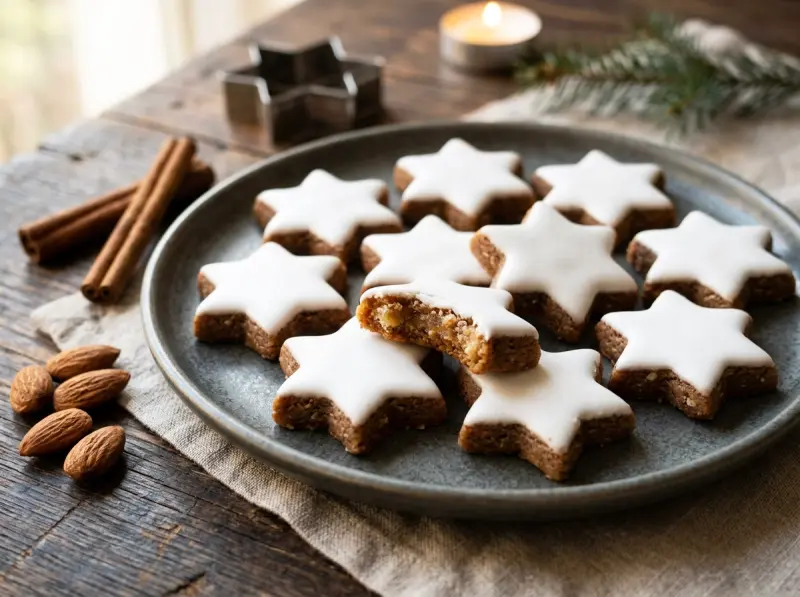
Zimtsterne (German Cinnamon Star Cookies)
Zimtsterne are star-shaped German Christmas cookies made without any flour: the dough is ground almonds, cinnamon and a meringue of egg whites and powdered sugar, and part of that same meringue becomes the white glaze on top. They come from Swabia in southern Germany and are chewy and soft inside, closer to marzipan than to a biscuit. They bake at a low 140°C so the glaze stays snow white. The 90 minutes cover whipping, cutting, glazing and two trays in the oven; the sticky dough also rests 45 minutes in the fridge before rolling. Makes about 40 stars, four to a serving, and they are naturally gluten-free.
Ingredients
- 3 egg whites
- 1 pinchsalt
- 250 gpowdered sugar
- 1 tsplemon juice
- 350 gground almonds
- 2 tspground cinnamon
- 50 gground almonds
Method
- Whip the meringue. Put the egg whites and the salt into a clean, grease-free bowl and beat to stiff peaks. Sift the powdered sugar and add it a spoonful at a time with the mixer running, then add the lemon juice. Keep beating for 5 to 7 minutes, until the meringue is thick, glossy and stands in a firm peak when you lift the whisk. The lemon juice steadies the foam and helps the glaze stay white.
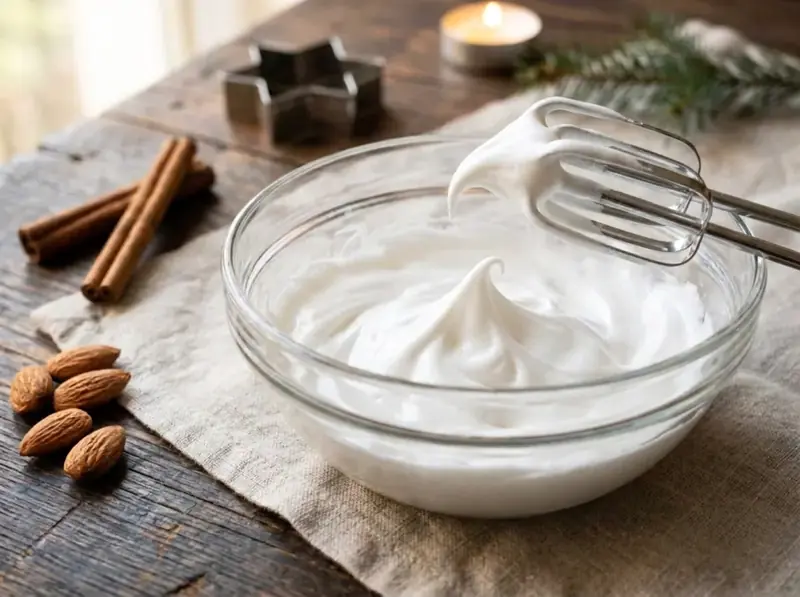
- Set the glaze aside first. Take 3 heaped tablespoons of the meringue, put them in a small bowl and cover it tightly so no crust forms. This is the glaze. It is easy to forget, and once the almonds are in there is no way back.
- Make the dough. Fold the 350 g of ground almonds and the cinnamon into the remaining meringue with a spatula until you have an even, sticky mass. It should be soft but hold its shape when you press it; if it flows, work in some of the extra 50 g of almonds. Wrap the dough and chill it for 45 minutes. Cold dough sticks far less.
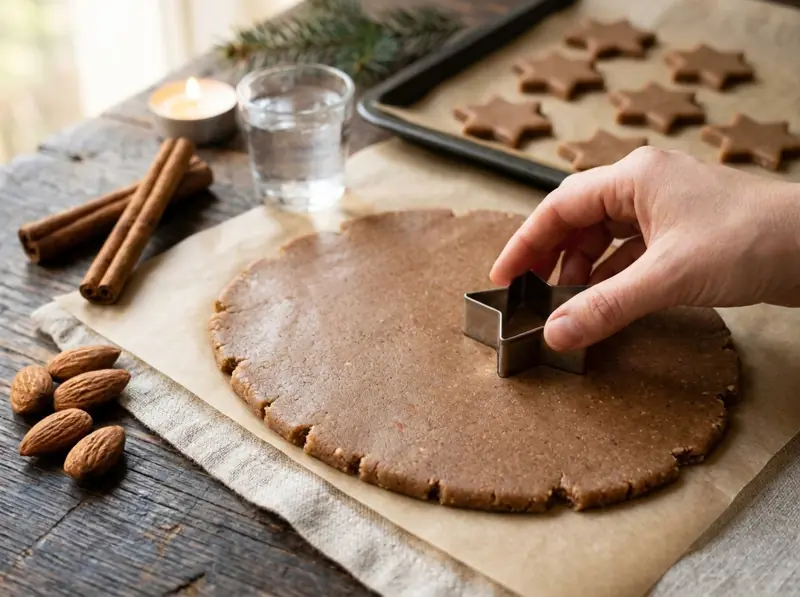
- Heat the oven to 140°C top and bottom heat (120°C fan) and line two trays with baking paper. Roll the dough out between two sheets of baking paper, dusted with a little of the remaining almonds, to a thickness of 8 to 10 mm. That is thicker than it feels right: thin stars dry out and bake hard.
- Cut the stars. Dip a 5 cm star cutter into a glass of cold water before every cut so the dough lets go cleanly, and set the stars on the trays 1 cm apart; they do not spread. Press the scraps together, roll out again and keep cutting until the dough is used up.
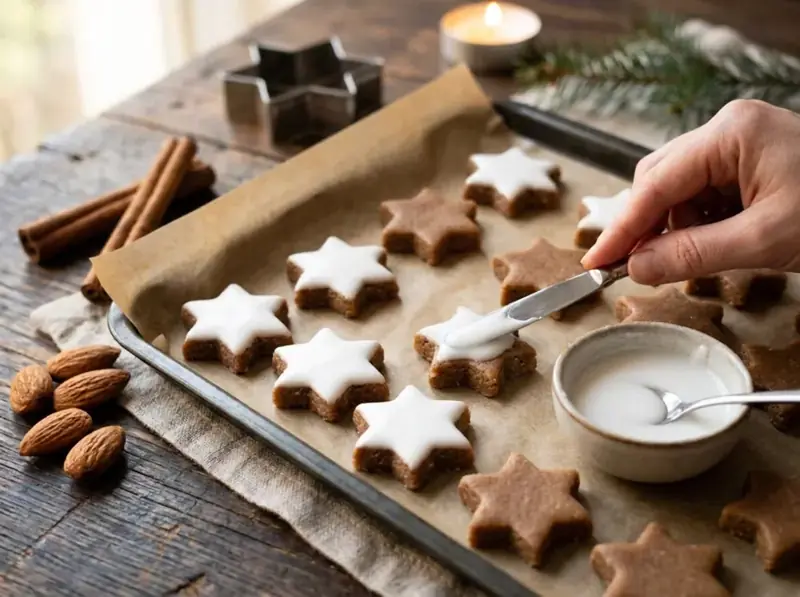
- Glaze. Stir the reserved meringue; if it has stiffened, loosen it with a few drops of water until it spreads but does not run. Put half a teaspoon on each star and push it out to the very tips with a small knife or the back of the spoon, about 2 mm thick.
- Bake one tray at a time on the lower third rack for 20 to 25 minutes. The glaze must stay white and the stars should lift off the paper with a dry underside that has barely coloured. They will still feel soft: they firm up as they cool. Leave them on the tray until cold, then store in a tin, with a slice of apple if you like them soft.
FAQ
They were baked too hot, too long or rolled too thin. Zimtsterne contain no fat and no flour, so the only thing keeping them soft is the moisture left in the almond and meringue dough, and that goes quickly above 150°C. Roll the dough 8 to 10 mm thick, bake at 140°C and take the tray out after 20 to 25 minutes, while the stars still give under a finger. If a batch is already hard, a slice of apple in the tin for 24 hours brings most of the softness back.
Low heat, a low rack and a little acid. Bake at 140°C top and bottom heat, or 120°C with the fan, on the lower third of the oven, so the top element never gets close to the meringue. A teaspoon of lemon juice in the meringue helps it stay white, and one tray at a time keeps the temperature even. If your oven runs hot and the tips start to colour after 15 minutes, lay a sheet of baking paper loosely over the tray for the rest of the time.
It is meant to be sticky: the dough is only almonds held together by meringue, with nothing dry in it to absorb moisture. Adding more and more almonds gives dry, crumbly stars, so stop at the extra 50 g. Chill the dough for 45 minutes, roll it between two sheets of baking paper rather than on the worktop, and dip the cutter in cold water before each star. Some German bakers dust the paper with powdered sugar instead of almonds, which works just as well.
The classic recipe is gluten-free by nature, since it uses ground almonds in place of flour; just check that your powdered sugar and cinnamon carry no wheat-based anti-caking agent. Ground hazelnuts can replace the almonds gram for gram and give a darker, stronger cookie, often sold as Haselnusssterne. They cannot be made vegan with a simple swap, because the meringue is both the binder and the glaze, although aquafaba whipped with the same amount of sugar comes close. They are in the same flourless family as French macarons.
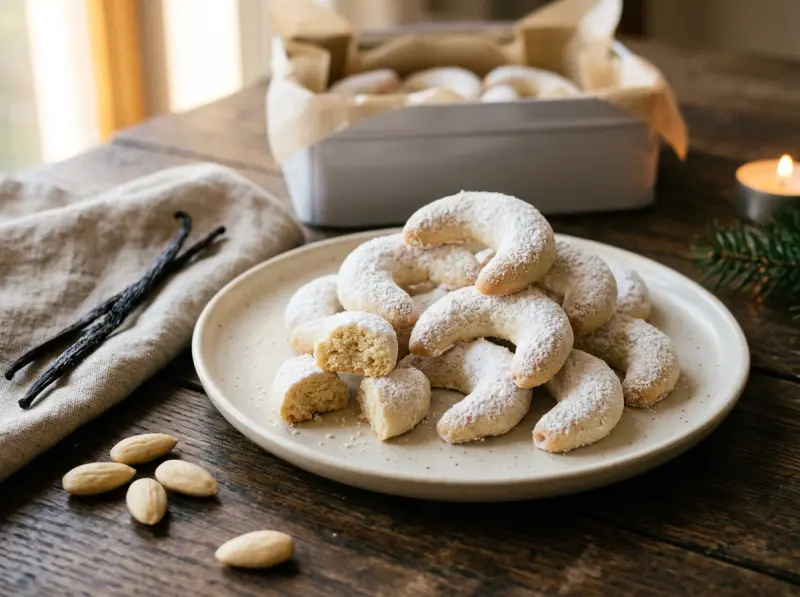
In a tin in a cool place they keep 3 to 4 weeks, and the flavour is rounder after the first few days. Store them on their own or with other soft, spiced cookies such as Lebkuchen. Do not put them in with Vanillekipferl or other butter shortbread: the moisture and cinnamon travel, the shortbread goes soft and everything ends up tasting the same. Put baking paper between the layers so the glaze does not stick. They freeze well for up to 3 months and thaw in an hour at room temperature.
Rate this
Recipes by email
One letter a week: a recipe picked for your taste, plus whatever is new on the site. Unsubscribe in one click.
Welcome gift: Sergei's cookbook (e-book).
By subscribing you agree to the privacy policy.
Tell us what you like to cook (30 seconds) →Keep browsing
More dishes from the German archive — picked by overlap with what you're cooking now.


Join the conversation
Comments
No comments yet — be the first!