
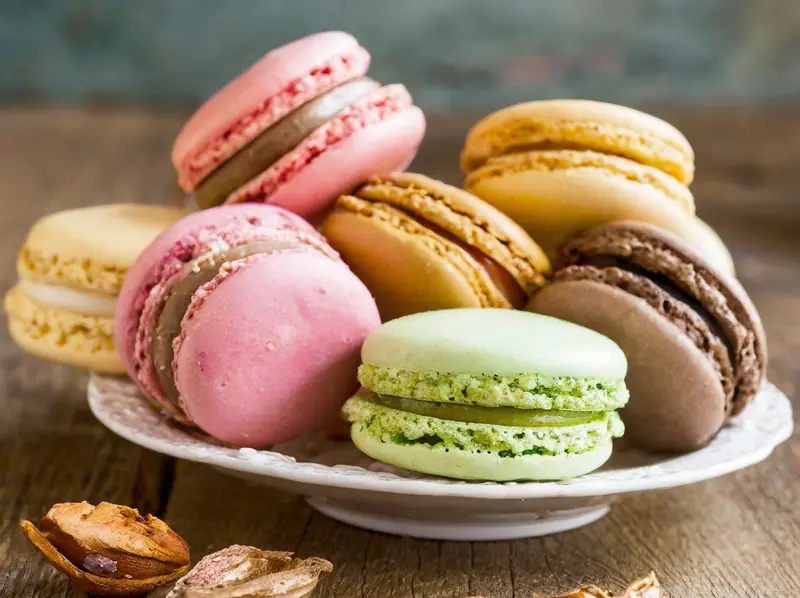
Macaron
The Macaron is a true icon of French pâtisserie — a delicate almond meringue cookie with a smooth crisp shell, chewy interior and signature ruffled feet, sandwiched with sweet buttercream.
Ingredients
- 100 galmond flour
- 100 gpowdered sugar
- 75 gegg whites, aged
- 75 ggranulated sugar
- pinchsalt
- gel or powder food coloring
- 100 gunsalted butter
- 150 gpowdered sugar
- 1 tspvanilla extract
- 1-2 tbspmilk or cream
Method
- Sift almond flour and powdered sugar together twice. In a clean bowl, whisk aged egg whites with a pinch of salt to stiff glossy peaks, gradually adding granulated sugar. Add food coloring if using.
- Fold meringue into dry ingredients in two stages until the batter flows from the spatula in a slow, continuous ribbon (the 'lava stage'). Do not overmix.

- Transfer to a pastry bag with a round tip. Pipe 3-4 cm circles onto a parchment-lined baking sheet. Tap tray firmly to remove air bubbles. Rest at room temperature for 30-60 minutes until a non-sticky skin forms.
- Preheat oven to 150°C. Bake 12-15 minutes until shells are stable and have developed 'feet'. Cool completely before removing from parchment.

- For buttercream: beat butter, add powdered sugar, vanilla and milk/cream. Pipe filling onto one shell and sandwich with another. Refrigerate in an airtight container for 24 hours to mature before serving.
FAQ
The 'feet' are the hallmark of a proper macaron. They form through correct macaronage (folding) and a dried skin before baking. If there are no feet: the batter was under-folded, the skin didn't form (rest 10–30 min at room temperature), or the oven was too cool.
Classic macarons use only almond flour — it's part of their nature. You can substitute hazelnut or pistachio flour for a different but equally interesting result. Coconut flour won't work — the structure will be completely different.
Aged whites (left uncovered in the fridge for 24–48 hours) lose excess moisture. Drier whites produce a more stable meringue and better skin. If you're short on time, fresh whites work too — just with slightly less reliable results.
Main reasons: the skin didn't form (not rested long enough), the batter is under-folded (too thick), or the oven is too hot. Temperature should be 140–150°C (285–300°F) — use a thermometer, not the dial.
In an airtight container in the refrigerator for up to 5 days. Freshly assembled macarons are too crisp — the flavor and texture peak after 24–48 hours when the filling softens the shells. They can also be frozen for up to 1 month.
Rate this
Recipes by email
One letter a week: a recipe picked for your taste, plus whatever is new on the site. Unsubscribe in one click.
Welcome gift: Sergei's cookbook (e-book).
By subscribing you agree to the privacy policy.
Tell us what you like to cook (30 seconds) →Keep browsing
More dishes from the French archive — picked by overlap with what you're cooking now.
Join the conversation
Comments (2)
Три раза пробовала печь макаронс, первые два раза полный провал, потрескались все. На третий раз стого по рецепту отмерила всё на весах и наконецто получились гладенькие с юбочкой! Терпение и точные граммовки решают.
Ingredient temperature matters enormously for macaron. Unless the recipe says otherwise, everything should be at room temperature. Cold almond flour doesn't cream properly, and the texture suffers throughout.