

Kokosmakronen (German Coconut Macaroons)
Kokosmakronen are small German coconut macaroons made from whipped egg white, sugar and desiccated coconut, baked in golden-tipped mounds on thin wafer discs called Oblaten. English recipes often just call them German coconut macaroons, and despite the name they have nothing to do with the French macaron. The egg white is beaten into a stiff meringue before the coconut goes in, and the mass is then warmed briefly over a water bath, which thickens it enough to hold a tall dome instead of spreading flat in the oven. Baked low and slow, the tips turn crisp and golden while the centre stays soft and chewy, closer to a coconut meringue than a biscuit.
Ingredients
- 3 egg whites
- 1 pinchsalt
- 150 gsugar
- 8 gvanilla sugar
- 200 gdesiccated coconut
- 30 wafer paper discs
Method
- Heat the oven to 150°C top and bottom heat (130°C fan) and line a baking tray with parchment paper. Arrange the wafer paper discs on top, spaced about 2 cm apart, so each has its own base once you add the mixture.
- Put the egg whites and salt in a clean, grease-free bowl and beat with a mixer on high speed until stiff peaks form: the meringue should stand up straight when you lift the beaters and not slide when you tilt the bowl. Any trace of fat or yolk on the bowl stops the whites from whipping properly, so wipe the bowl with a little vinegar or lemon juice first if you are unsure it is clean.
- With the mixer still running, add the sugar and vanilla sugar in a thin stream, then keep beating for 4 to 5 minutes more. The meringue should turn thick, glossy and hold sharp peaks; rub a little between two fingers, and if it still feels gritty, beat for another minute so the sugar fully dissolves.
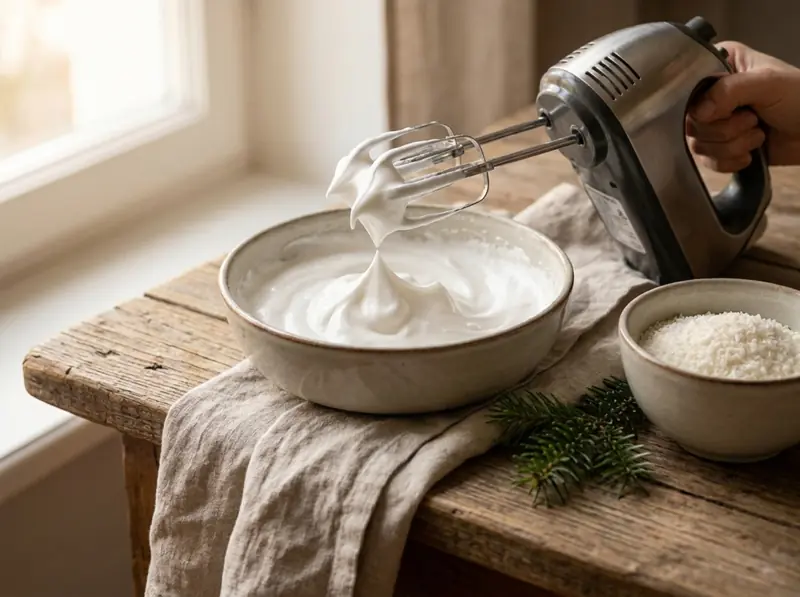
- Fold the desiccated coconut into the meringue with a spatula in wide strokes, not with the mixer. Stop as soon as no dry coconut is visible: overworking it here knocks the air back out of the meringue, and the macaroons need that air to hold a tall dome rather than spreading flat.
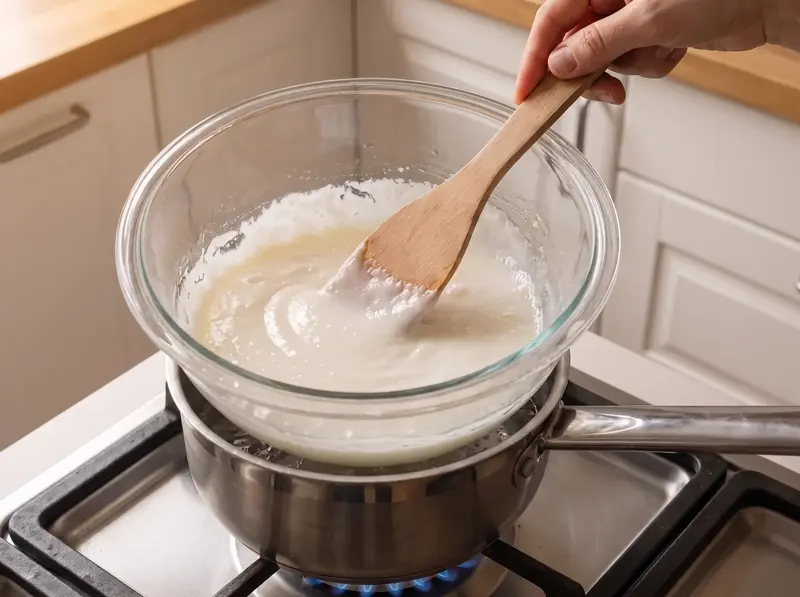
- Set the bowl over a pan of barely simmering water, making sure the bowl does not touch the water, and stir constantly for 3 to 5 minutes. The mixture should thicken visibly and turn slightly translucent and glossy; it is warm rather than hot to the touch, well under 60°C. This step is what separates a whipped meringue from a proper Kokosmakrone: gently cooking the mass firms it up so the mounds keep their shape and dry out from the inside as they bake, instead of weeping liquid and flattening in the oven.
- Using two teaspoons or a piping bag with a plain tip, mound the warm mixture onto the wafer discs, about 15 g each (a heaped teaspoon) — the mixture weighs roughly 450 g, enough for all 30 — building each one up into a rounded peak rather than spreading it flat.
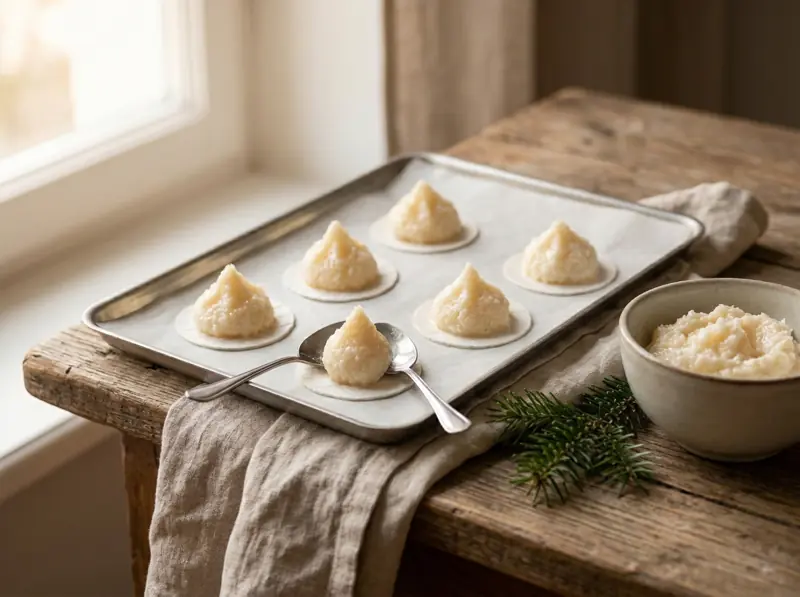
- Bake one tray at a time in the middle of the oven for 18 to 20 minutes. The macaroons are done when the tips and the top edge turn light golden brown; the centre and base should stay pale ivory, and the inside will still feel soft when you press it gently. If they are colouring too fast, loosely tent the tray with foil for the last few minutes.
- Let the macaroons cool completely on the tray before lifting them off: warm, they are fragile and the base can crack. Once cool they firm up into a chewy, slightly sticky centre with a crisp shell at the tips, and keep in an airtight tin.
FAQ
The meringue-coconut mixture went into the oven too loose. If you skip the water bath step or only warm it for a minute, the mass is still mostly foam and egg white, and it spreads and weeps liquid before the outside has a chance to set. Put the bowl back over barely simmering water and stir for another 2 to 3 minutes until it visibly thickens and looks slightly glossy and translucent, almost like a thick jam, before you shape the next batch. A too-cool oven has the same effect, so check that yours actually reaches 150°C with an oven thermometer rather than trusting the dial.
Yes. Oblaten are made from wheat starch, so a batch baked on them is not gluten-free even though the meringue-coconut mixture itself contains no flour. Pipe the mounds straight onto parchment paper brushed with a few drops of neutral oil instead, and they turn out just as good, if slightly flatter on the base and a touch faster to brown, so start checking at 15 minutes. This is exactly how several German recipes, including Dr. Oetker's own, make Kokosmakronen by default, with no wafer discs at all.
In an airtight tin at room temperature they keep for 2 to 3 weeks, and the texture actually improves after the first day, once the chewy centre has had time to settle. Do not refrigerate them: the cold draws moisture out of the coconut and turns the shell leathery. Baked and fully cooled macaroons freeze well for up to 3 months in a rigid container with parchment between the layers; thaw them at room temperature for about 30 minutes before serving. The raw meringue-coconut mixture does not freeze well, since it separates and turns watery once thawed, so only freeze the baked cookies.
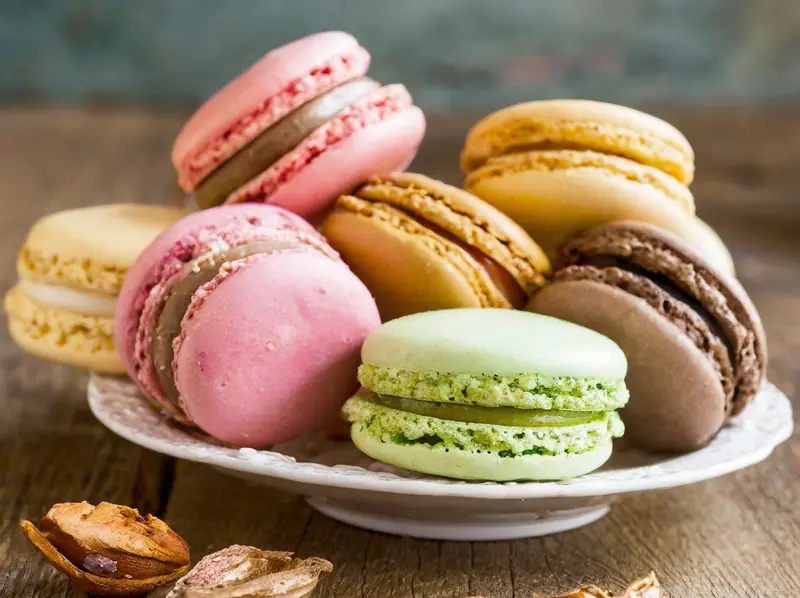
A French macaron is a delicate almond-flour meringue shell, piped in matched pairs and sandwiched around a ganache or buttercream filling; the two rely on similar egg-white technique but end up nothing alike on the plate. American coconut macaroons usually replace the whipped-meringue base with sweetened condensed milk stirred into shredded coconut, giving a denser, stickier, sweeter cookie with no dome and often a chocolate dip on the base. Kokosmakronen sit between the two: whipped egg white gives them lift and a light, meringue-like shell, while the coconut keeps the centre chewy, and the wafer disc underneath is a purely German detail neither of the other two uses.
Toasting is a genuine upgrade, not just a garnish: spread the coconut in a dry pan over medium heat for 3 to 4 minutes, stirring constantly until it turns pale gold, then let it cool fully before folding it into the meringue. It adds a roasted, nutty note without changing the sugar or texture. Coarser coconut flakes work too, but they make a rougher, less compact macaroon that spreads a little more, so cut the water bath time by a minute and watch the shape closely as you bake. Do not substitute sweetened flaked coconut sold for cakes, since the extra sugar it carries will make the mixture too wet to hold a dome.
Rate this
Recipes by email
One letter a week: a recipe picked for your taste, plus whatever is new on the site. Unsubscribe in one click.
Welcome gift: Sergei's cookbook (e-book).
By subscribing you agree to the privacy policy.
Tell us what you like to cook (30 seconds) →Keep browsing
More dishes from the German archive — picked by overlap with what you're cooking now.
Join the conversation
Comments
No comments yet — be the first!