

Flammkuchen (German Tarte Flambée)
Flammkuchen, tarte flambée in French, is a paper-thin flatbread of flour, water and oil, spread with soured cream and scattered with raw onion rings and cubes of smoked pork belly. It comes from Alsace, and Baden and the Palatinate on the German bank of the Rhine pour it at their September wine festivals with equal conviction that it belongs to them. There is no yeast in the dough, so it bakes into a cracker rather than a pizza base: ten to twelve minutes at 250°C on a sheet that has been heating along with the oven. The half hour the dough spends resting before it is rolled is the only slow part of the evening.
Ingredients
- 250 gflour
- 125 mlwater
- 2 tbsprapeseed oil
- 1 tspsalt
- 150 gcrème fraîche
- 100 gsour cream
- 200 gonion
- 150 gbacon
- 1 pinchnutmeg
- ½ tspblack pepper
- 2 tbspchives
Method
- Mix the flour with the salt in a bowl, pour in the cold water and the rapeseed oil, and bring it together into a ball. Knead for about five minutes on an unfloured surface until the surface goes smooth and stops sticking to your hands. There is no yeast in this and there should not be: a yeasted base puffs up and turns into pizza, while Flammkuchen is meant to stay flat and snap when you fold a slice. Wrap the dough and leave it at room temperature for 30 minutes so the gluten relaxes enough to roll thin.
- While the dough rests, set the oven to 250°C conventional top and bottom heat, put a heavy baking sheet or a pizza stone on the middle rack, and give it a full 20 minutes to get properly hot. A wood-fired oven bakes this from below off a hot stone floor, and a home oven has nothing like that, so preheated metal is the substitute. If your oven tops out at 230°C, use that and add two minutes to the bake. Fan heat dries the topping out before the base has coloured, so switch it off if your oven lets you.
- Stir the crème fraîche together with the sour cream, the black pepper, the nutmeg and a little salt until it spreads like thick paint. Both dairy products sit somewhere between 24 and 30 percent fat, and that matters here: anything leaner splits at this temperature and floods the dough. Go light on the salt, because the bacon brings plenty of its own.
- Peel the onions, halve them and slice into rings no thicker than 2 mm; a mandoline does this more evenly than a knife. Cut the bacon into cubes of about 5 mm. Both go onto the dough raw. Twelve minutes at 250°C renders the fat out of the bacon and takes the raw bite off the onion, whereas pre-frying leaves you with dry bacon and onion that has already given up its water.
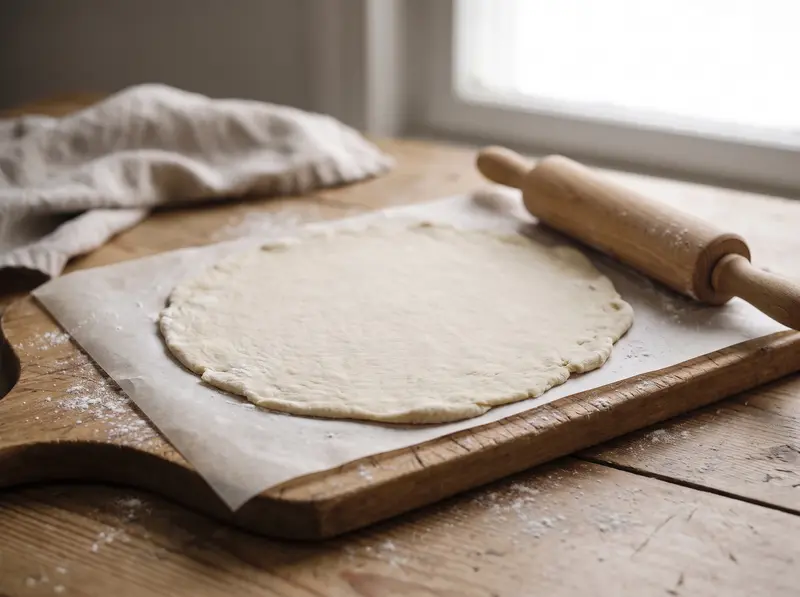
- Halve the dough and roll each piece straight onto a sheet of baking paper, turning the paper as you go, until it measures roughly 30×38 cm and sits about 2 mm thick. You should be able to make out the grain of the paper through the dough. If it springs back and refuses to stretch, walk away for five minutes and try again, because fighting it only tears the middle.
- Spread half the cream over one base in a thin layer, leaving a 1 cm rim bare, then scatter over half the onion rings and half the bacon. Keep the cream about as thick as butter on toast. Any more than that and the middle steams instead of baking, which is exactly how you get a wet centre with a crisp rim around it.
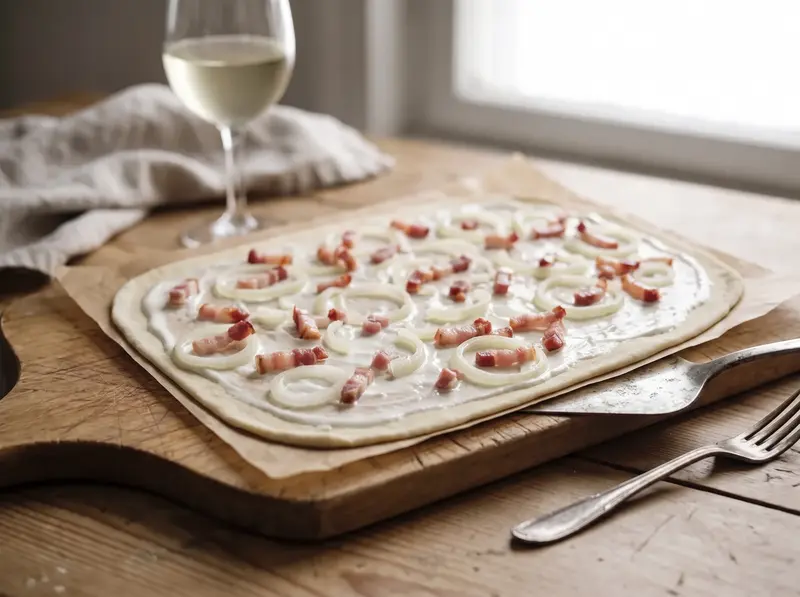
- Slide the paper with the Flammkuchen onto the hot sheet and bake for 10 to 12 minutes, until the rim is blistered and dark brown in places and the tips of the onion rings have caught and gone black. Those burnt edges carry half the flavour, so pulling it out at an even golden colour gives you something much blander. Scatter with the chopped chives, cut it into squares with a wheel, and eat it standing up while the second one rolls.
FAQ
Four causes, and usually more than one at a time. The oven was not hot enough: it needs 250°C top and bottom heat, and the sheet or stone has to preheat inside it for 20 minutes, because the base has to set from below within the first two minutes. The dough was rolled thicker than 2 mm, and at 4 mm it bakes like bread. The cream went on too generously, so the middle steamed under it. And the onions were cut thick, which means they let go of their water before the crust had set. Fix the temperature and the thickness first, then look at the topping.
Schmand is German soured cream at roughly 24 percent fat, crème fraîche sits nearer 30, and between them they give a topping that browns rather than runs. Full-fat quark at 20 percent whisked smooth with a spoonful of cream stands in well, as does Greek yoghurt strained in a sieve for 20 minutes to lose the whey. Thin 10 percent sour cream does not work: it splits at 250°C and soaks the base. Grated cheese does not belong here either, since that turns the dish into a thin pizza.
It does not, and the version without is the one worth making. Flour, water, oil and salt rolled to 2 mm bake into something between a cracker and very thin pastry, and that texture is the whole point of the dish. Add yeast, give it an hour to rise, and you get a raised base, which is a thin bacon pizza and perfectly pleasant but not this. The only rest this dough wants is the 30 minutes that let the gluten relax, and that is for rolling rather than for flavour.
Double the onion to 400 g, add 150 g of mushrooms sliced thin and dried out first in a hot dry pan, and finish the baked Flammkuchen with a handful of rocket. Leek in fine half-moons is even better in autumn, because it goes sweet at that heat. If you miss the savoury weight the bacon was carrying, dot the cream with small spoonfuls of Obatzda before it goes into the oven and let them melt into the topping. If you do want the real thing, Speck means fatty lightly smoked pork belly, and the nearest substitutes are diced pancetta or thick-cut streaky bacon cut from a block rather than bought in slices.
In Baden and the Palatinate it comes with a dry Riesling or a Weissburgunder, and from September onward with Federweisser, the cloudy half-fermented new wine that turns up for about six weeks and then vanishes. At those stands the Flammkuchen is not a main course: it arrives cut into squares on a wooden board and gets passed around while everyone carries on drinking. At home the same board works alongside soft pretzels and a bowl of radishes. If the sweet version is on offer, order it last, since it carries apple, cinnamon sugar and Calvados and no cream at all.
Rate this
Keep browsing
More dishes from the German archive — picked by overlap with what you're cooking now.


Join the conversation
Comments
No comments yet — be the first!