
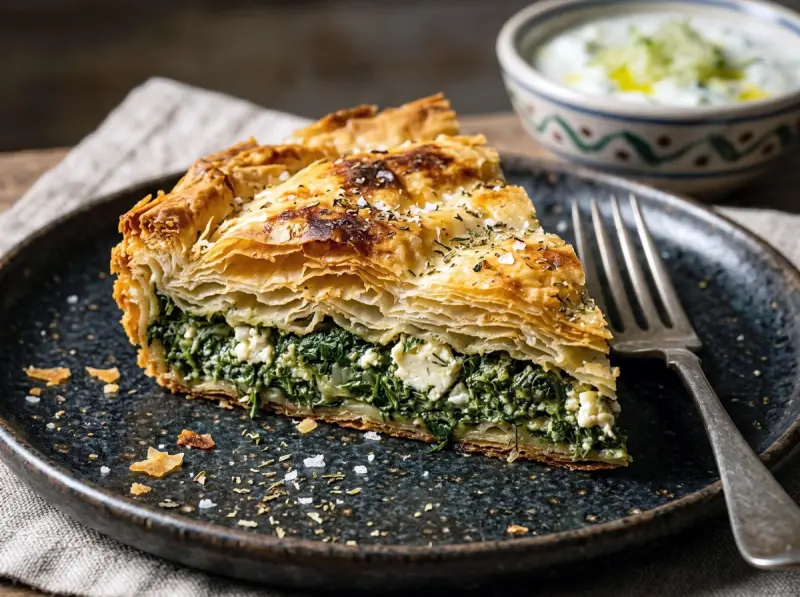
Spanakopita
Layers of phyllo pastry brushed with olive oil encasing a filling of spinach, feta, fresh dill, spring onions, and eggs. The moisture in the spinach is the main technical challenge — any liquid that reaches the phyllo turns it soft rather than crisp. The filling must be squeezed very dry before anything else happens. The phyllo must stay covered while you work — it dries and cracks in seconds of exposure. Neither problem is difficult, both just require attention. This recipe makes a baking-dish pie that serves 6; it slices cleanly and is equally good warm or at room temperature.
Ingredients
- 500 gfresh spinach
- 300 gGreek feta in brine
- 4 scallions
- 1 small onion, finely diced and sautéed until soft
- 3 tbspfresh dill
- 2 tbspfresh flat-leaf parsley
- 2 eggs
- 0.5 tspfreshly grated nutmeg
- 10 sheets of phyllo pastry, thawed overnight in fridge
- 80 mlolive oil
Method
- Prepare the spinach. If using fresh spinach: wash, place in a hot dry pan in batches, wilt completely, then tip into a colander and let cool. Once cool enough to handle, take handfuls and squeeze out as much liquid as you can — more than you think is necessary. Roughly chop. If using frozen spinach: thaw completely at room temperature, then squeeze out all moisture through a clean cloth or in handfuls. The spinach should feel almost dry when you compress it. This is the most important step: wet spinach is the single reason spanakopita goes soggy.
- Make the filling. Combine the squeezed spinach, crumbled feta, sautéed onion, spring onions, dill, parsley, beaten eggs, and nutmeg in a large bowl. Mix well. Taste before adding salt — feta is already salty, you may need very little or none. The filling should be cohesive and hold together when pressed, not wet or loose.
- Prepare the phyllo. Open the phyllo only when everything else is ready. Unroll the sheets and immediately cover with a very slightly damp kitchen towel — phyllo dries and becomes brittle in under two minutes of open-air exposure. Have your olive oil and pastry brush ready. Work one sheet at a time, keeping the rest covered. Tears and imperfections are normal and invisible once layered.
- Assemble and bake. Brush a 20 × 30 cm baking dish with oil. Lay one phyllo sheet in the dish, letting it overhang the sides, and brush with oil. Repeat with 4 more sheets, brushing each. Spread the entire filling evenly over the phyllo base. Top with the remaining 5 sheets, brushing each with oil. Fold the overhanging edges over the top and brush them well. Score the top layer into portions with a sharp knife — this prevents shattering when baked. Sprinkle a few drops of water over the top (creates steam, helps crispness). Bake at 180°C for 45 to 50 minutes until deep golden.
- Rest and serve. Leave the spanakopita to cool in the dish for at least 20 minutes before cutting along the scored lines. The filling needs to set or it will crumble when sliced. Serve warm or at room temperature. Spanakopita reheats well in a hot oven for 8 to 10 minutes — do not microwave, it turns the phyllo soft.
FAQ
Two rules for phyllo: cover and work fast. As soon as you open the package, unroll the sheets and lay a very slightly damp kitchen towel directly on top — phyllo exposed to air dries to crumbling brittleness in under two minutes. Work with one sheet at a time, replacing the damp towel over the rest immediately. Tears are normal and not a problem — multiple layers will cover any imperfections. Brush oil generously on each sheet before placing the next: the oil creates both the flakiness and the crisp. If a sheet tears badly, patch it with a piece from the pile and continue.
All from the spinach. Fresh spinach is mostly water, and frozen spinach, even after thawing, retains significant moisture. After cooking or thawing, the spinach must be squeezed until it feels almost dry. Take a handful and wring it as hard as you can over the sink — repeat until no more liquid comes out. A second cause is assembling the pie too far ahead and leaving it unbaked — the filling continues to release moisture into the phyllo over time. If assembling ahead, refrigerate or freeze the unbaked pie rather than leaving it at room temperature.
Both work. Olive oil is traditional — it gives a crisp, slightly less rich result with a faint fruitiness, and it is used in authentic Greek recipes. Butter gives a richer flavor and a slightly deeper golden color. Many home cooks use butter because the flavor is more familiar and forgiving. For the most authentic result, use good-quality Greek extra virgin olive oil. For a richer flavor and slightly more impressive visual result, use clarified butter or regular melted butter. Both produce excellent spanakopita; this is a personal choice.
Both work, with different handling. Fresh spinach gives marginally better flavor and texture: wilt in a hot dry pan in batches, cool, then squeeze thoroughly dry. Frozen spinach is more convenient and already broken down: thaw completely, then squeeze out all moisture — often more effectively than fresh because the freezing has already broken down the cell walls. The critical variable is not fresh versus frozen but whether it is dry enough before going into the filling. Wet spinach from either source will ruin the pastry regardless of everything else.
Both are traditional in different contexts. The pie (pita) format — filling layered in a baking dish between sheets of phyllo — is the traditional home-cooking version, made in one large pan and cut into squares or diamonds. It is the version made for family meals and celebrations. Triangles (trigonika) are the street-food and bakery version: filling wrapped in individual strips of phyllo folded into small triangular parcels. Both are authentic. The pie is easier to make in quantity and slices cleanly when cool; triangles are more portable and each has more crust relative to filling, which many people prefer.
Rate this
Recipes by email
One letter a week: a recipe picked for your taste, plus whatever is new on the site. Unsubscribe in one click.
Welcome gift: Sergei's cookbook (e-book).
By subscribing you agree to the privacy policy.
Tell us what you like to cook (30 seconds) →Keep browsing
More dishes from the Greek archive — picked by overlap with what you're cooking now.
Join the conversation
Comments (2)
The phyllo handling is where most people panic, but there is a trick: work fast and keep a damp towel over the unused sheets. Each layer gets a brush of melted butter, no exceptions. I count 8 layers on the bottom, filling, then 8 on top. The dill in the filling is non-negotiable — without it the pie tastes flat. And squeeze every last drop of water out of the spinach. I mean wring it like laundry.
La spanakopita me salió bien pero tengo una queja: la masa filo es un dolor de cabeza. Se rompe, se seca, se pega. Hay que trabajar rápido y con un trapo húmedo encima. El relleno de espinacas con feta y eneldo está muy bueno, eso sí. La próxima vez voy a hacer la versión con masa quebrada que es mas facil de manejar.