
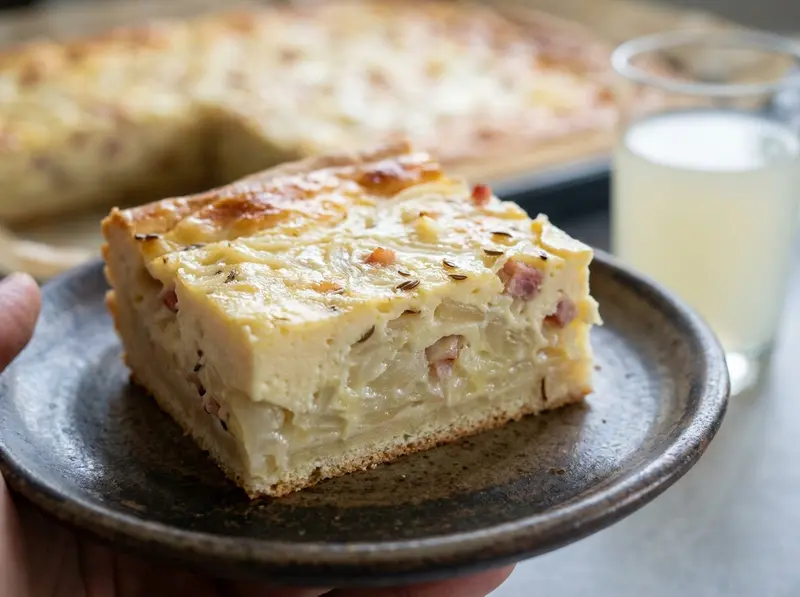
Zwiebelkuchen (German Onion Tart)
Zwiebelkuchen is a savoury onion tart from the wine villages of southern Germany (Swabia, the Palatinate, Baden, Franconia), eaten through September and October with Federweisser, the cloudy young wine that is still fermenting in the glass. Underneath the topping is yeast dough rather than pastry, a thin bread base pressed into a sheet pan, which is how it is sold at the autumn wine festivals. On top goes well over a kilo of onions sweated until they collapse, bound with sour cream and eggs, seasoned with caraway and studded with smoked bacon. The dough needs about an hour to rise before any of that begins, so the timing below does not include it.
Ingredients
- 400 gflour
- 250 mlmilk
- 7 gyeast
- 60 gbutter
- 1 tspsugar
- 2 tspsalt
- 1.2 kgonion
- 150 gbacon
- 2 tbspvegetable oil
- 250 gsour cream
- 3 eggs
- 2 tspcaraway seeds
- 2 tbspsemolina
- ½ tspblack pepper
Method
- Warm the milk to about 35°C, finger-warm and no hotter, or the yeast dies before it starts. Stir in the dry yeast with the sugar and leave it five minutes until the surface turns foamy. Add the flour, the soft butter and 1 tsp of the salt, then knead for eight to ten minutes until the dough stops sticking to your hands and springs back when you press it. Cover the bowl and leave it somewhere warm for about an hour, until it has doubled.
- Peel the onions, halve them and slice into half-rings about 4 mm thick. Resist chopping them finer than that: small dice turns to puree in the oven and the tart loses the texture that makes it worth eating. A kilo and a bit looks absurd piled in a bowl, and it will cook down to less than half.
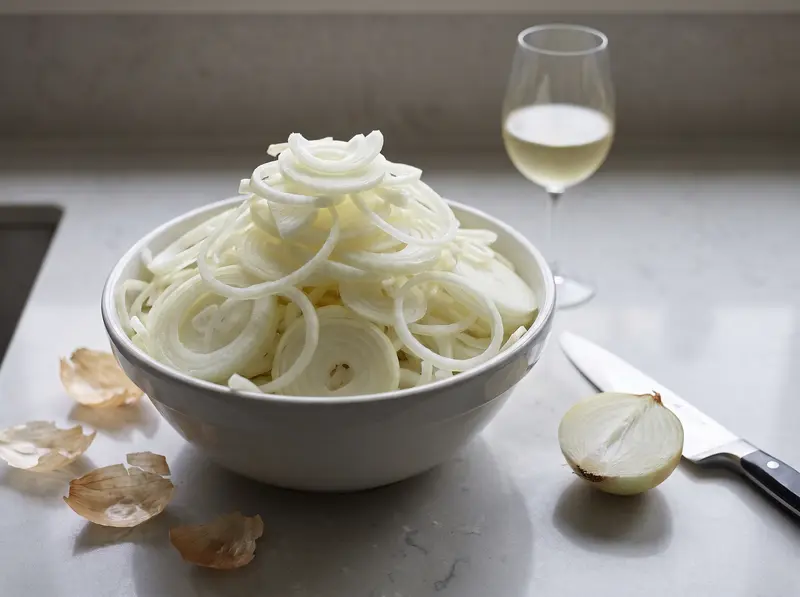
- Cut the bacon into short strips and render it in the oil over medium heat for three or four minutes, until the fat runs clear. Tip in the onions with 1 tsp salt, put a lid on and let them steam for ten minutes so they give up their water. Take the lid off and carry on for another fifteen to twenty minutes over medium-low heat, stirring now and then, until they have collapsed to half the volume and are completely soft but still pale. Colour is the enemy here: browned onions turn sweet and faintly bitter, and that flavour walks over everything else in the tart.
- Spread the onions on a cold plate or tray and leave them until they are no warmer than your hand, roughly twenty minutes. Warm filling softens the butter in the raw dough and steams it from underneath, and that one shortcut is behind most wet-bottomed onion tarts. If liquid has pooled under the onions, pour it off rather than stirring it back in.
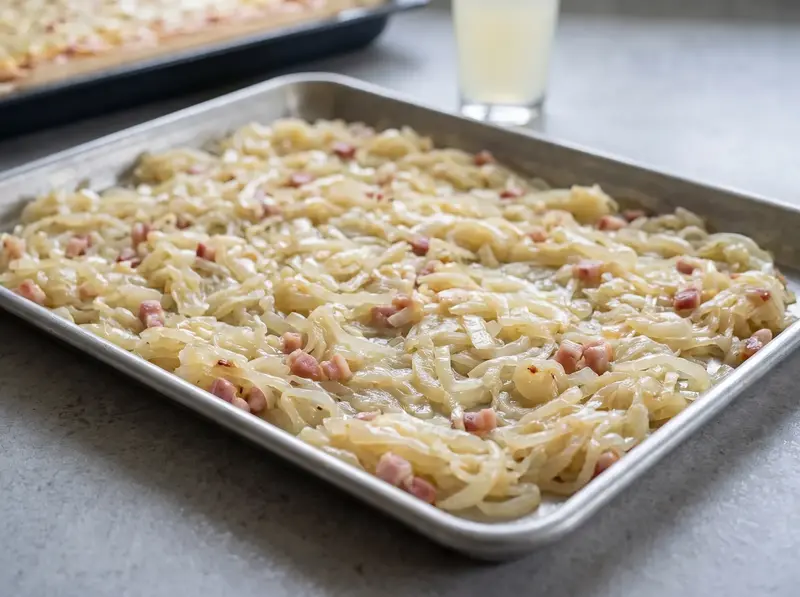
- Oil a 30×40 cm sheet pan. Knock the dough back, roll it out on a floured surface and lift it into the pan, pressing it into the corners and up the sides to make a rim about 2 cm high. Scatter the semolina evenly over the base, where it will drink up whatever liquid gets through and keep the dough dry. Leave it to rest fifteen minutes while the oven heats to 200°C, conventional heat, with the rack in the lowest position.
- Whisk the sour cream with the eggs, the caraway, the remaining salt and the pepper until smooth. Fold in the cooled onions and bacon; the mixture should be thick enough that a spoon leaves a trail, with far more onion than custard. Spread it over the dough right up to the rim in an even layer about 2 cm deep.
- Bake on the lowest rack for thirty-five minutes. It is done when the custard no longer wobbles in the centre, the onion tips have taken a little colour and the underside of the dough is properly brown. Lift a corner with a palette knife and look, since the top tells you nothing. Let it stand fifteen minutes before cutting, otherwise the filling slides off the slice, and serve it lukewarm, which is how it is eaten in Germany. Straight from the oven the caraway and the onion are still shouting over each other.
FAQ
Almost always because the filling went on while it was still warm. Yeast dough is raw bread: heat from above softens the butter in it and the steam has nowhere to escape, so the base cooks in its own moisture instead of baking. Spread the onions on a tray until they are cool to the touch, pour off any liquid that has pooled, and scatter two spoons of semolina or fine breadcrumbs over the dough before the topping goes on. Bake on the lowest rack rather than the middle one, so the sheet takes heat directly from below. If the top darkens before the base is ready, lay foil loosely over it and keep going.
Only softened, and this is where most home versions go wrong. Cook them covered for ten minutes so they release their water, then uncovered for fifteen to twenty more over medium-low heat until they are limp, translucent and still pale. Browned onions bring caramel sweetness and a faint bitterness that argues with the sour cream and dominates the whole tart. Deep brown is the right technique for a different dish, French onion soup, where that sugar is the entire point; here it is a fault.
Yes, and a good many Swabian households leave it out. The bacon supplies salt, smoke and fat, so put all three back: an extra teaspoon of salt, 2 tsp dried marjoram, and 20 g of butter in the pan with the onions. A pinch of smoked paprika gets close to the smell of Speck without any meat, though use it sparingly or it colours the custard pink. Taste the custard before it goes on the dough, because a kilo of onions swallows more salt than you expect.
The sheet pan version is the older festival one: yeast dough rolled thin, a rim pushed up by hand, baked in a 30×40 cm tray and cut into squares to eat off a paper plate. Round tins came later and usually carry shortcrust instead, most often around the Palatinate, where a crisper, richer base is preferred. The filling sits deeper in a tin, so it wants 40 to 45 minutes rather than 35. Yeast dough absorbs a little of the custard and tastes of bread under the onions; shortcrust stays separate and crumbles. This recipe is the sheet version, which is what a kilo of onions is for.
It keeps better than most savoury tarts. Cool it completely, store it in the fridge under a cloth rather than plastic, since plastic traps condensation and softens the dough overnight, and reheat it for ten to twelve minutes at 180°C sitting directly on the oven shelf so the underside crisps again. A microwave turns the base to rubber within seconds. Serve it lukewarm rather than hot, traditionally with Federweisser, the young wine still fermenting in the glass; where that is not sold, a dry apple cider sits in roughly the same place against the onions.
Rate this
Keep browsing
More dishes from the German archive — picked by overlap with what you're cooking now.

Join the conversation
Comments
No comments yet — be the first!