


Dinner Rolls (Soft Pull-Apart Yeast Rolls)
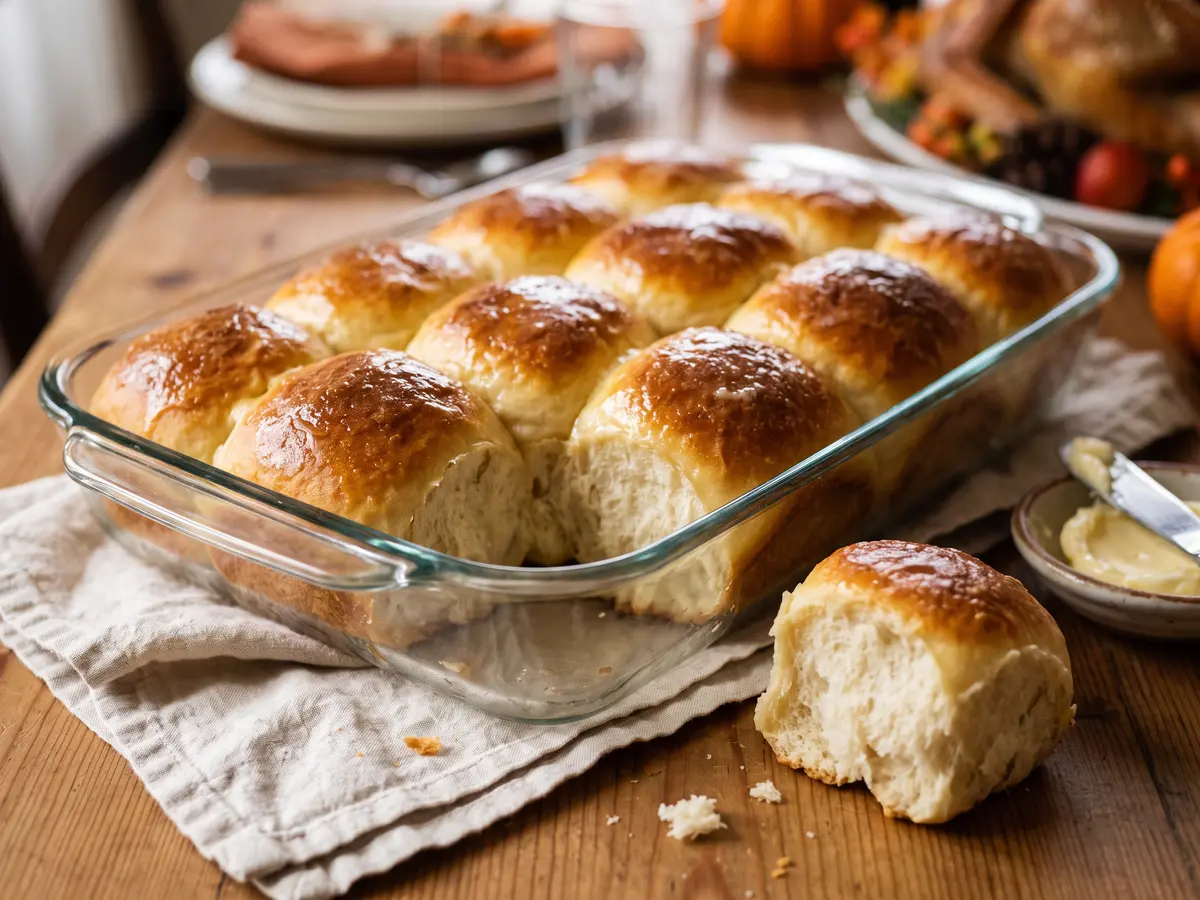
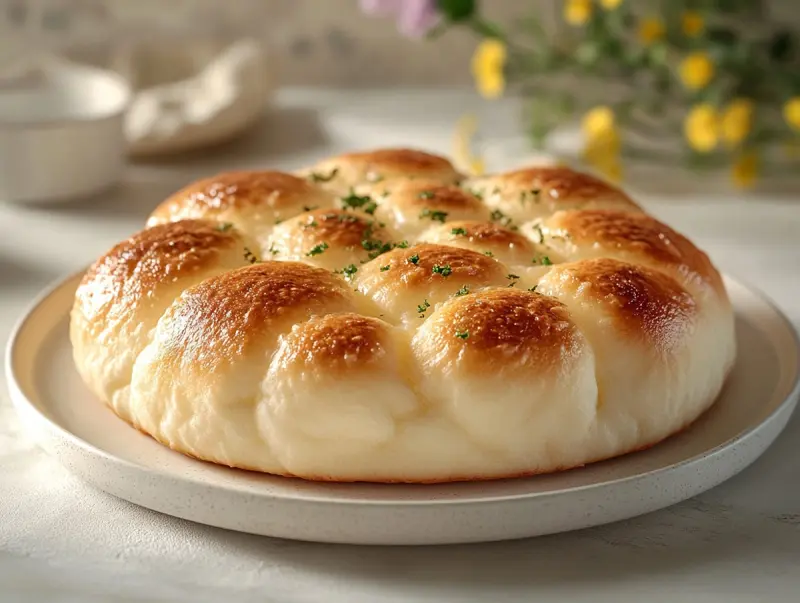
Dinner rolls are small, soft yeast rolls made from a slightly sweet dough of flour, milk, butter, egg and sugar, and in the US a warm basket of them goes on the Thanksgiving table. Here 15 round rolls bake side by side in one 23 × 33 cm (9 × 13 in) dish, so they rise into each other and come out as a single golden sheet that everyone pulls apart, which is why they are also called pull-apart rolls. The dough rises twice, first for 1 to 1.5 hours and then for 45 to 60 minutes, so count on close to 3 hours from warming the milk to the first warm roll. Under an hour of that is actual work.
What dinner rolls are
In American cooking, dinner rolls are the small, soft, slightly sweet yeast rolls that come to the table with the main meal. Milk, butter, egg and a little sugar make them soft and buttery. This recipe makes the pull-apart kind: round rolls set close together in one dish, so they bake into a single sheet and tear apart with soft sides.
Parker House rolls are a different shape. For those, a ball of dough is flattened in the centre and folded in half. According to Wikipedia, they come from the Parker House Hotel in Boston in the 1870s.
Dinner rolls on the Thanksgiving table
King Arthur Baking calls dinner rolls a non-negotiable side dish at Thanksgiving. They go with everything on the plate, especially gravy, and they turn into sandwiches the next day. Its Thanksgiving timeline has the rolls bake while the turkey rests. Our roast turkey finishes at 165 °C and rests for 30 minutes, or up to 1 hour if the side dishes need the oven, so turn the oven up to 175 °C as soon as the bird comes out.
Serve them with mashed potatoes and gravy, cornbread stuffing and cranberry sauce, and finish with pumpkin pie.
Glass dish or metal pan
Both work. Sally's Baking Addiction prefers a glass dish because rolls brown a little too fast in metal. Whichever you use, bake on a rack in the lower third and lay foil over the top if it colours before 20 minutes. The middle roll is the last to finish, so that's the one to check with the thermometer.
Ingredients
- 320 mlmilk
- 7 ginstant yeast
- 40 gsugar
- 1 egg
- 70 gbutter
- 8 gsalt
- 500 gflour
- 25 gbutter
Method
- Warm 320 ml whole milk in a small saucepan over low heat to 43 °C (110 °F). It should feel warm, and it must not steam. Pour it into a large mixing bowl or the bowl of a stand mixer, whisk in 7 g instant yeast and 15 g of the sugar, cover and leave for 5 minutes. Milk that is too hot can kill the yeast, and then the dough won't rise at all.
- Add the remaining 25 g sugar, the egg, 70 g soft butter cut into pieces, 8 g salt and 500 g all-purpose flour. With the dough hook, mix on low for 30 seconds, scrape down the bowl, then beat on medium for about 2 minutes until the dough comes together and pulls away from the sides. Keep kneading for 5 more minutes. By hand, stir everything together and knead on a lightly floured surface for about 10 minutes. The dough is ready when it is smooth, soft and slightly tacky and a finger poke slowly fills back in. If you like, stretch a small piece: it should go thin enough to let light through without tearing. Only add flour if the dough really sticks, and then 1 tsp at a time, because extra flour is what makes rolls dry and heavy.
- Lift the dough out, rub the same bowl with a little of the 25 g butter, put the dough back and turn it once so it is coated. Cover with a kitchen towel or plastic wrap and leave it somewhere warm for 1 to 1.5 hours, or up to 2 hours in a cool kitchen, until it has doubled in size. Go by the size of the dough, not the clock.
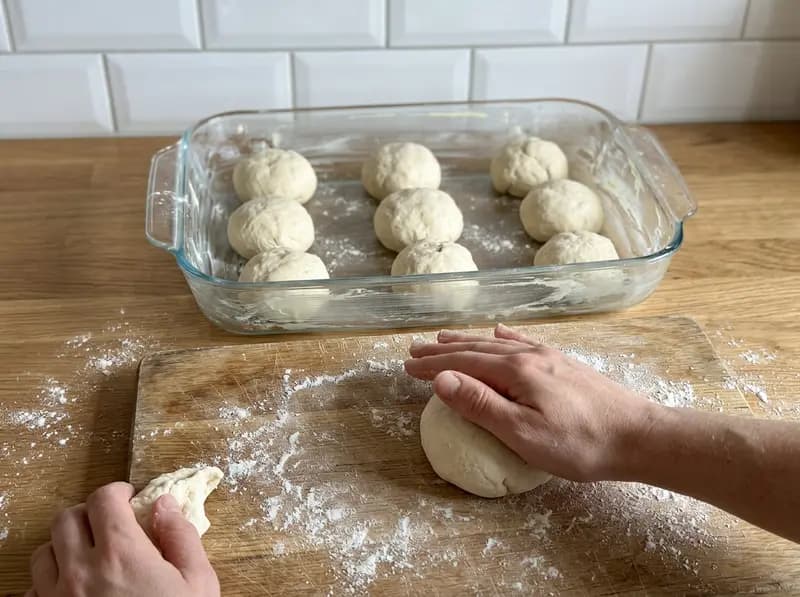
- Butter a 23 × 33 cm (9 × 13 in) glass baking dish with the rest of the soft butter, keeping 20 g to melt later. Press the air out of the dough, weigh it and divide it into 15 pieces of about 65 g each. To shape a roll, pull the dough together underneath into a small knot, then put it knot side down and roll it under your cupped palm until it is a smooth, tight ball. Set the balls in the dish in 3 rows of 5, evenly spaced. They should not touch yet, because the gaps close as they rise.
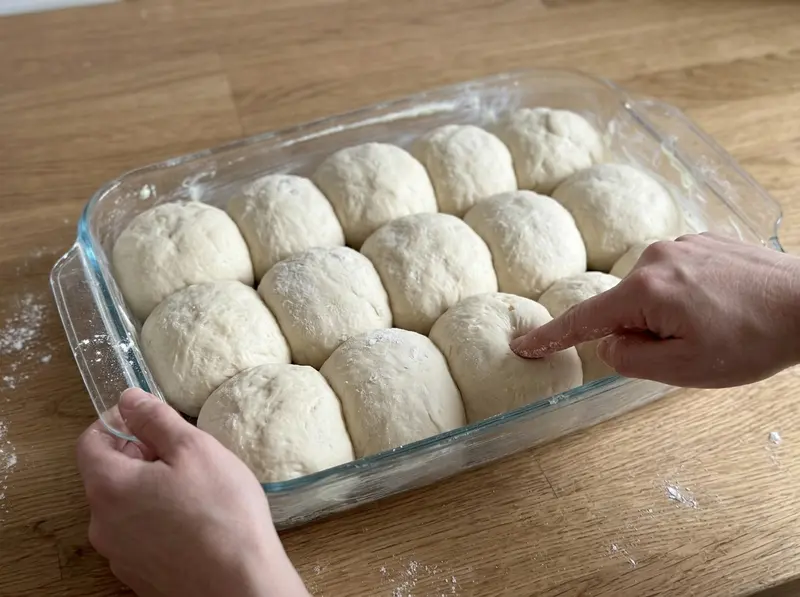
- Cover the dish and let the rolls rise for 45 to 60 minutes. Meanwhile heat the oven to 175 °C (350 °F) with top and bottom heat and set a rack in the lower third, so the tops don't burn before the middle is baked. From 45 minutes on, test: flour a finger and press it about 2.5 cm (1 in) into the side of a roll. If the dent stays, the rolls are ready. If it springs back, give them a little more time and test again. By now they should be very puffy and touching each other.
- Bake for 20 to 25 minutes, turning the dish halfway through, until the tops are deep golden brown and the sides lighter. If the tops are already dark before 20 minutes, lay a sheet of foil loosely over the dish. In a metal pan the rolls brown faster than in glass, so watch them. The surest test is a thermometer pushed into the middle roll: it should read 88 °C (190 °F). Check the middle one, since the rolls at the edge bake faster. If it reads less, give them a few more minutes, with foil over the top if they are already dark, and measure again.
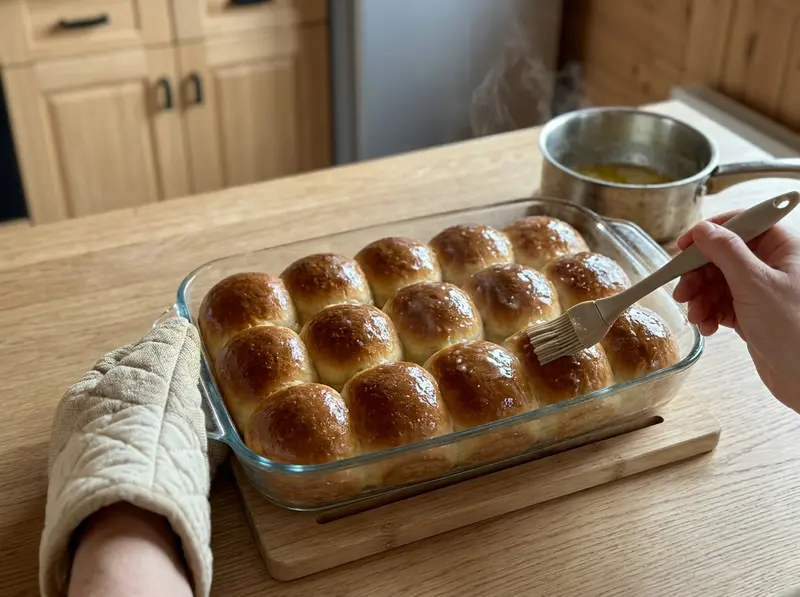
- Melt the 20 g butter while the rolls bake and brush it over them as soon as they come out of the oven, which keeps the crust soft. Leave them in the dish for 2 to 3 minutes, then serve them warm straight from the dish, or lift the whole sheet onto a wire rack.
Cooked it? Rate the recipe
FAQ
The simplest way is overnight. Make the dough, let it rise once and shape the rolls into the dish (steps 1 to 4), then cover them tightly and refrigerate for up to about 15 hours. Take them out at least 3 hours before dinner and let them rise, still covered, on the counter for about 1 to 2 hours before baking. For more lead time, freeze them instead: after the first rise, shape the rolls into the buttered dish, wrap it tightly and freeze it before the second rise, for up to 3 months. On the day, let them thaw and rise for 4 to 5 hours, then bake them while the roast turkey rests. It rests for 30 minutes, or up to 1 hour if the sides need the oven, and the oven has to go from the turkey's 165 °C up to 175 °C first. You can also bake them fully ahead, taking them out when they are pale gold and the middle roll reads 88 °C (190 °F). Cool them completely and freeze for up to 3 months, then thaw them in the fridge or at room temperature and reheat the lightly covered dish at 150 °C (300 °F) for about 10 minutes.
Usually there was too much flour. The dough should stay a little tacky, and every extra spoonful makes the rolls heavier. Milk that is too hot can kill the yeast, and then the dough barely rises. Warming it to 43 °C (110 °F) is enough. Rolls that go into the oven too early also stay tight, so do the poke test and bake only when a 2.5 cm dent stays put. Short kneading is another cause: the dough should stretch thin enough to let light through.
Yes to both, in the same amounts. Bread flour works gram for gram, so use 500 g. Sally's Baking Addiction notes the rolls come out chewier and that nothing else in the recipe changes. Active dry yeast also swaps 1 for 1 at 7 g, but it rises a bit more slowly, so expect the longer end of each rise. Step 1 dissolves the yeast in the warm milk for 5 minutes, which is how Sally's Baking Addiction handles either kind.
At 175 °C (350 °F) they take 20 to 25 minutes. The tops turn deep golden brown and the sides stay lighter. Colour alone can fool you, though, because the rolls on the outside bake faster than the middle one. In King Arthur Baking's test, 15 minutes into the bake, an edge bun already read 89 °C (192 °F) while the centre bun was at 77 °C (171 °F), so push an instant-read thermometer into the middle roll and wait for 88 °C (190 °F). If the tops darken before 20 minutes, cover the dish loosely with foil and keep baking.
Brushing them with melted butter straight out of the oven already keeps the crust soft. Once they have cooled, cover them tightly and keep them at room temperature for 2 to 3 days. For longer, freeze them for up to 3 months, thaw at room temperature, and reheat the lightly covered dish at 150 °C (300 °F) for about 10 minutes. Leftover rolls also make good next-day sandwiches with sliced turkey.
Keep browsing
More dishes from the American archive — picked by overlap with what you're cooking now.


Recipes by email
One letter a week: a recipe picked for your taste, plus whatever is new on the site. You can stop the letters in one click.
Welcome gift: Sergei's cookbook (e-book).
By signing up for the newsletter you agree to the privacy policy.
Tell us what you like to cook (30 seconds) →
Join the conversation
Comments (1)
Булки как булки :)