

Adjarian Khachapuri
Boat-shaped bread filled with molten cheese, finished with a raw egg cracked into the center and a pat of butter. The yolk stays runny — you break off the crust, stir everything together and dip. Georgia's most iconic dish.
Ingredients
- 500 gflour
- 400 gmozzarella
- 6 eggs
- 200 mlmilk
- 100 gbutter
- 7 gdry yeast
- 1 tspsugar
- 1 tspsalt
Method
- Warm the milk to 38–40°C — comfortably warm on your wrist but not hot. Dissolve the yeast and sugar in it and leave 10 minutes until frothy. In a large bowl, combine flour and salt. Add the yeast mixture and 30 g of melted butter. Mix, then knead for 8 minutes until the dough is soft, smooth and slightly tacky — not stiff. It should feel softer than an earlobe. Cover and leave in a warm place for 1–1.5 hours until doubled.
- While the dough rises, grate the mozzarella. Mix with 1 egg, a pinch of salt and 30 g of the butter, softened. The filling should be creamy, not dry — add 2–3 tbsp of full-fat ricotta or cottage cheese if needed.
- Divide the dough into 4 equal pieces. On a floured surface, roll each into an oval roughly 30×20 cm. Distribute the cheese filling over the surface leaving a 2 cm border. Tightly roll both long sides toward the center, rolling them over the filling. Pinch and twist the two ends firmly to seal — this is what keeps the boat shape in the oven. The result should look like a gondola.
- Transfer to parchment-lined baking sheets. Beat one egg and brush it over the exposed dough edges. Rest 15 minutes while the oven heats to 220°C (425°F).
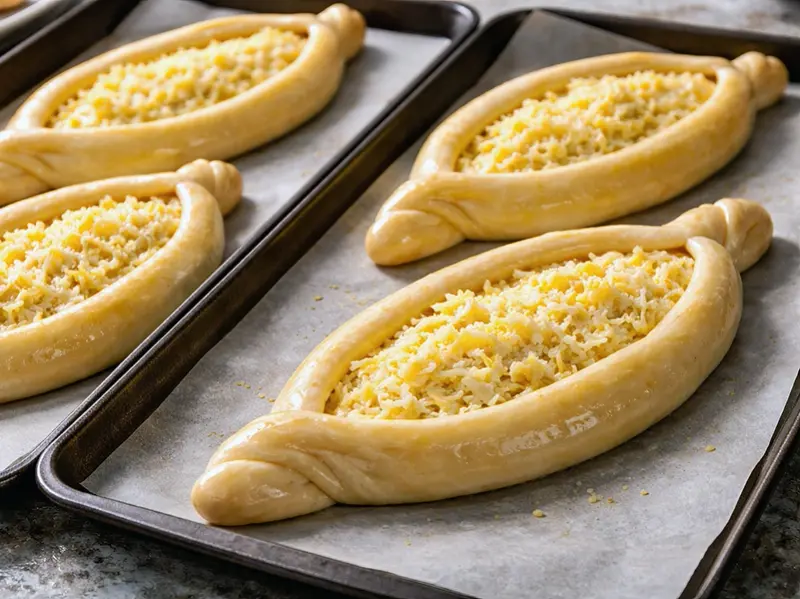
- Bake for 13–15 minutes until the sides are deep golden and the cheese is fully melted and bubbling. Remove from the oven. Using the back of a spoon, press a well in the center of the cheese. Crack one egg into each well — keep the yolk intact.

- Return to the oven for 3–4 minutes: the white should just set, the yolk must stay runny. Remove immediately. Place 10 g of butter in each boat. Bring to the table at once — the cheese sets quickly. Stir the butter, egg and cheese together with a fork, then tear off the crust ends and dip.
FAQ
The closest substitute is a combination of low-moisture whole-milk mozzarella (the block kind, not fresh in brine) and feta. Use 300 g mozzarella for the stretch and melt, plus 100 g crumbled feta for the saltiness and slight tang that sulguni has. Adding 2–3 tablespoons of ricotta or full-fat cottage cheese makes the filling creamier, closer to the Georgian imeruli cheese that is also traditionally used. Avoid hard aged cheeses — they break and become grainy when melted instead of pulling into strings. Never use pre-shredded cheese: the anti-caking coating prevents smooth melting.
Roll the dough into an oval, then tightly roll both long edges toward the center — not just fold them, but roll them over the filling so they grip it. The two ends are the critical point: pinch them firmly, then twist each end like wringing out a cloth, pulling slightly outward as you do. Press the twisted ends flat onto the baking sheet so they can't unroll. Brush the sides with beaten egg before baking — it acts as a sealant and browns the edges. Letting the shaped boats rest 15 minutes before baking gives the dough time to relax into the shape.
Bake the filled boats at 220°C for 13–15 minutes until the sides are deep golden and the cheese is fully melted and bubbling throughout. Then remove from the oven, press a well in the center of the cheese with a spoon, crack in one egg per boat and return for exactly 3–4 minutes — the white sets opaque, the yolk stays liquid. For a fully cooked yolk, 5–6 minutes. Do not leave it longer: the egg continues cooking for 1–2 minutes after you remove it from the oven as the hot cheese carries heat. Serve immediately — this dish waits for nobody.
Three common mistakes. First: the milk was too hot — above 45°C kills the yeast. It should feel comfortably warm on your wrist, around 38–40°C. Second: too much flour was added — khachapuri dough should be soft and slightly sticky, not firm like bread dough. Add flour gradually and stop earlier than you think. Third: insufficient rising time or too cold an environment. The dough needs 1–1.5 hours in a genuinely warm spot (near a radiator, or in an oven with just the light on) until it doubles. Test readiness by pressing a finger in: the indent should slowly spring back halfway.
Khachapuri arrives at the table straight from the oven — the cheese sets within 5 minutes, so there is no waiting. Drop a 10 g knob of butter directly into the hot filling next to the egg. Using a fork, stir the butter, runny yolk and molten cheese into a unified creamy sauce. Then break off the twisted ends of the boat with your hands — these are the natural dipping tools — and use them to scoop up the filling. Continue tearing strips from the sides and dipping as you eat. No knife, no plate, no utensils other than the fork for the initial stir. The boat shape exists precisely to make this hands-on eating method work.
Rate this
Recipes by email
One letter a week: a recipe picked for your taste, plus whatever is new on the site. Unsubscribe in one click.
Welcome gift: Sergei's cookbook (e-book).
By subscribing you agree to the privacy policy.
Tell us what you like to cook (30 seconds) →Keep browsing
More dishes from the Georgian archive — picked by overlap with what you're cooking now.
Join the conversation
Comments (2)
Каждый второй рецепт хачапури в интернете делает лепёшку с сыром. Аджарский хачапури — это лодочка, и тесто должно быть мягким, дрожжевым, пышным по краям. Яйцо кладётся в самом конце и не должно быть полностью готовым — его размешивают в горячем сыре за столом. Если яйцо сварилось в духовке — вы опоздали.
Ingredient temperature matters enormously for adjarian khachapuri. Unless the recipe says otherwise, everything should be at room temperature. Cold flour doesn't cream properly, and the texture suffers throughout.