


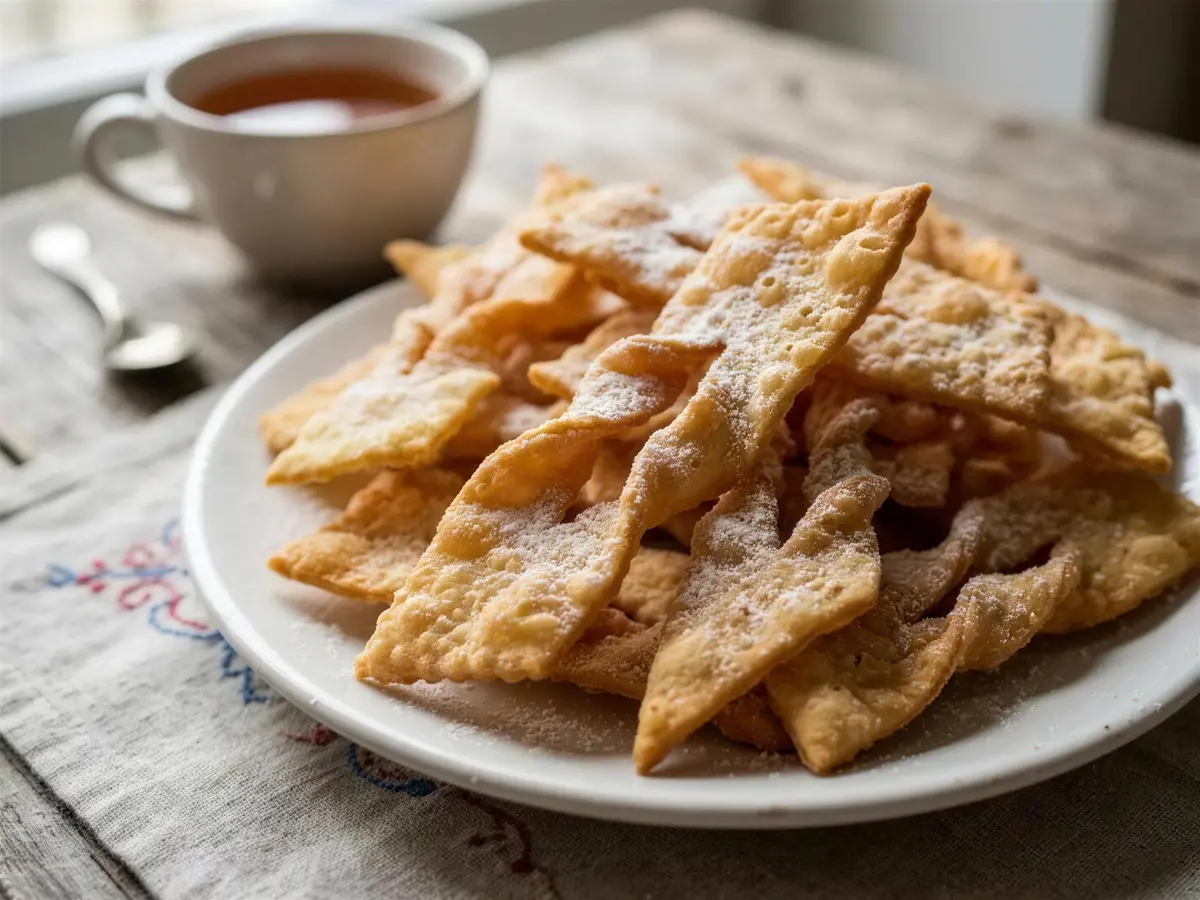
Khvorost (Ukrainian Fried Pastry)
Khvorost ('brushwood') is a crisp fried pastry made across Russia and Ukraine (in Ukraine it is called verhuny or khrusty): thin strips of dough twisted into a bow and dusted with powdered sugar (the Poles make the same thing and call it chruściki or faworki). The dough is rolled almost see-through, and a splash of brandy weakens the gluten, which is what makes the pastry brittle and crisp. The dough rests for 30 minutes before rolling.
Ingredients
- 500 gwheat flour
- 4 eggs
- 3 tbspmilk
- 2 tbspbrandy
- 2 tbsppowdered sugar
- 0.5 tspsalt
- 500 mlvegetable oil for frying
- 30 gpowdered sugar for dusting
Method
- Sift the flour into a large bowl. Add the 2 tbsp powdered sugar and the salt. In a separate bowl, beat eggs lightly, then add milk and brandy. Gradually pour the liquid into the flour, mixing first with a spoon then by hand, until the dough comes together into a firm, slightly dry ball.
- Transfer to a floured surface and knead for 10–15 minutes until the dough is very smooth, elastic, and firm. Shape into a ball, cover with a towel or wrap in a bag so it does not dry out, and rest 30 minutes.
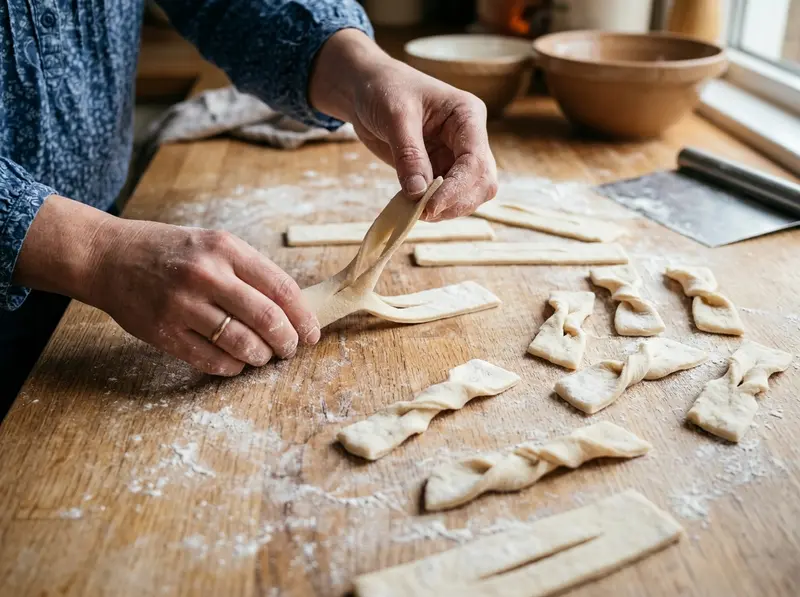
- Divide the rested dough into several portions. Roll each portion as thin as possible (1–2 mm) on a floured surface — the thinner, the crispier. Cut into strips about 3×10 cm. Make a slit in the middle of each strip and pull one end through the slit to form a twist.
- Heat vegetable oil in a deep pot to 160–170 °C. No thermometer: a scrap of dough dropped in should rise and sizzle within 2 seconds. Fill the pot no more than halfway with oil, keep water well away from it and do not leave it unattended. Keep a lid for the pot within reach. If the oil starts to smoke, take it off the heat; if it catches fire, cover the pot with a lid and never pour water on it. The oil should be deep enough for the khvorost to float freely. Fry in small batches, lowering the strips in away from you, for 1–2 minutes, turning constantly, until light golden on both sides.
- Remove with a slotted spoon and drain on paper towels. Dust generously with powdered sugar once they have cooled a little; if you are keeping some for later, dust those just before serving.
Cooked it? Rate the recipe
FAQ
The oil was not hot enough or the dough was too thick. Keep the oil at 160–170 °C — a scrap of dough should rise and sizzle within 2 seconds. Roll the dough as thin as possible — 1–2 mm.
You can bake at 180 °C for 12–15 minutes, but the result is quite different — baked khvorost is more like a cracker and loses the characteristic light, airy crunch. Frying is strongly recommended.
Keep in an airtight tin or box at room temperature for up to 5 days. Do not refrigerate — moisture will make them soft. Dust the ones you are storing with powdered sugar just before serving, not ahead of time.
Yes, but the texture is less tender. For an egg-free dough replace the eggs and milk with cold water and 1 tbsp oil, adding the water gradually until the dough comes together; expect to use roughly as much liquid as the eggs and milk gave. Rest the dough for 30 minutes as usual.
The most classic shape is a flat ribbon twisted into a bow or a thin strip with a slit in the middle and one end pulled through. Both shapes fry evenly. If you like fried dough sweets, try chak-chak next.
Keep browsing
More dishes from the Ukrainian archive — picked by overlap with what you're cooking now.




Recipes by email
One letter a week: a recipe picked for your taste, plus whatever is new on the site. You can stop the letters in one click.
Welcome gift: Sergei's cookbook (e-book).
By signing up for the newsletter you agree to the privacy policy.
Tell us what you like to cook (30 seconds) →
Join the conversation
Comments
No comments yet — be the first!