
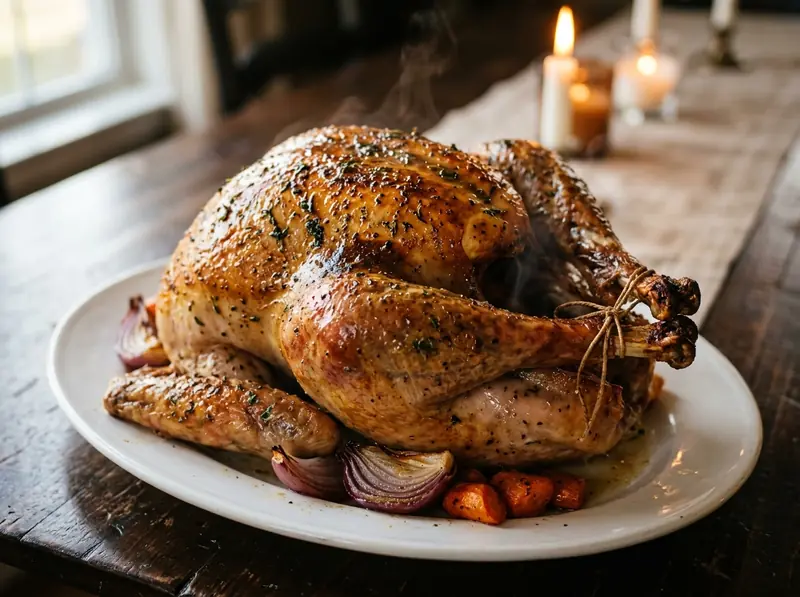
Roast Turkey (Dry-Brined Thanksgiving Turkey)
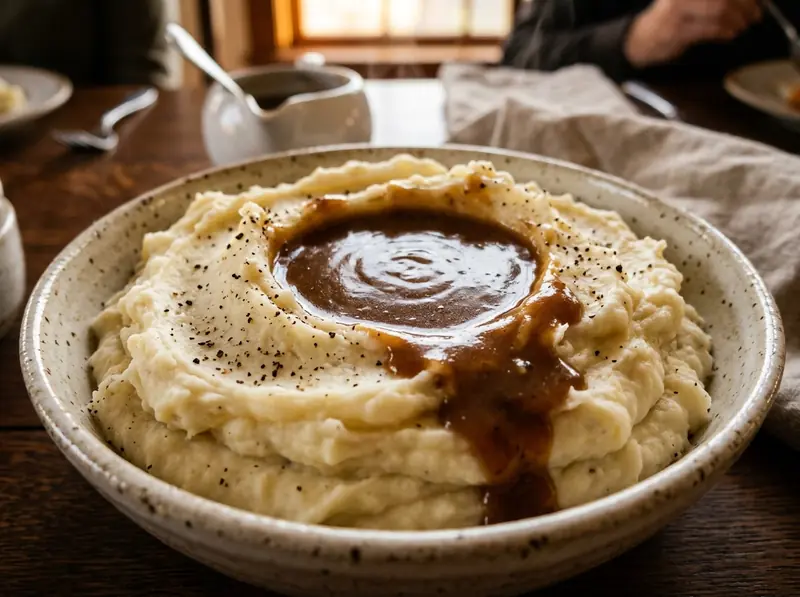
Roast turkey is the whole oven-roasted bird at the centre of the American Thanksgiving dinner, here a 5.4 kg (12 lb) turkey salted in advance, rubbed with herb butter under the skin and roasted until the thigh reads 74°C (165°F). This version is written for a home oven and for someone doing it the first time: the dry brine, plain salt rubbed on 1 to 2 days ahead, seasons the meat all the way through and helps the breast stay juicy, and a night uncovered in the fridge dries the skin so it crisps. The 195 minutes cover the day itself, about 30 minutes of prep and 2¾ hours in the oven; on top of that come 3 days of thawing in the fridge, 1 to 2 days of brining and a 30-minute rest before carving. It feeds 10, and the pan juices go into the gravy from our mashed potatoes recipe.
Ingredients
- 5.4 kgwhole turkey
- 1 onion
- 2 carrot
- 2 celery stalks
- 115 gunsalted butter
- 40 gkosher salt
- 1 tbspbaking powder
- 1 tbspfresh parsley
- 1.5 tspdried sage
- 1.5 tspdried thyme
- 0.5 tspblack pepper
- 240 mlwater
Method
- Thaw the turkey in the fridge, and start 5 days before the dinner. Leave the frozen bird in its wrapper, put it on a tray to catch the drips and set it on the lowest shelf; at 4°C (40°F) or colder it needs about 24 hours for every 2 kg (4 to 5 lb), so a 5.4 kg (12 lb) turkey takes 3 days. Do not thaw it on the counter, because the outside sits warm for hours while the middle is still ice. When it is thawed, unwrap it and pull the neck and the bag of giblets out of both cavities; keep the neck for gravy.
- Salt the bird 1 to 2 days before roasting. Mix the 40 g of salt with the baking powder, pat the turkey very dry with paper towels and set it breast side up on a rack in a rimmed tray. Pinch up the mixture and let it fall from 15 to 25 cm above the bird so it lands evenly: a little inside the cavity, most of it on the breast and thighs, where the meat is thickest. The salt dissolves some of the muscle proteins, so the meat squeezes out less juice in the oven, and the baking powder helps the skin brown and crisp.
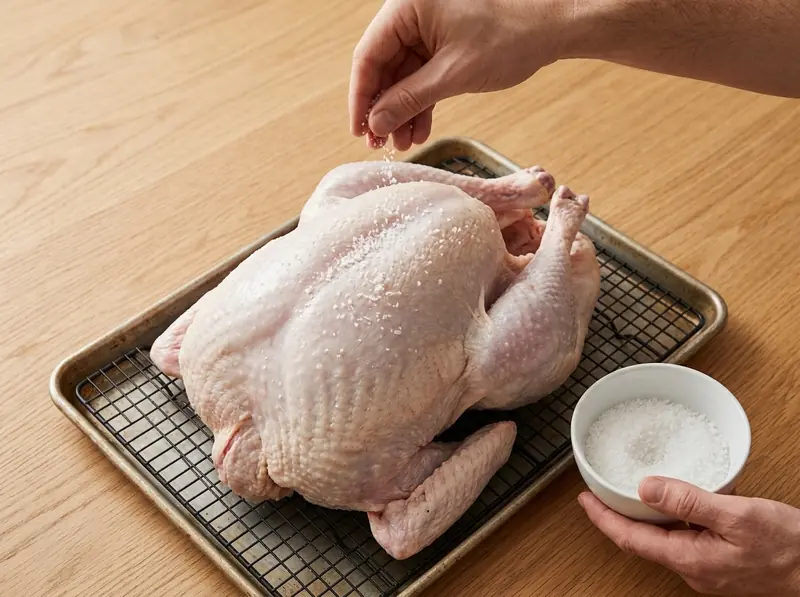
- Put the tray in the fridge and drape cling film loosely over the turkey. Take the film off for the last 12 to 24 hours so the skin can dry in the cold air; a dry skin is what crisps in the oven. By roasting day no salt grains should be visible and the skin should feel dry and tight under your fingers. Do not rinse the bird, since that only wets the skin again.
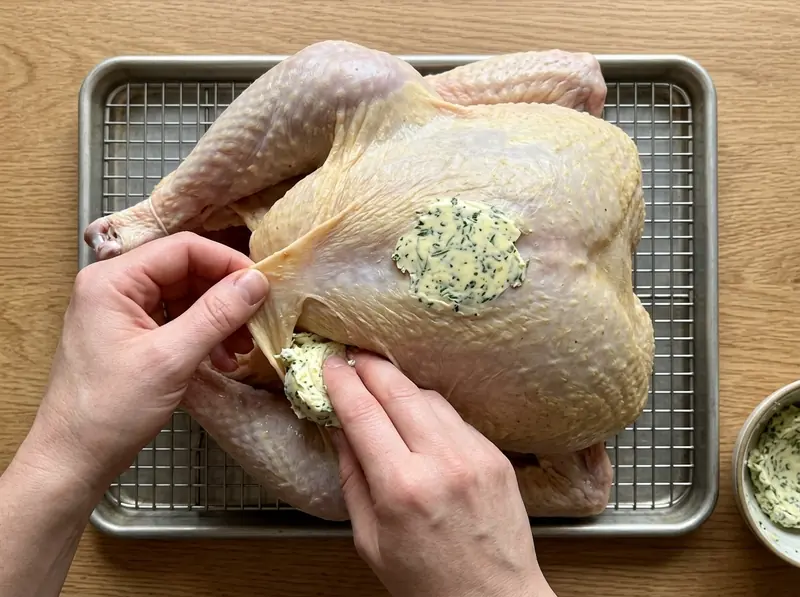
- On the day, take the turkey out of the fridge 1 hour before it goes into the oven and pat it dry one last time. Mash the soft butter with the chopped parsley, sage, thyme and pepper; add no salt, the bird has enough. Slide your fingers between the skin and the breast meat to loosen it without tearing, push about half of the butter underneath and press on the skin from outside to spread it over both breasts. Rub the rest over the outside, tuck the wing tips under the back and tie the ends of the drumsticks together with kitchen string so the bird keeps its shape and cooks evenly.
- Set an oven rack in the lowest position and heat the oven to 220°C (425°F). Cut the onion into wedges and the carrots and celery into 5 cm pieces, scatter them in a shallow roasting tin, pour in the water and stand the rack with the turkey on top, breast side up. A tin 5 to 6 cm deep is right, because high sides shield the thighs from the heat and they are the slowest part to cook. The water stops the drippings from burning on the hot metal; add another 120 ml whenever the tin looks dry.
- Roast for 30 minutes at 220°C (425°F), until the skin has started to turn golden, then turn the oven down to 165°C (325°F). For this size plan on about 2¾ hours in the oven altogether, roughly 30 minutes per kg, but treat that as an estimate: a salted bird often cooks faster than the tables say, so start measuring after 2 hours. If the breast is deep brown before the meat is ready, lay a loose sheet of foil over the breast only.
- Check the temperature in three places with an instant-read thermometer. Push it into the thickest part of the thigh, in the crease where the leg meets the body, without touching the bone: it should read 74°C (165°F). Then check the innermost part of the wing and the thickest part of the breast near the neck end, where 71 to 72°C (160 to 162°F) is enough to take the bird out, because the breast keeps heating while it rests. If the thigh is not there yet, give it another 10 to 15 minutes and measure again, and do not rely on a pop-up timer.
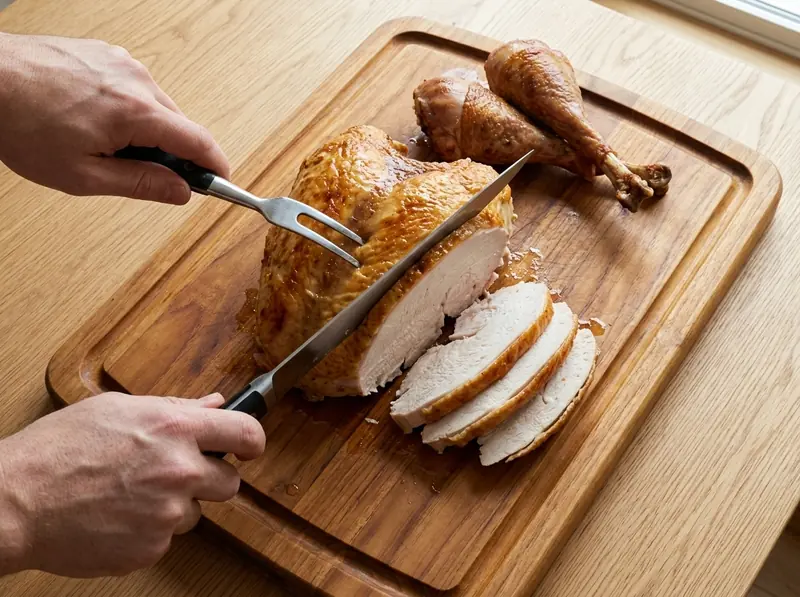
- Lift the turkey onto a board, cover it loosely with foil and let it rest for 30 minutes, and up to 1 hour if the side dishes need the oven. Measure the breast once more before carving: it should now read 74°C (165°F), and if it does not, put the bird back in the oven for 10 minutes. Strain the juices from the tin into a jug for the gravy in the mashed potatoes recipe and taste them first, since they are salty and may need diluting with stock. To carve, cut through the skin between leg and body, pull the leg outwards and cut through the joint, then separate drumstick and thigh and take off the wings. For the breast, make one deep horizontal cut just above the wing joint and slice straight down towards it, so each slice falls free.
FAQ
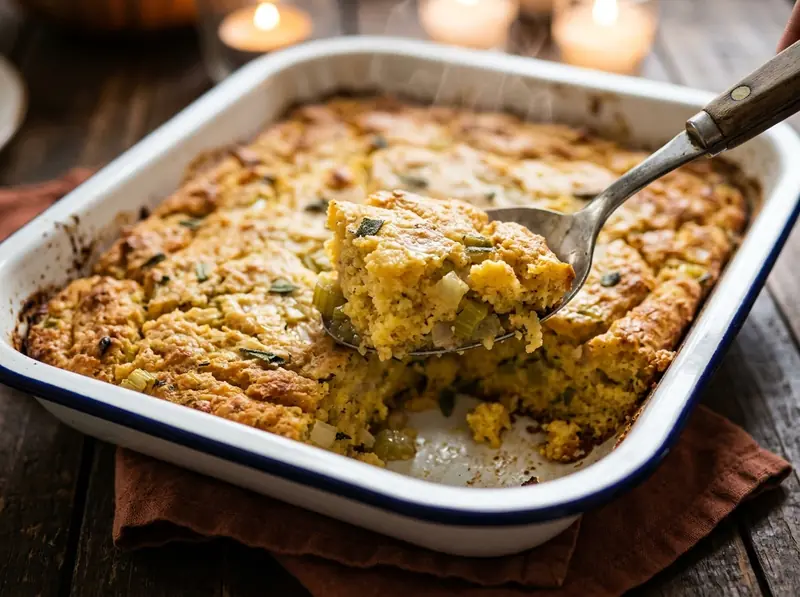
The USDA rule is 1 pound (about 450 g) of raw whole turkey per person, and Food Network counts 1 to 1½ pounds if you want leftovers for the next day. For 10 guests that means a bird of 4.5 to 6.8 kg (10 to 15 lb). The 5.4 kg (12 lb) turkey in this recipe covers 10 plates when there is cornbread stuffing and mashed potatoes next to it, with a little left for sandwiches. Remember that a bigger bird also takes longer: the USDA table gives 3¾ to 4¼ hours at 165°C (325°F) for 14 to 18 lb, against about 3 hours for 12 lb.
In a fridge at 4°C (40°F) or colder, the USDA allows about 24 hours for every 4 to 5 pounds, which is 3 days for a 12-pound bird and 3 to 4 days for 12 to 16 pounds. A thawed turkey can stay in the fridge another 1 to 2 days, and that is exactly the window the dry brine uses. If it is still hard on the morning, put it in a leak-proof bag, sink it in cold tap water and change the water every 30 minutes; allow 30 minutes per pound, so about 6 hours for 12 pounds, and cook it straight away. In that case salt it just before roasting and skip the long brine. Roasting a turkey from frozen is also safe, but it takes at least 50 percent longer.
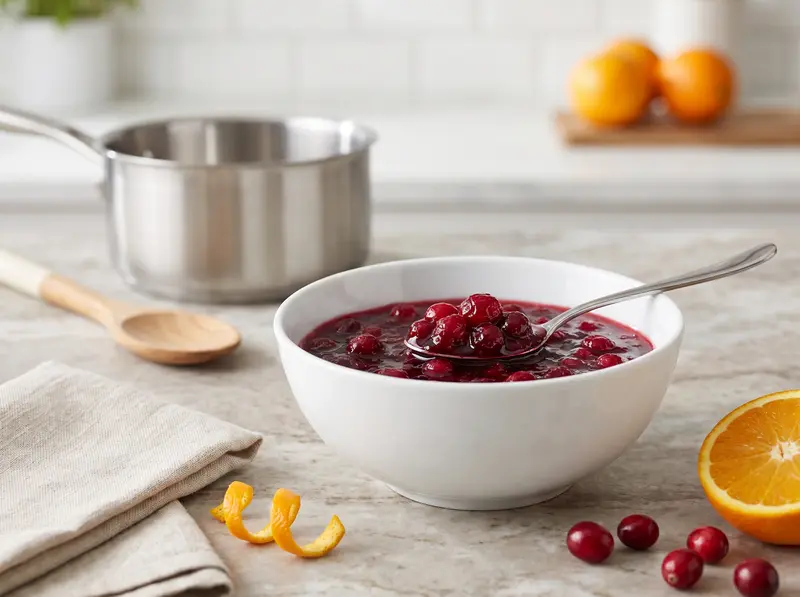
Breast and legs want different temperatures. Kenji López-Alt of Serious Eats puts the best texture for breast meat at around 66°C (150°F), while the legs do not turn tender below 74°C (165°F), so a bird roasted until the legs are done often has a breast far past its best. Three things help: salting 1 to 2 days ahead, laying foil over the breast once it is golden, and pulling the bird by thermometer instead of by time or by a pop-up timer. Then rest it for 30 minutes before carving. If the breast is already dry, slice it thin and spoon hot gravy from the mashed potatoes recipe over it; a spoonful of cranberry sauce on the plate helps as well.
Read the label first. Serious Eats points out that kosher, enhanced and self-basting turkeys have already been treated with salt and should not be brined again; with those, skip the salt and only leave the bird uncovered in the fridge overnight so the skin dries. Table salt works if you weigh it: 40 g is 40 g whatever the crystal. By the spoon it goes wrong, because King Arthur's weight chart lists a tablespoon of Diamond Crystal kosher salt at 8 g, Morton kosher at 16 g and table salt at 18 g. So 40 g is 5 tablespoons of Diamond Crystal, 2½ tablespoons of Morton or a little over 2 tablespoons of table salt.
The USDA says to discard turkey that has stood at room temperature for more than 2 hours, so take the meat off the bones soon after dinner and chill it in shallow covered containers, where it cools quickly. In the fridge it keeps 3 to 4 days; in the freezer it is best used within 2 to 6 months. To reheat, put the slices in a dish with a splash of broth or water, cover it and warm it in an oven set no lower than 165°C (325°F) until the meat reaches 74°C (165°F). Cold turkey is fine to eat as it is, for example in a sandwich with cranberry sauce.
Rate this
Recipes by email
One letter a week: a recipe picked for your taste, plus whatever is new on the site. Unsubscribe in one click.
Welcome gift: Sergei's cookbook (e-book).
By subscribing you agree to the privacy policy.
Tell us what you like to cook (30 seconds) →Keep browsing
More dishes from the American archive — picked by overlap with what you're cooking now.
Join the conversation
Comments
No comments yet — be the first!