
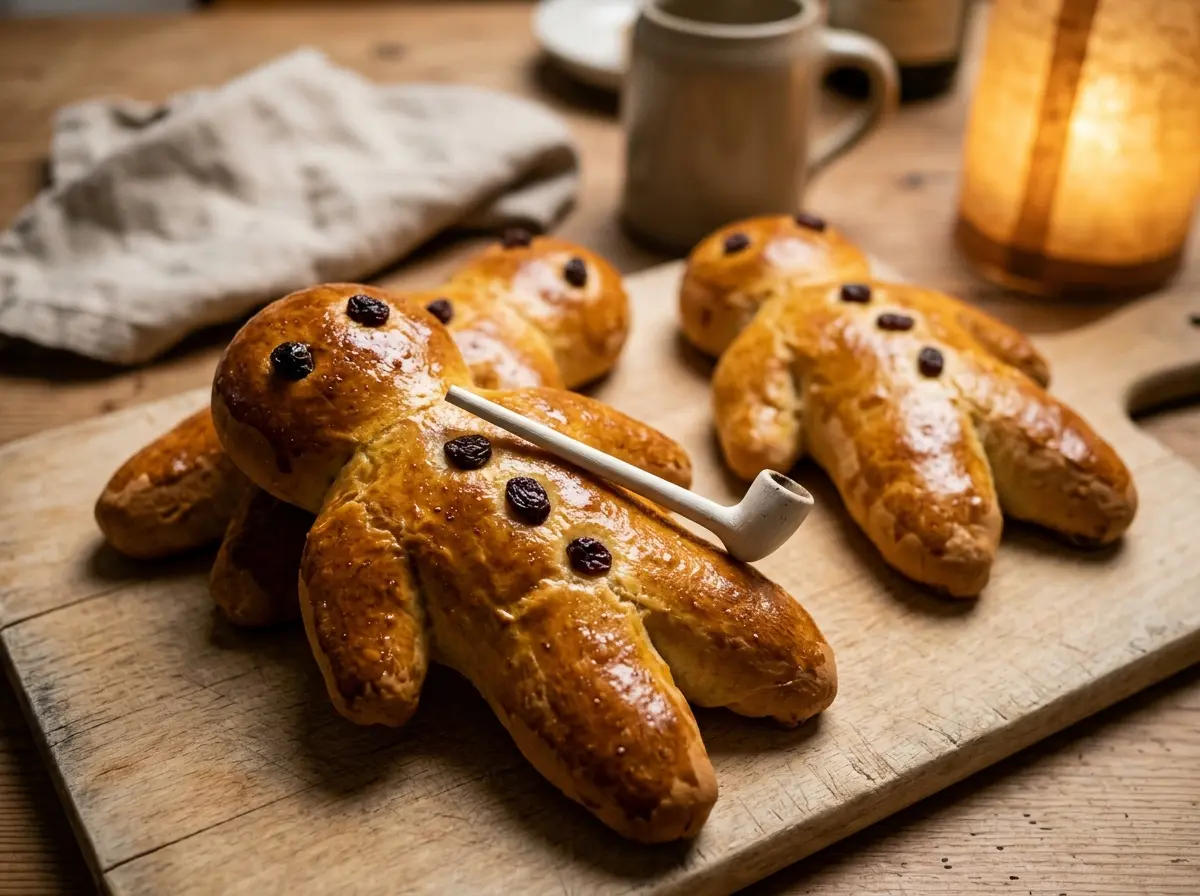
Weckmann (German St. Martin's Bread Man)
A Weckmann is a German bun shaped like a little man, made of sweet yeast dough with raisins for the eyes and buttons and often a small clay pipe tucked into one arm. In the Rhineland, Hesse and the Rhine-Neckar region children get one on St. Martin's Day, 11 November, after the lantern procession, while in many other parts of Germany it comes on St. Nicholas Day, 6 December. Westphalia and the north call it a Stutenkerl, and you will also hear Weckmännchen, Klausenmann, Hefekerl and Dambedei, or Grittibänz in Switzerland. The dough is plain milk, butter and egg with no spices, and it rises once for 30 to 45 minutes, so with a fan oven, from warming the milk to the first warm bun takes about an hour and a half.
What a Weckmann is
A Weckmann is a figure bread: a man made of sweet yeast dough, with raisin eyes and buttons and often a clay pipe. Stuten is the German word for that sweet dough and Kerl means fellow, which gives the northern name Stutenkerl, while a Wecken is a bread roll. German Wikipedia says the figure probably once showed a bishop, St. Nicholas or St. Martin. According to t-online, in the Middle Ages such breads were handed out after Mass to people who could not take communion.
Backen macht glücklich calls the dough more or less the basic German yeast dough. It is milk, butter, sugar and an egg, with no spices. It bakes soft and pale inside under a glossy golden crust.
Why a Weckmann carries a pipe
The pipe is said to be the bishop's staff turned upside down. The Goethe-Institut puts it the same way: people think the pipe was once St. Martin's staff. Nobody knows for certain how the staff became a pipe. German Wikipedia says it may date from the 17th and 18th centuries, when clay pipe making was at its height, and may have been influenced by the Reformation, as a way to make a Catholic symbol more worldly. Bakers tell a simpler story, about an 18th-century baker who ran out of little staffs and found clay pipes in the tobacco shop next door.
Not everyone uses one. The Swiss Grittibänz traditionally has no pipe, REWE notes that in some regions the Weckmann comes without a pipe or staff, and in 2018 echo24 reported that more bakeries on the Lower Rhine were leaving it off because some parents saw it as a lesson in smoking. If you add one, it is only decoration. Take it out before eating and keep it away from small children.
St. Martin's Day in the Rhineland
On 11 November children walk through the streets with lanterns and sing, sometimes led by someone dressed as St. Martin, who in the legend cut his cloak in half for a freezing beggar. In the Rhineland children are given a Weckmann after the procession. In some towns, Mit Vergnügen writes, they only get one if they share it with someone else.
German Wikipedia notes that in many places St. Martin's Day brings sweet buns shaped like geese instead, and the same dough works for those. For the grown-ups' dinner on 11 November there is our Martinsgans, the roast St. Martin's goose.
Ingredients
- 250 mlmilk
- 80 gbutter
- 500 gflour
- 7 gdry yeast
- 70 gsugar
- 0.5 tspsalt
- 1 egg
- 1 egg yolk
- 1 tbspmilk
- 15 graisins
Method
- Warm 250 ml of milk with 80 g of butter in a small saucepan over low heat, just until the butter has melted. Take the pan off the heat and let it cool to 38–40 °C, when it feels pleasantly warm on the inside of your wrist but not hot. Liquid hotter than about 59 °C kills yeast, while lukewarm milk gets it working quickly.
- In a large mixing bowl, stir 500 g of flour (plain wheat flour, type 405) together with 7 g of dry yeast, one packet of the instant kind that goes straight into the flour. Add 70 g of sugar, ½ tsp of salt, the egg and the warm milk and butter. Knead with the dough hooks of a hand mixer for about 5 minutes, first on the lowest speed and then on the highest, or knead by hand for about 10 minutes. The dough is ready when it is smooth and soft and comes away from the sides of the bowl.
- Cover the bowl with a clean tea towel and leave it somewhere warm for 30 to 45 minutes, until the dough has roughly doubled. Judge by the size of the dough rather than the clock, because a cool kitchen slows it down. While it rises, line two large baking trays with baking paper and heat the oven to 160 °C fan (180 °C top and bottom heat).
- Knead the dough briefly on a lightly floured surface and divide it into 6 pieces of 160 g each on a kitchen scale. Roll each piece into a log about 15 cm long, a little thicker at one end, and lay three on each tray with plenty of space between them, because they spread in the oven. With the side of your hand, press a neck into each log a third of the way from the thick end and round the top into a head, then flatten the body with your palm. Cut the lower half up the middle with a knife and spread the two legs slightly apart. Make a slanting cut on each side just below the head and pull the pieces out as arms. If you own a Weckmann cutter (Lecker uses one 17 cm tall), skip the dividing: roll the whole dough out 2–3 cm thick, cut out the men, knead the scraps together and roll them out again. How many you get depends on the cutter.
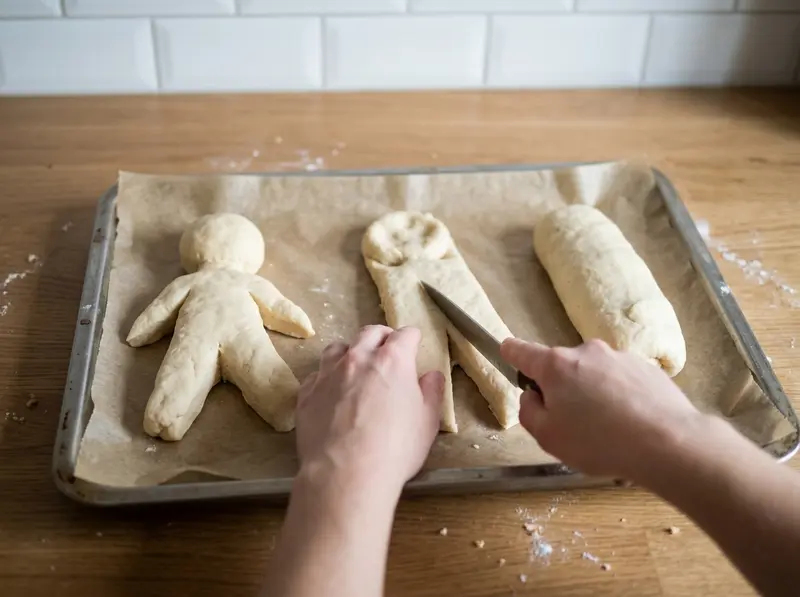
- Beat the egg yolk with 1 tbsp of milk and brush it all over the men (with top and bottom heat, only the first tray for now, see step 6), so they bake to an even shine. Press in the raisins, two for the eyes and three down the front for buttons, about 30 in all. Push each one in halfway so it stays put while the dough puffs up in the oven.
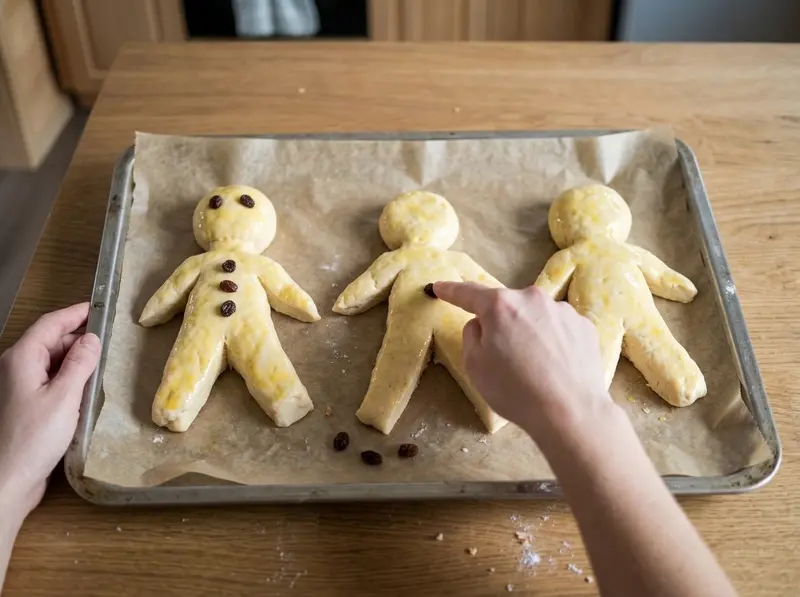
- With a fan oven, bake both trays together for 18–20 minutes. With top and bottom heat, bake one tray at a time on the middle shelf for the same time and keep the second tray covered with the tea towel on the counter, and brush it with the glaze and press in its raisins only just before it goes in. The men are done when they are golden brown and the base sounds hollow when you tap it. If you have a thermometer, the thickest part should read about 88 °C, which also tells you the egg in the dough is fully cooked. Much higher and they dry out as they cool.
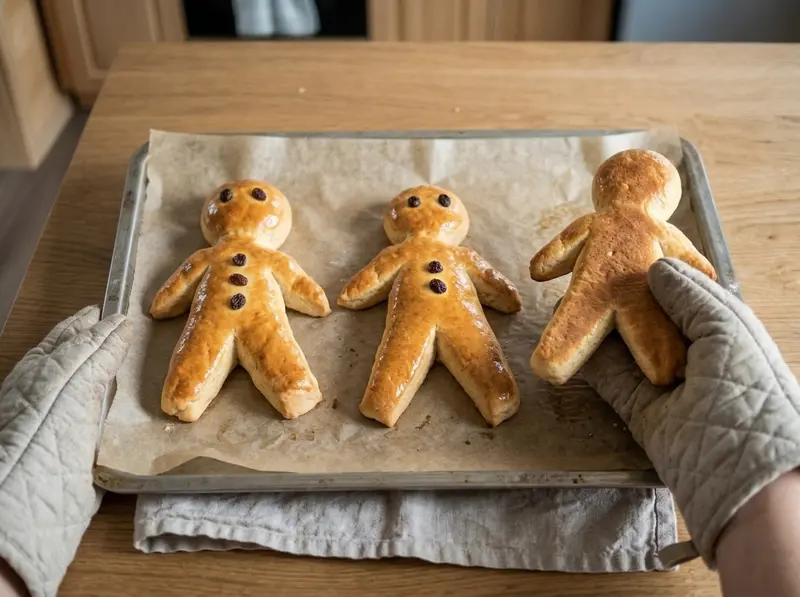
- For the traditional clay pipe, push it into one arm as soon as the tray comes out, while the bread is still warm and soft. Some German recipes press the pipe in before baking. We could not find out whether every pipe on sale can go in the oven, so this recipe adds it afterwards and it never goes in. The pipe is made of clay and can't be eaten. Take it out before anyone bites in, and leave it off for small children, who could choke on it. Let the men cool on a wire rack. They are best on the day they are baked. Once cool and well wrapped they keep for several days at room temperature, and they freeze well. After thawing, warm them briefly in the oven.
FAQ
The usual cause is milk that was too hot. King Arthur Baking notes that liquid above about 59 °C kills yeast, so let the milk and butter cool to 38–40 °C, just warm on the wrist. The second cause is tired yeast: dry yeast that sat somewhere warm loses its strength, so check the date and keep opened packets in the freezer. A cool kitchen slows things down too. The 30 to 45 minutes in the recipe are only a guide, so wait until the dough has roughly doubled, however long that takes.
Only the name. German Wikipedia gives Weckmann for the Rhineland, Saarland, the Palatinate, Hesse and Baden-Württemberg, and Stutenkerl for Lower Saxony, Schleswig-Holstein, Mecklenburg and Westphalia, where Stuten is the usual word for a sweet raisin bread. Klausenmann (after St. Nicholas), Hefekerl and Dambedei are other names, and in German-speaking Switzerland the same bun is a Grittibänz, traditionally without a pipe. A Cologne city magazine counts more than 50 names in the Rhineland alone. The day differs as well: 11 November in the Rhineland, Hesse and the Rhine-Neckar region, 6 December in many other places.
Yes. Use 21 g of fresh yeast, half a German cube, instead of the 7 g of dry yeast. King Arthur Baking converts fresh yeast to instant dry yeast by multiplying by 0.33, and 21 g is exactly what Backen macht glücklich uses for 500 g of flour. Crumble it into the milk once it has cooled to 38–40 °C, the same temperature we use for the liquid in our challah, and stir until it dissolves. If you like, pour it into a well in the flour with 1 tsp of the sugar and leave it for 15 minutes before adding everything else, as Backen macht glücklich does. Fresh yeast spoils fast: keep it in the fridge and use it within a week or two.
They taste best on the day they are baked. Once they are completely cool, wrap them well and keep them at room temperature for several days, or freeze them. After thawing, warm them briefly in the oven to bring the crust back. If you want them fresh in the morning, Dr. Oetker suggests making the dough with cold ingredients and letting it rise overnight in a covered bowl in the fridge. The next day, shape the men on the trays, cover them with the tea towel and let them rise in a warm place until they look clearly puffed. Dr. Oetker gives no time for this, and dough straight from the fridge takes longer than the 30 to 45 minutes in step 3, so go by size. Heat the oven while they rise, then glaze, add the raisins and bake as in steps 5 and 6.
The figure probably once showed a bishop, St. Nicholas or St. Martin, and the pipe is said to be his staff turned upside down. A bakers' legend tells of an 18th-century baker who ran out of little staffs and found clay pipes in the tobacco shop next door, which looked much like a staff held upside down. You can't eat the pipe, so take it out before eating, and leave it off altogether for small children, who could choke on it. We could not confirm that every pipe on sale is fit for the oven, which is why this recipe pushes it in after the men come out. In 2018 echo24, citing derwesten.de, reported that more and more bakeries on the Lower Rhine were leaving the pipe off, because some parents felt it taught children to smoke and bought the men without it.
Keep browsing
More dishes from the German archive — picked by overlap with what you're cooking now.
Recipes by email
One letter a week: a recipe picked for your taste, plus whatever is new on the site. Unsubscribe in one click.
Welcome gift: Sergei's cookbook (e-book).
By subscribing you agree to the privacy policy.
Tell us what you like to cook (30 seconds) →
Join the conversation
Comments
No comments yet — be the first!