
Pumpkin Pie
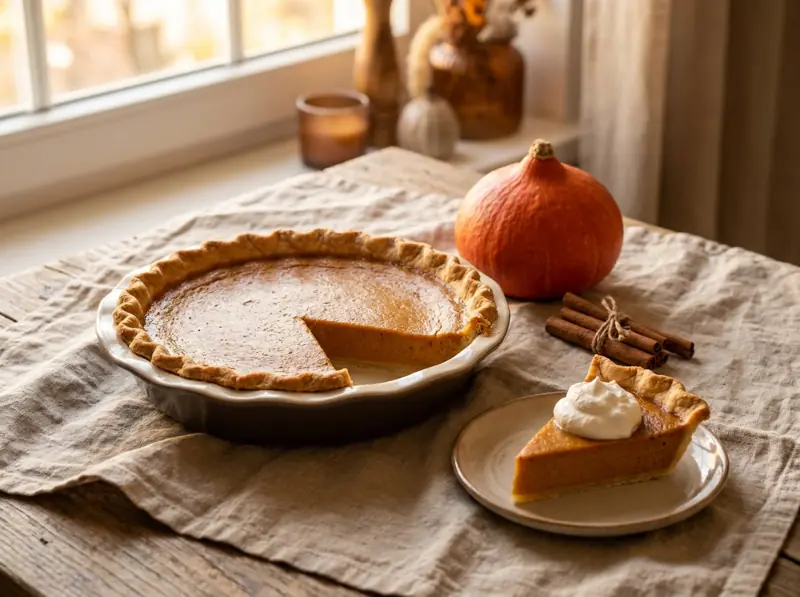
Pumpkin pie is an American custard tart: a spiced pumpkin filling baked inside a blind-baked butter crust, the standard dessert on the American and Canadian Thanksgiving table since the 19th century. The filling is a true custard, egg and dairy set by heat rather than a starch-thickened paste, which is why it needs a slow second bake and a slow cool. Warm spices, cinnamon, ginger, nutmeg and clove, carry the pumpkin rather than mask it, and dark brown sugar adds a faint molasses note under the sweetness. This version works with a can of pumpkin purée or with pumpkin roasted and blended from scratch, useful outside the US where the canned kind is hard to find. Active work is under 40 minutes; the dough needs an hour to chill and the baked pie another two to three to cool before it holds a clean slice.
Ingredients
- 190 gall-purpose flour
- 115 gcold unsalted butter
- 3 gsalt
- 45 mlice water
- 425 gpumpkin purée
- 3 eggs
- 340 gevaporated milk
- 150 gbrown sugar
- 5 gground cinnamon
- 2 gground ginger
- 1 gground nutmeg
- 1 gground cloves
- 3 gsalt
Method
- Pulse the flour (about 1½ cups) and salt in a food processor, or whisk them in a bowl. Add the cold butter cubes (115g, about 1 stick) and cut it in with the processor or your fingertips until the biggest pieces are pea-sized and the mixture looks like coarse sand — those butter flecks are what turn into flaky layers in the oven, so do not rub them in completely. Drizzle in the ice water one tablespoon at a time (about 45ml/3 tbsp total), pulsing or folding just until the dough clumps together when pressed; it should not form a smooth ball. Flatten it into a disc, wrap tightly and refrigerate for at least 1 hour, or overnight.
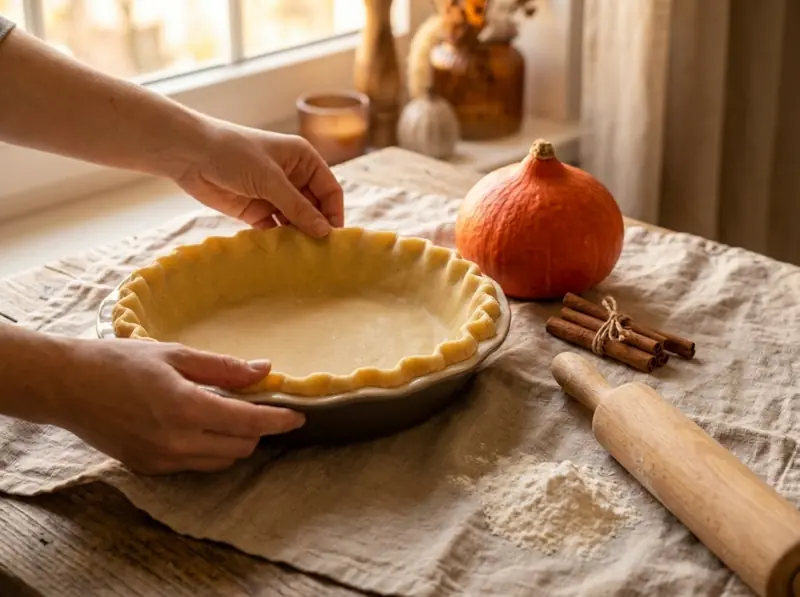
- Roll the chilled dough on a floured surface into a 30cm circle, about 3mm thick, and ease it into a 23cm (9-inch) pie dish without stretching. Trim the overhang to 2cm, fold it under itself and crimp the edge, then chill the shaped shell for 15 minutes while the oven heats to 200°C. Line the shell with parchment paper, fill it right to the rim with pie weights or dried beans, and bake for 15 minutes. Lift out the parchment and weights and bake the empty crust for 5 more minutes, until the base looks dry and pale gold rather than translucent — this is what keeps the bottom from turning soggy once the wet filling goes in.
- For homemade purée, halve a 1.5-2kg Hokkaido pumpkin or butternut squash lengthwise, scoop out the seeds, and roast cut-side down on a lined tray at 200°C for 45-60 minutes, until a knife slides into the thickest part with no resistance. Scoop the flesh from the skin, purée it smooth, then tip it into a fine sieve lined with a tea towel and let it drain for 20-30 minutes, pressing gently. Homemade purée holds noticeably more water than canned, and a filling made from undrained purée will stay loose and never fully set. If using canned pumpkin, measure 425g of plain purée, not pre-spiced pumpkin pie filling, and skip this step entirely.
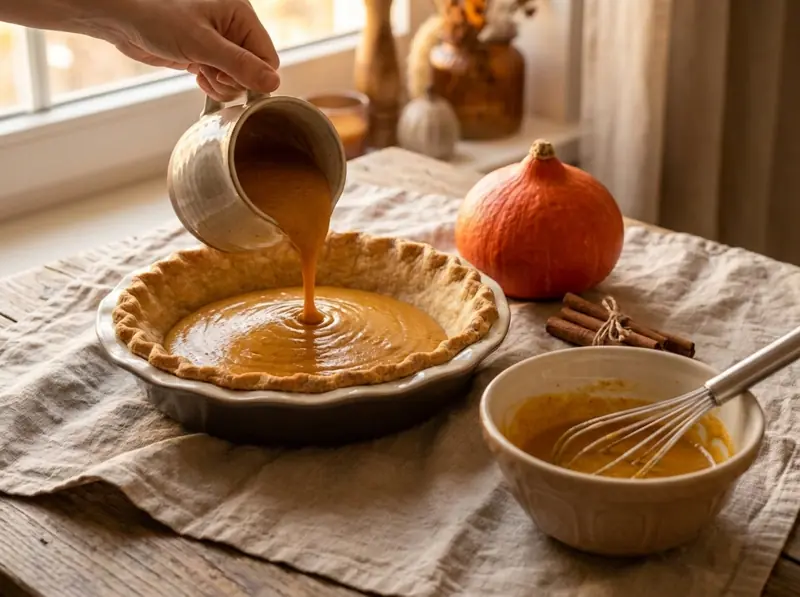
- Heat the oven to 220°C. In a large bowl, whisk the pumpkin purée with the eggs, evaporated milk, brown sugar, cinnamon, ginger, nutmeg, cloves and salt until smooth and streak-free. Whisk by hand rather than with a mixer: beating in extra air makes the custard puff up in the oven and then collapse and crack as it cools.
- Pour the filling into the warm crust and place the pie on the middle rack. Bake at 220°C for 15 minutes, then, without opening the door for longer than it takes to check, lower the heat to 175°C and continue baking for 40-50 minutes more. The initial blast of heat sets the outer ring of custard quickly, the way a professional oven does at the start, so the crust never sits soaking in raw filling for long.
- Start checking at the 40-minute mark: the filling is done when the outer 5cm is fully set and only a circle about 7-8cm across in the center still jiggles slightly when the dish is nudged, like set jelly rather than liquid. An instant-read thermometer inserted in the center should read around 80°C. Pulling the pie while that center still trembles is deliberate — pumpkin custard keeps cooking from residual heat, and the single biggest cause of a deep crack down the middle is leaving it in until the whole surface looks still, which means the eggs have already overcooked and started to weep.
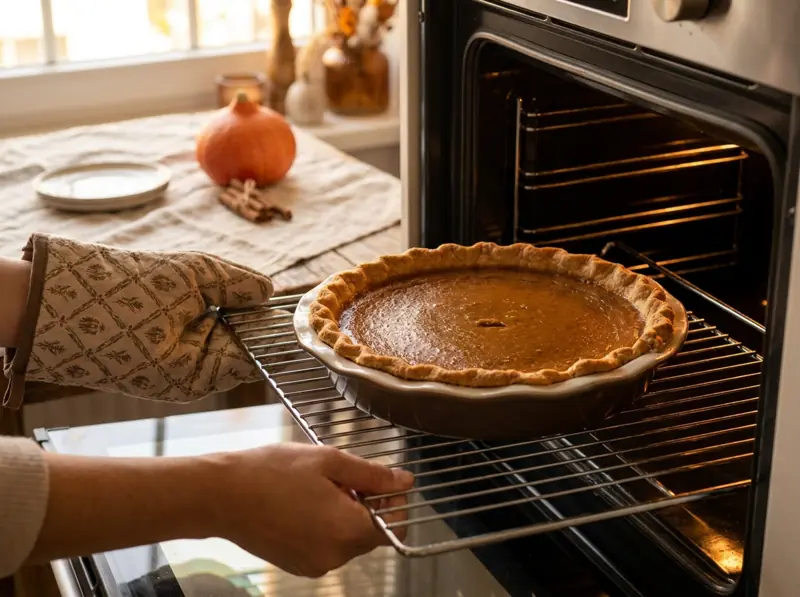
- Turn off the oven, prop the door open with a wooden spoon, and let the pie sit inside for 10 minutes before moving it to a wire rack. Cool at room temperature for at least 2 hours, then refrigerate for another hour before slicing; a pie cut warm collapses into wedges instead of clean slices. Serve chilled or at room temperature with lightly whipped, barely sweetened cream.
FAQ
Cracking almost always means the custard overcooked, either because it stayed in the oven until the whole surface stopped moving, or because the final temperature crept above 175°C. Pumpkin custard is done when only a 7-8cm circle in the center still jiggles like set jelly and an instant-read thermometer there reads about 80°C; it keeps firming up from residual heat once it is out of the oven. A second cause is too much air whipped into the filling with an electric mixer, which puffs the pie up in the oven and then collapses it as it cools. Cool the finished pie gradually, oven door propped open for 10 minutes, rather than moving it straight from a hot oven to a cold counter or the fridge.
Blind bake the empty crust fully before the wet filling goes in: 15 minutes at 200°C with pie weights, then 5 more minutes with the weights removed, until the base looks dry and pale gold instead of translucent. A dark metal or ceramic pie dish conducts heat into the bottom faster than glass or a shiny pan, which also helps. Setting the pie on a preheated baking sheet on the lowest oven rack gives the base another direct hit of heat from below during the main bake. Skipping the second, weight-free stretch of blind baking is the most common reason the bottom stays pale and underbaked under a wet filling.
Yes, Hokkaido pumpkin (kabocha) or butternut squash both work well and are the easiest substitute where canned pumpkin purée is hard to find. Halve the squash, scoop out the seeds, and roast it cut-side down at 200°C for 45-60 minutes until a knife meets no resistance in the thickest part, then purée the flesh until smooth. Homemade purée holds noticeably more water than the canned kind, so drain it in a fine sieve lined with a tea towel for 20-30 minutes before measuring; skipping this step leaves the custard loose and unable to set fully. Use 425g of drained purée to match the amount in one standard can.
Mix 170ml heavy cream with 170ml whole milk to replace the 340g of evaporated milk; together they match its fat content and concentrated dairy flavor without a tinned taste. Do not swap in sweetened condensed milk without cutting the sugar by roughly two-thirds, since it is already sweetened and syrup-thick, or the filling turns cloying. For a dairy-free version, light coconut milk works, though it shifts the flavor slightly and sets a little softer, so add one extra egg yolk to firm it back up. Whichever you use, keep the total liquid at 340g so the custard-to-liquid ratio, and the bake time, stay the same.
Bake it up to 2 days ahead: cool it completely, cover, and refrigerate, and the spice flavor actually deepens by the second day. The fully baked pie also freezes well for up to 1 month wrapped tightly in foil; thaw it overnight in the fridge and let it sit at room temperature for an hour before serving. The empty, blind-baked crust freezes separately for up to 3 months if you want to split the work over two sessions. Do not freeze the raw, unbaked custard on its own, since the eggs and dairy separate on thawing and the texture turns grainy once baked.
Rate this
Recipes by email
One letter a week: a recipe picked for your taste, plus whatever is new on the site. Unsubscribe in one click.
Welcome gift: Sergei's cookbook (e-book).
By subscribing you agree to the privacy policy.
Tell us what you like to cook (30 seconds) →Keep browsing
More dishes from the American archive — picked by overlap with what you're cooking now.

Join the conversation
Comments
No comments yet — be the first!