
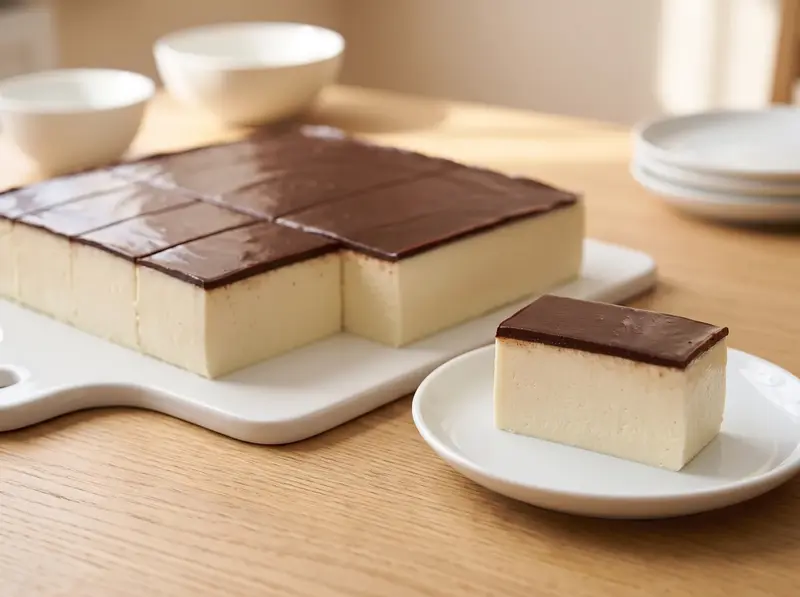
Ptichye Moloko (Bird's Milk Cake)
An iconic Russian confection: an airy soufflé made from a custard-butter cream folded into stiff meringue and set with gelatin, covered with a glossy dark chocolate glaze. Light, almost cloud-like in texture, it is one of the most beloved Soviet-era desserts.
Ingredients
- 200 mlmilk
- 100 gsugar
- 20 gflour
- 4 eggs
- 100 gbutter
- 200 gsugar
- 1 tspvanilla extract
- 15 ggelatin
- 100 gdark chocolate
- 50 gbutter
Method
- Soak gelatin in cold water for 10–15 minutes, then heat gently until fully dissolved. Cool to warm.

- Separate eggs. Mix yolks with the first 100 g of sugar and the flour. Bring milk to a boil, pour into yolks in a thin stream, whisking. Return to heat and cook, stirring, until thickened like condensed milk. Cool completely. Beat softened butter until white and fluffy, then gradually beat in the cooled custard. Add vanilla.

- Beat egg whites to stiff peaks. Gradually add the remaining sugar (200 g), continuing to beat until glossy and firm. Pour in the dissolved gelatin in a thin stream, beating constantly.

- Gently fold the butter-custard cream into the meringue in several additions using a spatula, working from bottom to top to preserve the airiness.

- Pour into a mould and smooth the surface. Refrigerate 2–3 hours until set.

- Melt chocolate with butter. Pour over the set soufflé, smooth, and chill 30 more minutes. To slice cleanly, use a hot dry knife, wiping after each cut.

FAQ
Nine times out of ten it is the gelatin. It has to be fully melted, with no grains left, and poured into the meringue while still warm and liquid; gelatin that has cooled and begun to gel goes in as lumps and never binds the rest. Too-hot gelatin is the opposite problem: it deflates the whites, and a collapsed meringue reads as runny too. Whip the whites to stiff peaks before the sugar goes in, keep the mixer running while you pour, and give the mould a full 2 to 3 hours in the fridge. This soufflé does not rise in the oven; it firms up in the cold.
The classic Soviet recipe uses agar-agar (2–4 g per 250 ml liquid), which gives a denser, more stable texture. Modern versions often use gelatin (10–15 g) for a softer consistency. If using gelatin, do not boil the mixture after adding it — heat destroys its gelling ability. Agar sets at room temperature, gelatin requires refrigeration.
Chocolate seizes (turns grainy and thick) when moisture gets into it. Always melt chocolate in a completely dry bowl over a water bath, making sure no steam enters. Add 1–2 tbsp of butter or cream to make the glaze smooth and glossy. Pour the warm glaze over the chilled (but not frozen) souffle for an even coat.
Yes. Replace the whipped whites with 200 ml of well-chilled coconut cream or aquafaba (the liquid from a can of chickpeas), whipped to stiff peaks. Keep the same amount of sugar and gelatin, and pour the gelatin in warm, in a thin stream, just as in the main recipe. Skip the yolks in the custard: cook the flour with the milk into a thick paste, cool it, then beat it into the butter. The texture comes out a little airier and less dense. Chill 2–3 hours to set.
Store Bird's Milk cake in the refrigerator, covered with cling film or in an airtight container, for up to 5 days. The cake can be frozen (without the chocolate glaze) for up to 1 month — thaw in the refrigerator overnight. Do not leave the cake at room temperature for more than 2 hours, especially in warm weather.
Rate this
Recipes by email
One letter a week: a recipe picked for your taste, plus whatever is new on the site. Unsubscribe in one click.
Welcome gift: Sergei's cookbook (e-book).
By subscribing you agree to the privacy policy.
Tell us what you like to cook (30 seconds) →Keep browsing
More dishes from the Russian archive — picked by overlap with what you're cooking now.
Join the conversation
Comments (1)
Ingredient temperature matters for ptichye moloko, just not the way you'd think. The milk gets boiled for the custard, but the butter must be soft at room temperature or it won't beat into a smooth cream, and the whites whip best from a cold bowl. Cold butter is where most grainy versions go wrong.