Germany · Flour and Confectionery Products
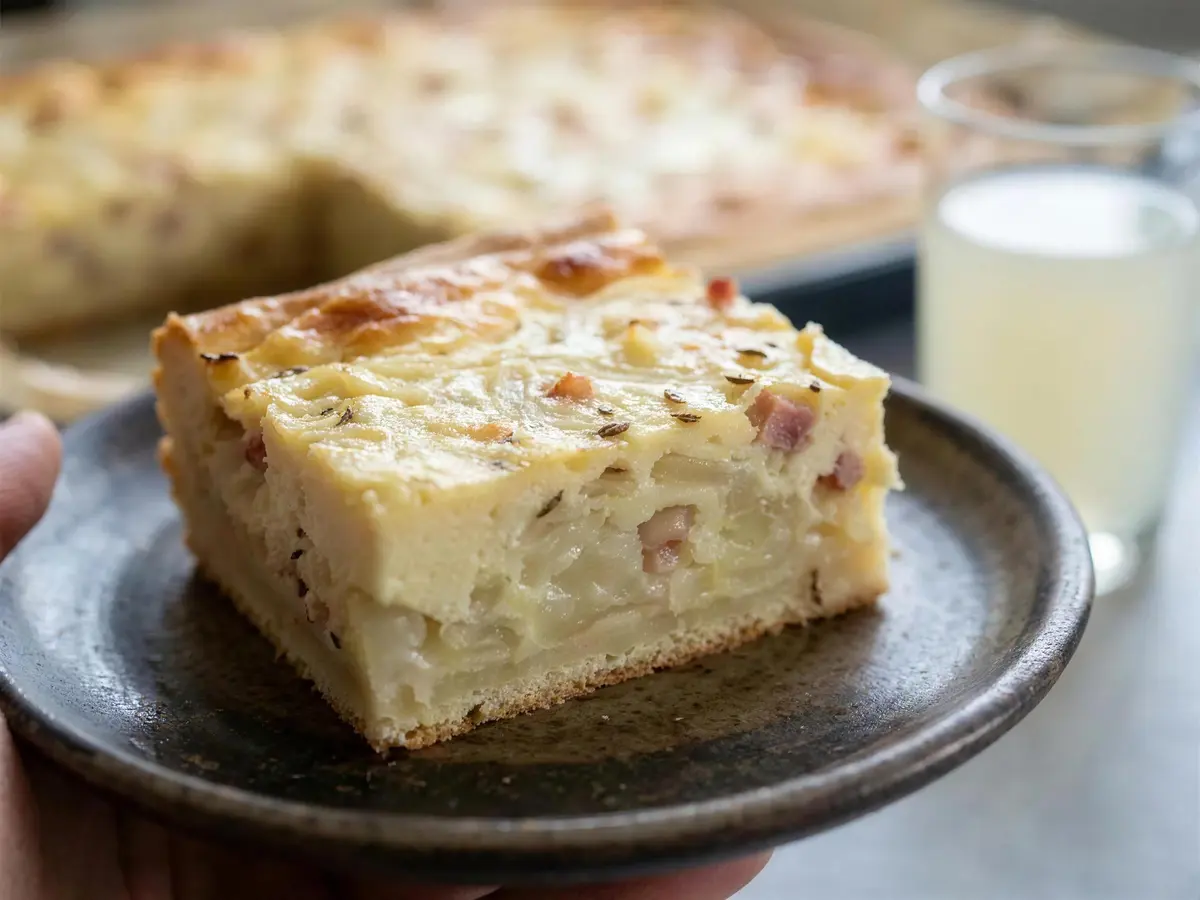
Zwiebelkuchen (German Onion Tart)
Zwiebelkuchen is a savoury onion tart from the wine villages of southern Germany (Swabia, the Palatinate, Baden, Franconia), eaten through September and October with Federweisser, the cloudy young wine that is still…
Ingredients
- flour400 g
- milk250 ml
- dry yeast7 g
- butter60 g
- sugar1 tsp
- salt2.5 tsp
- onion1.2 kg
- bacon150 g
- vegetable oil2 tbsp
- sour cream250 g
- eggs3
- caraway seeds2 tsp
- semolina2 tbsp
- black pepper0.5 tsp
Method
- 1Warm the milk to about 35°C, finger-warm and no hotter, or the yeast dies before it starts. Stir in the dry yeast with the sugar and leave it five minutes until the surface turns foamy. Add the flour, the soft butter and 1 tsp of the salt, then knead for eight to ten minutes until the dough stops sticking to your hands and springs back when you press it. Cover the bowl and leave it somewhere warm for about an hour, until it has doubled.
- 2Peel the onions, halve them and slice into half-rings about 4 mm thick. Resist chopping them finer than that: small dice turns to puree in the oven and the tart loses the texture that makes it worth eating. The 1.2 kg looks absurd piled in a bowl, and it will cook down to less than half.
- 3Cut the smoked streaky bacon into short strips and render it in the oil in a large (28–30 cm) lidded frying pan or wide pot over medium heat for three or four minutes, until the fat runs clear. Tip in the onions with 1 tsp salt, put a lid on and let them steam for ten minutes so they give up their water. Take the lid off and carry on for another fifteen to twenty minutes over medium-low heat, stirring now and then, until they have collapsed to half the volume and are completely soft but still pale. Colour is the enemy here: browned onions turn sweet and faintly bitter, and that flavour walks over everything else in the tart.
- 4Spread the onions on a cold plate or tray and leave them until they are no warmer than your hand, roughly twenty minutes. Warm filling softens the butter in the raw dough and steams it from underneath, and that one shortcut is behind most wet-bottomed onion tarts. If liquid has pooled under the onions, pour it off rather than stirring it back in.
- 5Lightly oil a 30×40 cm sheet pan (this oil is extra to the 2 tbsp in the list). Knock the dough back, roll it out on a floured surface and lift it into the pan, pressing it into the corners and up the sides to make a rim about 2 cm high. Scatter the semolina evenly over the base, where it will drink up whatever liquid gets through and keep the dough dry. Leave it to rest fifteen minutes while the oven heats to 200°C, conventional heat, with the rack in the lowest position.
- 6Whisk the sour cream with the eggs, the caraway, the remaining ½ tsp salt and the pepper until smooth. Fold in the cooled onions and bacon; the mixture should be thick enough that a spoon leaves a trail, with far more onion than custard. Spread it over the dough right up to the rim in an even layer about 1–1.5 cm deep.
- 7Bake on the lowest rack for thirty-five minutes. It is done when the custard no longer wobbles in the centre, the onion tips have taken a little colour and the underside of the dough is properly brown. Lift a corner with a palette knife and look, since the top tells you nothing. Let it stand fifteen minutes before cutting, otherwise the filling slides off the slice, and serve it warm rather than piping hot. Straight from the oven the caraway and the onion are still shouting over each other.