
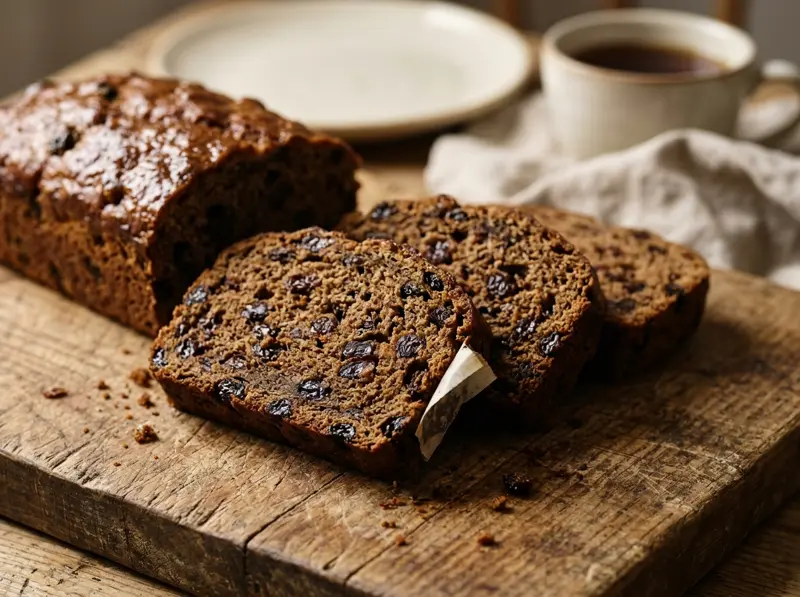
Barmbrack (Irish Halloween Fruit Bread)
Barmbrack is the Irish Halloween fruit loaf: a dense, lightly spiced bread packed with raisins soaked overnight in tea and a splash of whiskey, with a ring traditionally hidden inside. In Irish it is bairín breac, the speckled loaf, and in English it is often shortened to brack. This is a tea brack, raised with baking powder instead of yeast, which is how most of the Irish recipes we read make it at home, Darina Allen's Ballymaloe brack and Donal Skehan's among them. Start two days ahead: the raisins soak overnight, the loaf bakes for about an hour, cools completely and rests wrapped for a day before you slice it.
What barmbrack is
Barmbrack is a fruit loaf. Ireland's government website translates its Irish name, bairín breac, as "speckled loaf": bairín means loaf and breac means speckled, after the dried fruit that freckles every slice. The English word barm may come from somewhere else, the froth of fermenting ale once used as yeast, called beorma in Old English. The same website calls it the traditional Halloween dish and says Irish people have made it for centuries on the Eve of Samhain, 31 October, as a way to tell the future.
It is sweeter than ordinary bread but not as rich as a cake, dense and moist with fruit, and usually eaten buttered, with a cup of tea.
Tea brack or yeasted brack
The older barmbrack is a yeast bread. In Darina Allen's version, 450 g of flour is mixed with milk, butter, sugar, an egg, sultanas, currants and candied peel, left to double, kneaded again and risen once more in two loaf tins before baking. The tea brack skips the yeast: the fruit soaks overnight in tea, and baking powder or self-raising flour does the rising. King Arthur Baking describes this quicker loaf as just as popular in Ireland as the yeasted one.
Not everyone agrees they are the same thing. One Irish food blogger insists that a real Halloween barmbrack is the yeast bread and that tea bracks are tea cakes, eaten all year round. Most of the Irish recipes we read, though, make the tea version at home. It is also the easier one to get right, because there is nothing to knead and no dough to wait for, and the loaf keeps for days.
The ring in the brack
The fortune-telling is the point of a Halloween brack. A ring meant a wedding within the year and a coin meant money. A pea, a stick, a rag and a bean all meant some kind of bad luck in love or money. Clemson Extension notes that the same objects were hidden in champ and colcannon, Ireland's mashed potato dishes. Today most bracks hold only a ring or a coin, and in Ireland, Wikipedia notes, shop-bought Halloween bracks still contain a toy ring but none of the other objects.
If you hide a ring, wrap it in baking paper, tell everyone before the first slice is cut, and leave it out when small children are eating. A hidden object is a choking hazard for anyone who doesn't expect it, and a bite on metal can break a tooth. If the ring hasn't turned up by the end of the meal, it is still in the loaf, so find it before the rest is put away.
Ingredients
- 375 graisins
- 250 mlblack tea
- 50 mlwhiskey
- 125 gbrown sugar
- 1 egg
- 225 gflour
- 2 tspbaking powder
- 0.75 tspcinnamon
- 0.25 tspnutmeg
- 0.25 tspsalt
- 10 gbutter
- 1 tbsphoney
Method
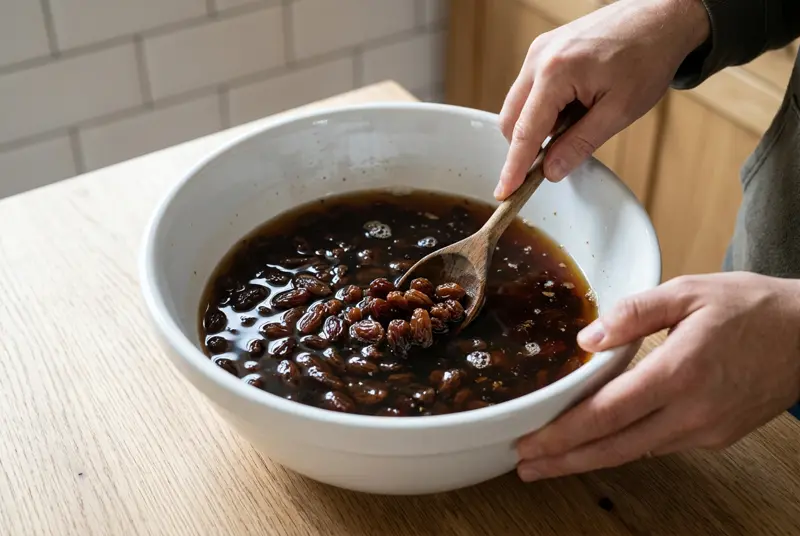
- Start the evening before. Brew 250 ml of strong black tea (Irish or English Breakfast) and pour it, still hot, over the 375 g of raisins in a large mixing bowl. Add the 50 ml of whiskey, stir, cover the bowl with a plate and leave it at room temperature overnight, or for at least 3 hours if you are short of time. By morning the raisins should be swollen and soft and most of the liquid soaked up. Fruit that has drunk its fill of tea is what keeps the loaf moist.
- The next day, heat the oven to 170 °C with top and bottom heat (150 °C on a fan oven) and set a shelf in the middle. Grease a 900 g (2 lb) loaf tin, about 23 × 13 cm and 7 cm deep, with the 10 g of butter and line the base and sides with baking paper so it lies flat against the tin. The batter is sticky with sugar and fruit, and the paper lets you lift the loaf out in one piece.
- Beat the egg in a cup. Stir it and 125 g of brown sugar (a light one) into the soaked raisins, together with all the tea and whiskey left in the bowl. Set a sieve over the bowl and sift in 225 g of flour (plain, all-purpose), 2 tsp of baking powder, ¾ tsp of ground cinnamon, ¼ tsp of ground nutmeg and ¼ tsp of salt. Stir with a wooden spoon only until no dry flour shows. You want a thick, wet batter that drops heavily off the spoon, with no dry pockets at the bottom of the bowl. Sifting breaks up lumps, so the baking powder and spices spread evenly through the batter.
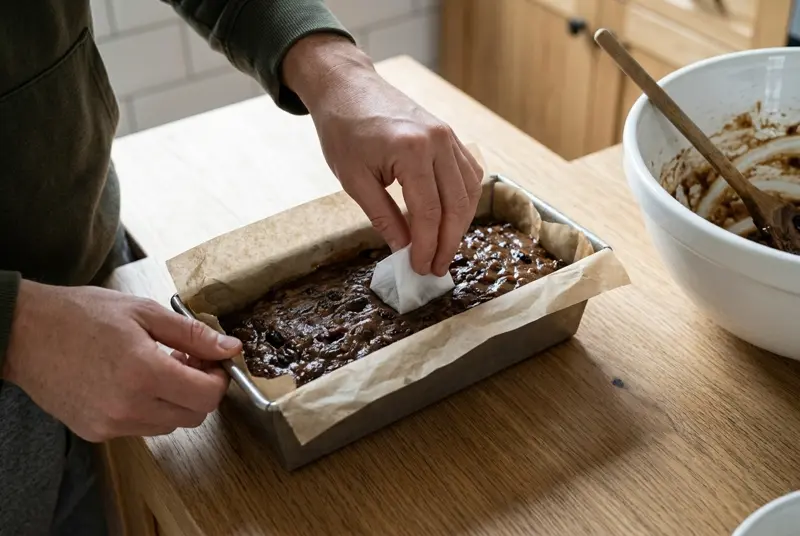
- Scrape the batter into the tin and level the top. If you want to keep the Halloween tradition, wash a plain ring, wrap it in a small square of baking paper, push it down into the batter and smooth the surface over it so no paper shows. A hidden ring is a choking hazard for anyone who doesn't know it is there, and biting down on metal can break a tooth, so tell everyone before you slice. When small children are going to eat the brack, leave the ring out.
- Bake on the middle shelf for 60 minutes. The loaf is ready when it has risen, the top is deep brown and firm, and a skewer pushed into the centre comes out clean, without wet batter on it. If batter still clings to the skewer, cover the top loosely with foil so it doesn't darken further, bake for another 10 minutes and test again. Keep baking in 10-minute steps until the skewer comes out clean: the egg in the batter has to be cooked through.
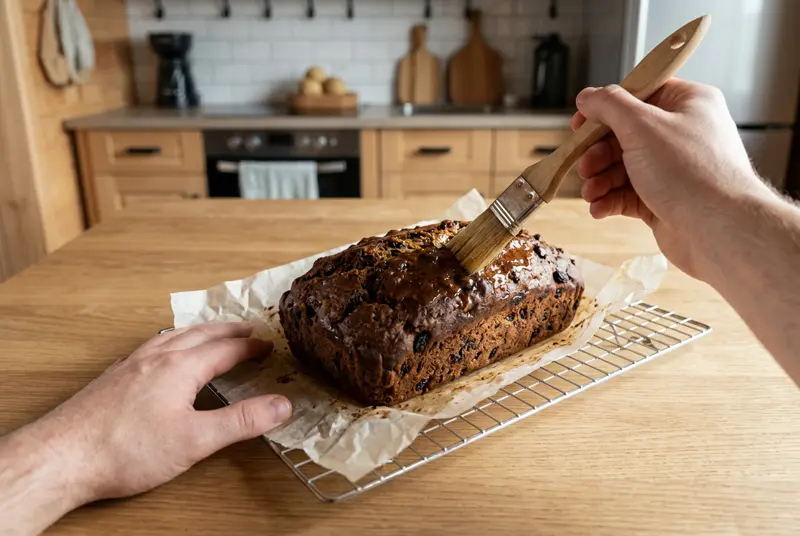
- Leave the loaf in the tin for 5 minutes, then lift it out by the paper onto a wire rack and peel the paper away. While it is still warm, brush the top with the 1 tbsp of honey, which gives it a glossy, slightly sticky crust. Let it cool completely, until it is cold to the touch all the way through. A brack sliced warm is gummy inside.
- Wrap the cold loaf tightly in cling film and then in foil, and leave it at room temperature for a day before you cut it. Donal Skehan leaves his brack wrapped for one to two days before cutting, and after a day the crumb has settled and slices more cleanly.
- If you baked a ring into it, tell everyone at the table before you cut the brack, so they bite carefully and check their slice. With a bread knife, cut it into 12 slices about 2 cm thick. If nobody has found the ring, it is still in the loaf: find it before you wrap the rest, or tell whoever eats the leftovers. Wrapped well, the brack keeps at room temperature for up to 3 days, and for longer in the freezer. Once it starts to dry out, toast the slices.
FAQ
Usually it came out of the oven too soon or was cut too early. Test it with a skewer in the very centre after 60 minutes at 170 °C: it has to come out clean, without wet batter. If it doesn't, cover the top with foil, give it another 10 minutes, and repeat until the skewer comes out clean. King Arthur warns that a tea brack sliced while still warm turns gummy, so let it cool right through. Better still, wrap it and leave it for a day before slicing, as Donal Skehan does.
Yes. Replace the 50 ml of whiskey with 50 ml more strong black tea, so the raisins soak in 300 ml of tea in total. That is how Clemson Extension adapts its barmbrack, and Donal Skehan says you can drop the whiskey if you like. If small children are eating it, leave out the ring as well. The honey glaze goes on after baking, so leave it off for babies under one year old.
Ireland's government website lists the old meanings: a ring means you will marry within the year, a coin means good fortune, a pea that you won't marry that year, a stick an unhappy marriage or quarrels, a rag bad luck or poverty, and a bean a future without money. Today most bracks hold only a ring or a coin. If you add one, wash it, wrap it in a small square of baking paper, as Darina Allen wraps her charms, and push it into the batter once it is in the tin. Clemson Extension points out that a hidden object is a choking hazard for anyone who doesn't know about it. Biting on metal can also break a tooth, so tell everyone before you slice, and bake the brack without the ring when small children are at the table.
Not by swapping the flour one for one. Darina Allen publishes a separate gluten-free brack with its own proportions: 175 g rice flour, 50 g cornflour, 1 tsp xanthan gum and 1½ tsp gluten-free baking powder, with 305 g dried fruit soaked overnight in 200 ml tea, 150 g soft brown sugar, 1 egg and 3 tbsp milk. She bakes it in a 1 kg (2 lb) tin at 180 °C for about 1¼ hours, until a skewer comes out clean. Use that recipe as it is written rather than adapting this one.
Wrapped in cling film and foil, it keeps at room temperature for up to 3 days, and you can freeze it for longer. If the ring hasn't turned up yet, find it before you put the rest away, or warn whoever eats it. In Ireland it is cut into thick slices, spread with butter and eaten with a cup of tea. Once it starts to go stale, toast the slices, which is how Darina Allen suggests using up the last of a brack. If you are cooking an Irish supper the same evening, a pot of Irish stew and a brack for afterwards make a simple menu.
Keep browsing
More dishes from the Irish archive — picked by overlap with what you're cooking now.

Recipes by email
One letter a week: a recipe picked for your taste, plus whatever is new on the site. Unsubscribe in one click.
Welcome gift: Sergei's cookbook (e-book).
By subscribing you agree to the privacy policy.
Tell us what you like to cook (30 seconds) →
Join the conversation
Comments
No comments yet — be the first!