
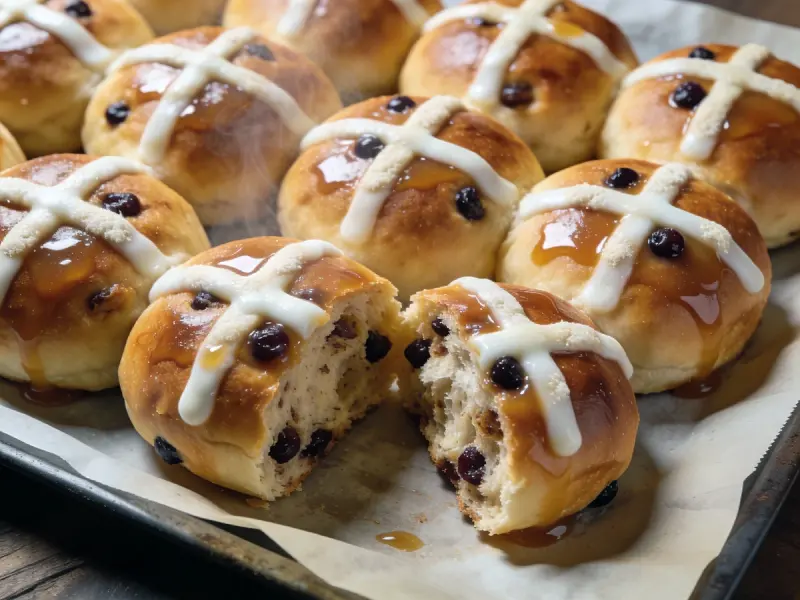
Hot Cross Buns
Hot cross buns go back to 14th-century England — a monk at St Albans Abbey made spiced, fruit-studded sweet buns with a cross cut into the top and gave them to the poor on Good Friday. The cross meant something then. Now they mean spring, and they still smell extraordinary coming out of the oven. The dough is enriched with butter, eggs, and warm milk; spiced with cinnamon, allspice, and nutmeg; and loaded with plumped currants and orange zest. The cross is piped on with a simple flour paste before baking, then the finished buns get a sticky apricot glaze and an icing cross on top. Eat them warm, split and buttered, with tea.
Ingredients
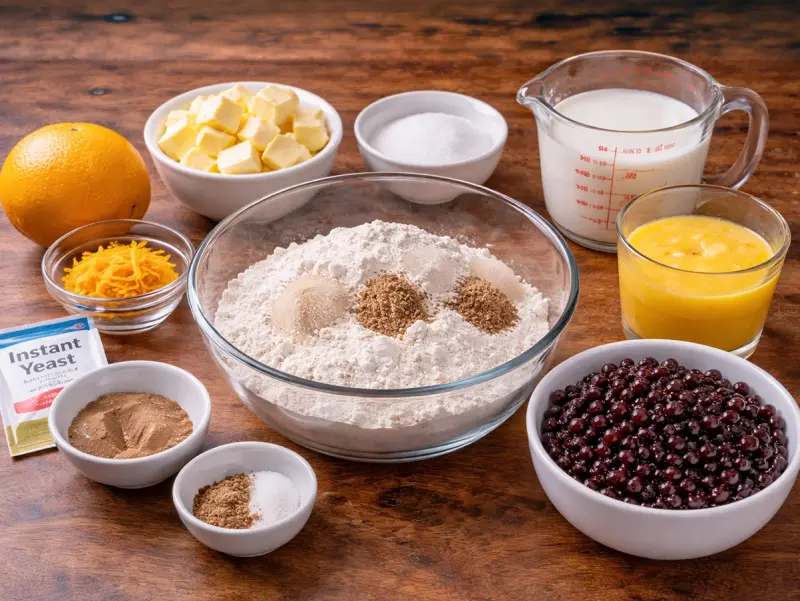
- 500 gstrong white bread flour
- 7 ginstant yeast
- 75 gcaster sugar
- 1 tspfine salt
- 1.5 tspground cinnamon
- 1 tspground allspice
- 0.5 tspground nutmeg
- 75 gunsalted butter
- 2 large eggs
- 200 mlwhole milk
- 1 orange
- 150 gcurrants or raisins
- 4 tbspplain flour
- 3 tbspapricot jam
- 100 gicing sugar
- 1 tbspmilk or orange juice
Method
- Make the dough and first rise. Put the bread flour, yeast, sugar, salt, and spices into the bowl of a stand mixer and stir briefly to combine. Add the softened butter in small pieces and rub it into the flour with your fingers until the mixture looks like coarse sand — this takes 2 to 3 minutes and coats the flour in fat, which gives the buns their tenderness. Add the beaten eggs, warm milk, and orange zest. Mix with the dough hook on medium speed for 8 to 10 minutes, until the dough is smooth, elastic, and pulls away cleanly from the bowl sides. It will feel soft and slightly tacky — that is correct. Tip the dough into a lightly oiled bowl, cover with cling film, and leave somewhere warm to double in size. This takes 1 to 1½ hours depending on the temperature of your kitchen. While the dough rises, soak the currants in hot water for 10 minutes, then drain them and pat them dry.
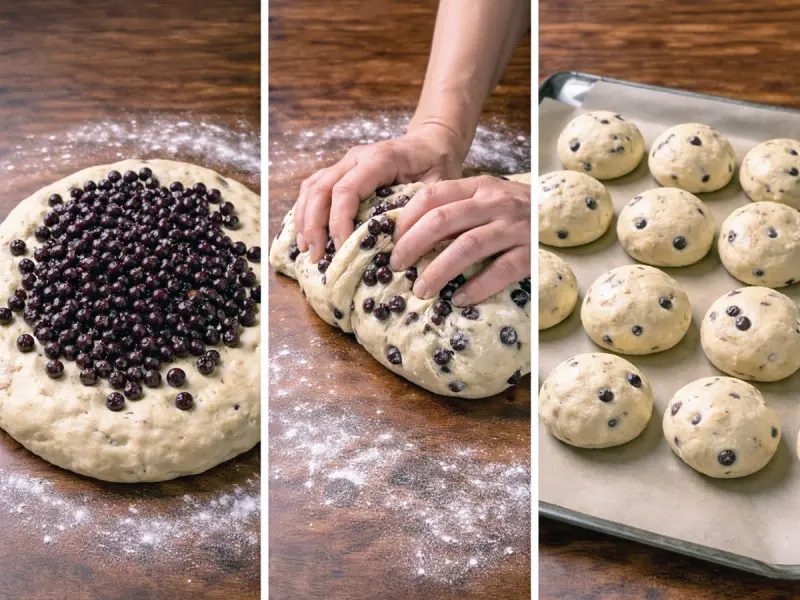
- Add the fruit and shape. Once the dough has doubled, punch it down gently to release the air. Scatter the soaked, dried currants over the dough and knead them in by hand on a lightly floured surface for 2 to 3 minutes until evenly distributed. Try not to add extra flour if you can help it — the dough becomes easier to work with as the currants break up the stickiness. Divide the dough into 12 equal pieces, about 85 g each. To shape each bun: cup your palm over the piece of dough and roll it against the surface in small, tight circles, pressing down gently. The dough should feel taut on top. Place the buns on a baking tray lined with parchment, spaced about 2 cm apart — they'll grow into each other as they proof, which gives the characteristic soft, pull-apart sides.
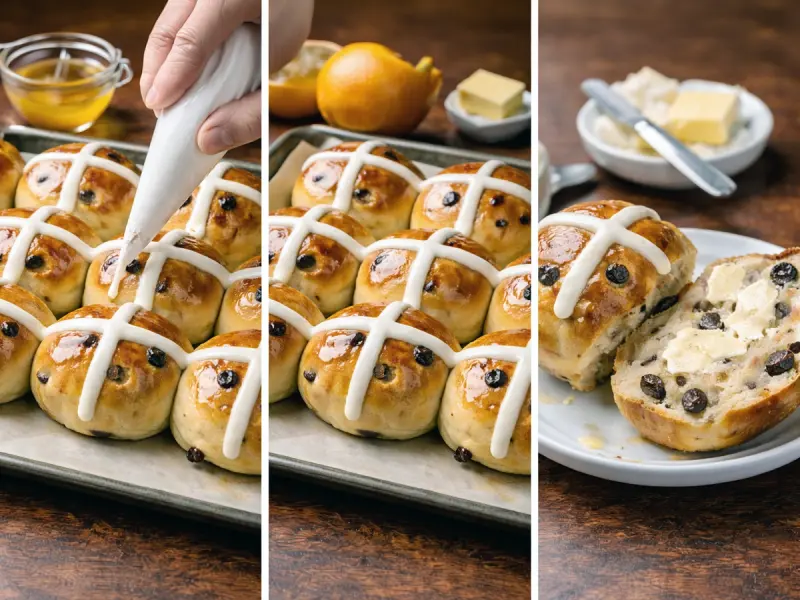
- Second rise and cross paste. Cover the shaped buns loosely with a damp tea towel or oiled cling film and leave to prove again for 45 minutes to 1 hour until they're visibly puffed and almost touching. Meanwhile, mix 4 tablespoons of plain flour with enough water (about 4 to 5 tablespoons) to make a thick, smooth, pipe-able paste — about the consistency of toothpaste. Transfer to a piping bag or a zip-lock bag with a corner snipped. Preheat the oven to 200°C (fan 180°C). When the buns are proved, pipe a continuous line down each row, then across, to make crosses. The paste will hold its shape in the oven and turn a light golden color.
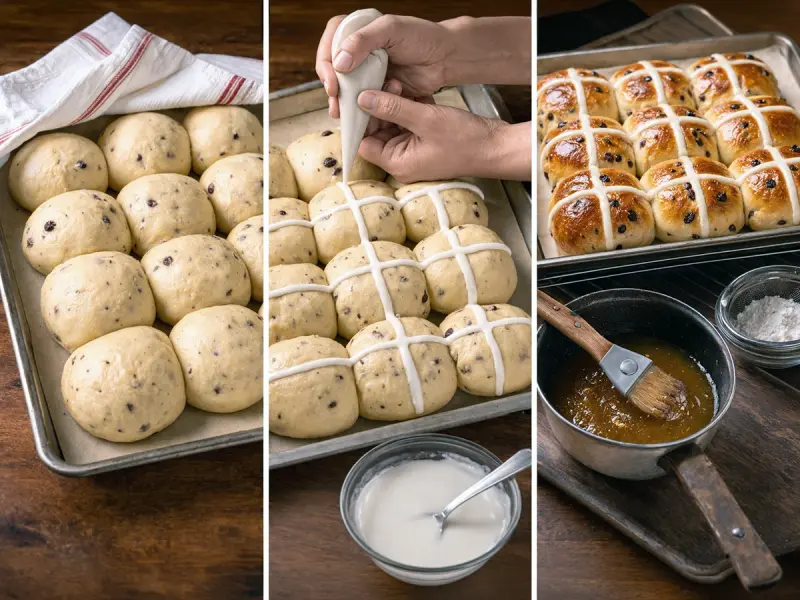
- Bake and glaze. Bake the buns for 18 to 22 minutes until deep golden on top and the bottoms sound hollow when tapped. While they bake, warm the apricot jam in a small saucepan with a tablespoon of water until liquid, then push it through a sieve to remove any fruit pieces. As soon as the buns come out of the oven, brush the hot glaze generously over the entire surface — it absorbs into the hot bread and gives the buns their characteristic sticky sheen. Leave to cool on the tray for at least 10 minutes.
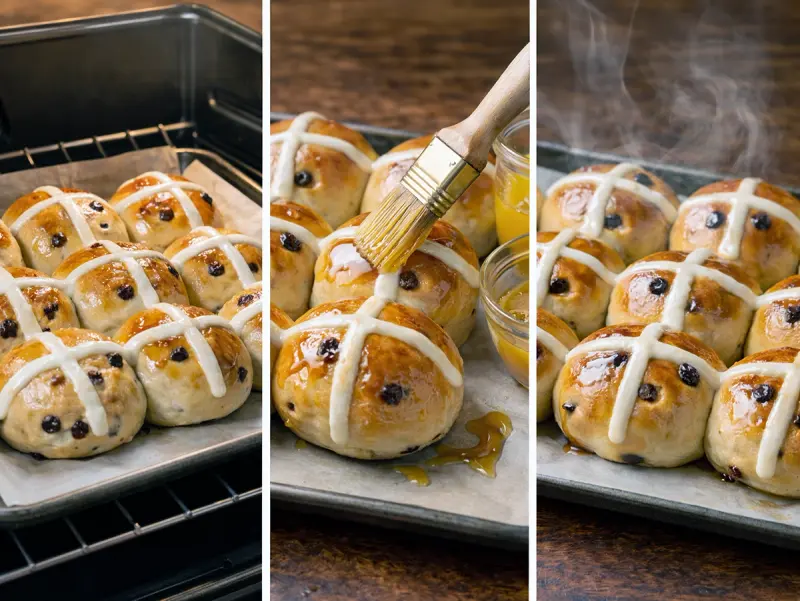
- Ice the crosses and serve. Mix the icing sugar with enough milk or orange juice to make a thick, smooth, white icing that holds its shape when piped — not runny, not stiff. Transfer to a small piping bag. Once the buns are completely cool (warm buns will melt the icing), pipe the white icing over the pastry cross lines. Serve the same day if possible: split in half, buttered generously. Day-old buns are very good toasted. They can be stored in an airtight container for 3 days or frozen for up to 3 months.
FAQ
The flour paste cross is a traditional technique: the raw paste, piped before baking, puffs slightly in the oven and turns pale golden, becoming part of the bun's surface. It adds a faint texture but is almost tasteless. The icing cross applied after baking is a more modern addition that adds sweetness and a clean white visual contrast — making the cross more visible and decorative. Many bakers use one or the other, but using both layers gives a more finished result. The flour paste is structural, the icing is decorative. Some recipes use only the paste (traditional), some only the icing (easier), some both.
Yes. Combine the dry ingredients in a large bowl, rub in the butter, make a well, add the wet ingredients and mix to a shaggy dough. Turn out onto a lightly floured surface and knead by hand for 10 to 12 minutes — the dough starts sticky and gradually becomes smooth and elastic as the gluten develops. This is more effort than machine kneading but produces an identical result. The indicators that the dough is properly developed: it stretches without tearing when you pull a piece of it thin, it springs back slowly when you press it, and it feels silky rather than rough.
Bread flour has a higher protein content (about 12 to 14%) than plain flour (9 to 11%). The extra protein forms more gluten when hydrated and kneaded, which gives the dough the structure and elasticity needed to trap the gas produced by the yeast and rise properly. Plain flour can be used for hot cross buns and produces a slightly softer, more cake-like bun, but the enriched dough benefits from the extra structure that bread flour provides. If you only have plain flour, it will still work — just be prepared for a slightly stickier dough that takes longer to come together.
The traditional combination is cinnamon, allspice, and nutmeg. Allspice is the most distinctive — it tastes like a blend of cloves, cinnamon, and nutmeg simultaneously. Some recipes include mixed spice, which is a pre-blended British spice mix containing all three plus coriander, caraway, ginger, and mace. Cardamom is a particularly good addition — it adds a floral, almost camphor-like quality that pairs well with the orange zest. Ground cloves can be added very sparingly (no more than ¼ teaspoon, as they are overpowering). Ginger is less traditional but works. The spice amount is intentionally modest here — hot cross buns should be warmly spiced, not overwhelmingly so.
Fresh hot cross buns are best eaten within 4 to 6 hours of baking, when the crust is still slightly crisp and the crumb is tender. Day-old buns reheat well in two ways: split in half and toasted cut-side down in a frying pan with a little butter, or placed in a 160°C oven for 5 to 8 minutes wrapped loosely in foil. Microwaving makes them steam-soft but loses the crust. They keep in an airtight container at room temperature for 3 days. They freeze very well: freeze them immediately after the apricot glaze has dried, without the icing cross. Defrost at room temperature, reheat in the oven, then add the icing cross fresh.
Keep browsing
More dishes from the British archive — picked by overlap with what you're cooking now.
Recipes by email
One letter a week: a recipe picked for your taste, plus whatever is new on the site. Unsubscribe in one click.
Welcome gift: Sergei's cookbook (e-book).
By subscribing you agree to the privacy policy.
Tell us what you like to cook (30 seconds) →
Join the conversation
Comments
No comments yet — be the first!