Germany · Flour and Confectionery Products
Christstollen (German Christmas Stollen)
Christstollen, also called Weihnachtsstollen or simply Stollen, is a German Christmas yeast loaf: a buttery Hefeteig packed with rum-soaked raisins, candied orange and lemon peel (Orangeat and Zitronat) and almonds…
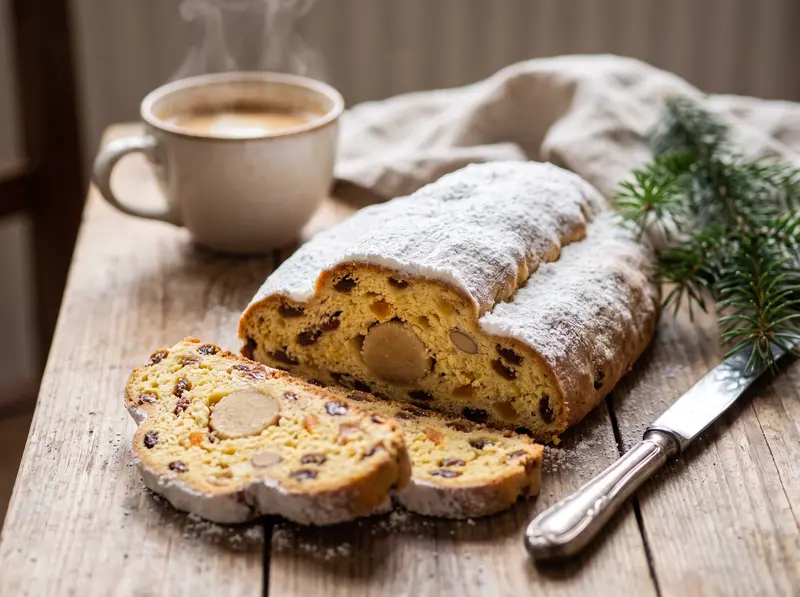
Ingredients
- wheat flour (type 550)500 g
- milk, lukewarm100 ml
- fresh yeast30 g
- sugar60 g
- vanilla sugar1 tbsp
- salt1 pinch
- organic lemon zest, finely grated1 tsp
- ground cinnamon1 tsp
- ground cardamom0.5 tsp
- ground ginger0.5 tsp
- ground nutmeg0.25 tsp
- butter, soft200 g
- egg, medium1
- raisins200 g
- candied orange peel (orangeat)75 g
- candied lemon peel (zitronat)75 g
- blanched almonds, chopped100 g
- dark rum4 tbsp
- butter, for brushing100 g
- powdered sugar150 g
Method
- 1The evening before (or at least an hour ahead), put the raisins, Orangeat, Zitronat and chopped almonds in a bowl, pour over the rum and stir. Cover and stir once or twice more. Dry fruit would pull moisture out of the dough and leave the crumb dry, while soaked fruit stays plump and stays juicy through weeks of storage.
- 2Warm the milk until lukewarm, crumble the fresh yeast into it and stir in 1 tablespoon of the sugar and 100 g of the flour. Cover and leave for 15 minutes until the surface is bubbly. This small starter (Vorteig) proves the yeast is alive before you commit 200 g of butter to the dough, which slows yeast down.
- 3Add the remaining 400 g flour, the rest of the sugar, vanilla sugar, salt, lemon zest, cinnamon, cardamom, ginger and nutmeg to the starter, then the egg and the soft butter. Knead with a dough hook for 8 to 10 minutes, until the dough is smooth, shiny and pulls away from the bowl; at least 5 minutes is the minimum. Cover and leave in a warm spot for about 1 hour. Because of the butter it rises slowly and will grow noticeably but not double.
- 4Tip the soaked fruit and almonds into a sieve for a minute to drain the excess rum, then knead them into the dough by hand for only 1 to 2 minutes, until spread through. Longer kneading smears the fruit and turns the dough grey and wet. Cover and rest another 30 minutes.
- 5On a floured surface pat the dough into an oval of about 30 × 22 cm. Press a groove lengthwise with a rolling pin, slightly off centre, then fold the smaller side over the larger, stopping about a finger's width short of the far edge, so the loaf keeps its typical ridge. Press the seam lightly, lift onto a baking tray lined with baking paper and leave 30 minutes. If any raisins poke out of the surface, tuck them in: they burn first.
- 6Heat the oven to 200°C (180°C fan) with the rack in the lower third. Bake 10 minutes, turn the oven down to 170°C (150°C fan) and bake 40 minutes more, until the crust is deep golden and a wooden skewer pushed in from the side comes out with no wet dough. If the top darkens before that, lay foil on loosely for the last 15 minutes.
- 7Melt the 100 g butter. As soon as the stollen leaves the oven, brush it all over, sides and underside included, with about half; wait 5 minutes for it to soak in, then brush on the rest. Sift half the powdered sugar over the hot stollen so it sticks to the butter, let it cool completely, then sift the rest thickly over the top. Wrap in aluminium foil and keep in a cool, dark place for 2 to 3 weeks before cutting: the butter-and-sugar crust seals in moisture while the flavours spread through the crumb.