
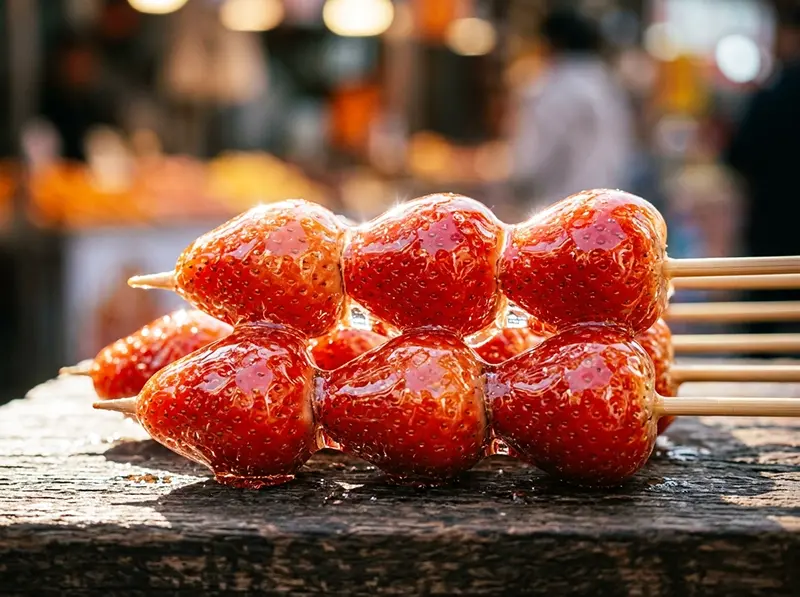
Tanghulu (Chinese Candied Fruit)
Tanghulu has been sold on Beijing streets since the Song dynasty, but most people outside China discovered it through TikTok — where the cracking sound became its own genre. Fresh fruit on a stick, sealed in boiling sugar that sets like glass. Three ingredients. You will probably mess it up the first time. The instructions below exist so you don't.
Ingredients
- 300 gstrawberries
- 200 ggranulated sugar
- 100 mlwater
Method
- Wash the fruit and dry it completely — not mostly dry, bone dry. Press each piece between paper towels. Any water left on the surface will make the sugar seize into a white, grainy crust instead of a clear glass shell.
- Thread 3–4 pieces of fruit onto each bamboo skewer, leaving a small gap between pieces. That gap matters when eating: you can bite cleanly from one piece to the next without shattering the sugar on the piece below.
- Line a baking sheet or plate with parchment paper and set it next to the stove. Fill a large bowl with cold water and a few ice cubes — you'll use this to test the syrup.
- Add the sugar and water to a small, heavy-bottomed saucepan. Stir once just to wet the sugar, then stop. Do not stir again. Stirring introduces air and causes crystallization — you'll end up with something white and chalky instead of glassy and clear. Cook over medium-high heat.
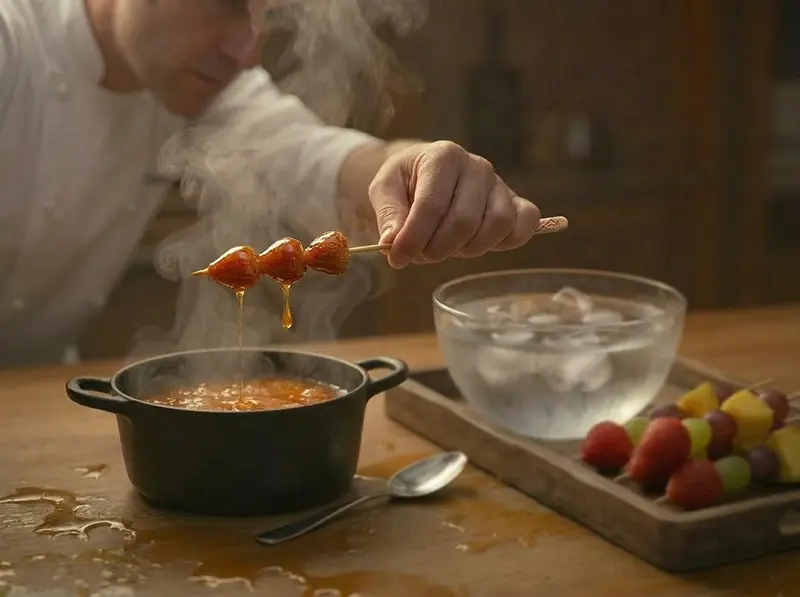
- Cook without touching the syrup until it reaches 300°F (150°C) — the hard-crack stage. No thermometer? Drip a few drops into the ice water. If they form brittle threads that snap when bent, you're there. If they bend instead of snap, cook a little longer.
- Remove the pot from heat. Tilt it to one side and dip each skewer in, rotating slowly to coat evenly. Lift it out, let the excess drip for 2 seconds, then lay flat on the parchment. The coating sets in about 30 seconds.
- Wait at least 10 minutes before eating so the sugar is fully cool and hard. Eat within 2 hours — the fruit's moisture gradually softens the shell from the inside, and by hour three you'll have something sticky rather than crunchy.
FAQ
The syrup didn't reach 300°F (150°C), which is the hard-crack stage. At lower temperatures the sugar stays in the soft-ball or soft-crack range and sets as chewy toffee rather than brittle glass. Use a candy thermometer, or test by dropping a bit of syrup into ice water — it should form threads that snap, not bend. Another cause: wet fruit. Even a thin film of moisture prevents the syrup from bonding properly. Dry the fruit with paper towels until there's no visible dampness.
A thermometer makes it easier, but you can do without one. The ice water test works: drop a small amount of hot syrup into a bowl of ice water. If it immediately hardens into brittle threads that break when you bend them, you've hit hard crack (300°F). If the threads bend or feel rubbery, keep cooking. The syrup usually takes 15–20 minutes on medium-high heat to get there. The tricky part is that it can go from perfect to slightly burnt in under a minute at the end — so watch closely once it starts looking thick and slightly golden.
Tanghulu is best eaten within 2 hours of making it. After that, moisture from inside the fruit slowly migrates outward through the candy shell, softening it from the inside. Room humidity accelerates this — on a hot, muggy day you might have 60–90 minutes before it softens. Don't refrigerate tanghulu: the condensation that forms when you take it out will dissolve the sugar coating immediately. If you want to prep in advance, skewer and dry the fruit ahead of time, then cook the syrup and dip just before serving.
Best choices are firm fruits with relatively low water content: strawberries (with the hull removed), seedless grapes, blueberries, firm cherries, and kiwi slices. Slightly underripe is better than fully ripe — firmer flesh holds the skewer better and gives a tarter contrast to the sweet shell. Fruits to avoid: watermelon, mango, and banana — too soft and too juicy, they slide off the skewer and release so much moisture that the coating barely sets. Oranges and mandarins work if you dry each segment very thoroughly and remove as much white pith as possible.
No, not reliably. Regular granulated sugar reaches a hard-crack stage because of how sucrose behaves at high temperatures. Erythritol has a different crystallization point and tends to recrystallize into an opaque, gritty crust rather than a clear glass shell. Monk fruit sweetener doesn't caramelize or harden the same way at all. Several recipe developers have tested sugar-free versions and none produce the signature transparent, brittle snap. For a lower-sugar result, the best approach is to use the standard recipe but eat one or two skewers instead of several — the fruit itself is nutritious and the sugar coating per serving is around 40g.
Keep browsing
More dishes from the Chinese archive — picked by overlap with what you're cooking now.
Recipes by email
One letter a week: a recipe picked for your taste, plus whatever is new on the site. Unsubscribe in one click.
Welcome gift: Sergei's cookbook (e-book).
By subscribing you agree to the privacy policy.
Tell us what you like to cook (30 seconds) →
Join the conversation
Comments
No comments yet — be the first!