
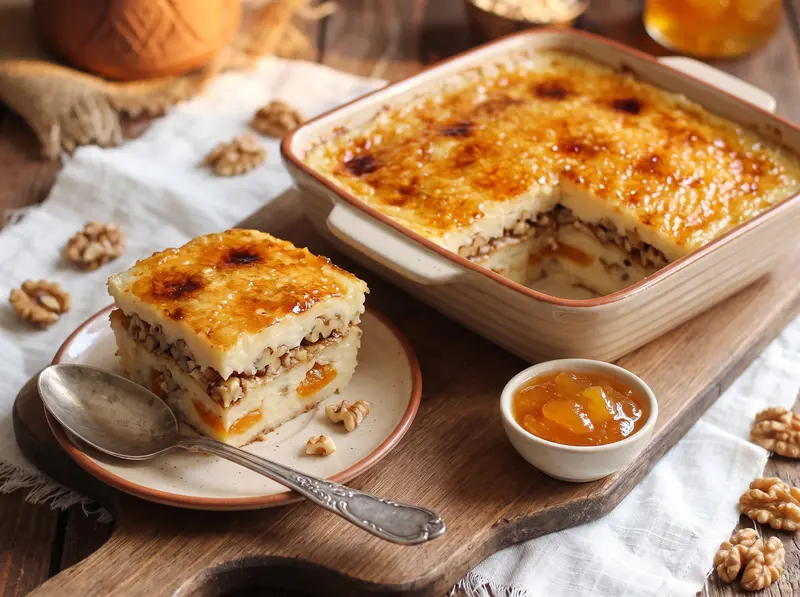
Guriev Porridge
Guriev porridge is a Russian dessert of baked semolina layered with sweet milk skins, toasted walnuts and dried apricots, finished with a caramelized sugar crust. It's named after Count Dmitry Guriev, a statesman at the court of Tsar Alexander I in the early 19th century.
Ingredients
- 1 lmilk
- 200 gsemolina
- 100 gsugar
- 50 gbutter
- 100 gwalnuts
- 100 gdried fruit (dried apricots)
- 400 mlcream 33%
- vanillin, to taste
Method
- Bring the milk to a near boil, then whisk in the semolina in a thin, steady stream so it doesn't clump. Cook for 5-7 minutes, stirring, until the porridge is thick and holds its shape on a spoon. Stir in the sugar (reserve 2 tablespoons for the topping), butter, and vanillin until smooth, then take off the heat.
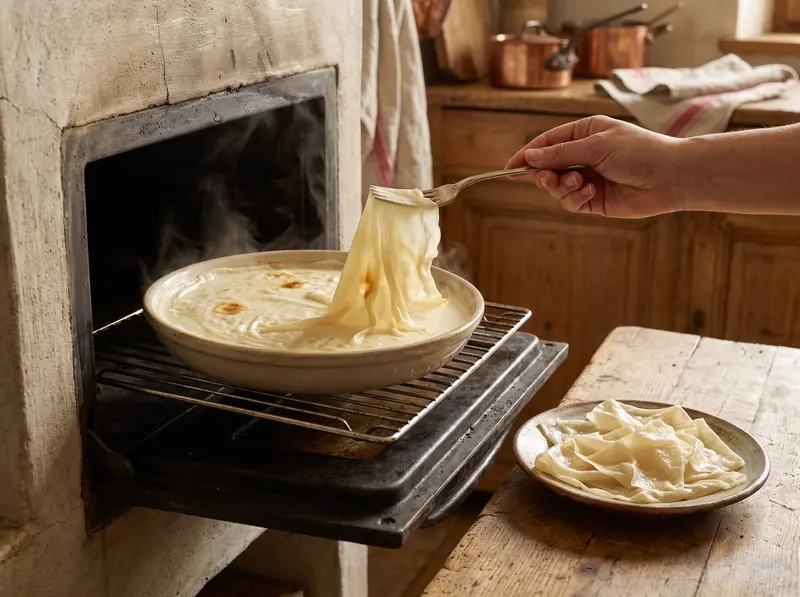
- Make the milk skins: pour the cream into a wide, shallow ovenproof dish and place it in the oven at 180-200°C (355-390°F). Every 8-10 minutes, a golden skin will form on the surface — lift it off with a fork or spatula and stack it on a plate. Repeat until you have 5-6 skins in total.
- Toast the walnuts in a dry skillet until fragrant, then chop them coarsely. Cut the dried apricots into small pieces.
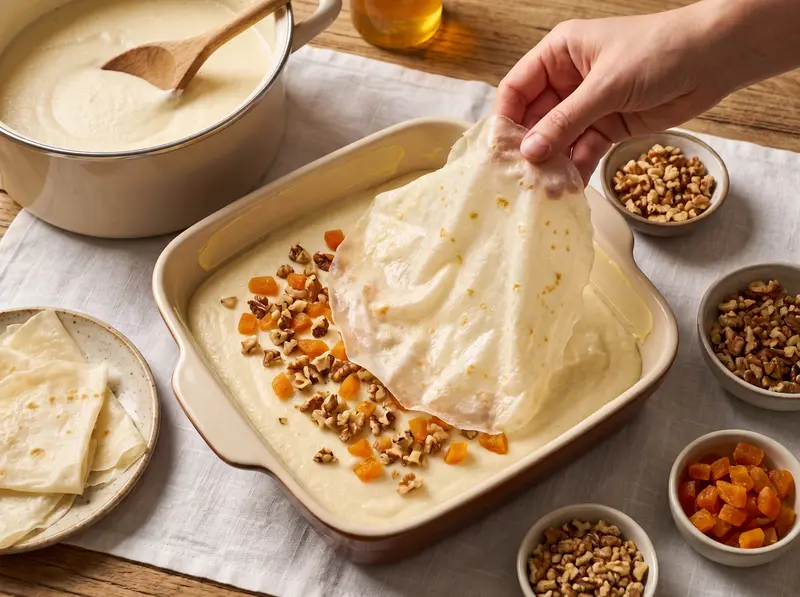
- Butter a 20x20 cm baking dish and build 3-4 layers, alternating semolina porridge, a milk skin, and a scattering of walnuts and dried apricots. Finish with a layer of porridge on top.
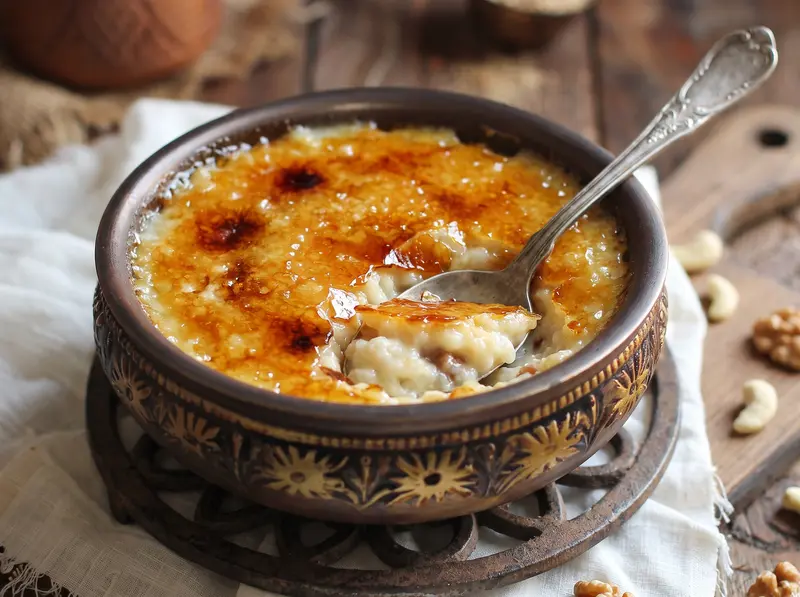
- Sprinkle the reserved 2 tablespoons of sugar evenly over the surface and bake at 200°C (390°F) for 10-15 minutes, until a caramel crust forms.
- If the crust needs more color, finish under the grill/broiler for 1-2 minutes, watching closely so it doesn't burn, or use a kitchen torch. Serve warm, with jam or extra nuts alongside.
FAQ
Semolina is what gives Guriev porridge its dense, custardy base, and there isn't a perfect substitute. Finely ground rice or rice flour makes a passable stand-in, though the texture turns denser and less silky. If you want the same basic semolina-milk porridge without the layers and skins, our manna kasha recipe uses the same base and is a good place to start. Ground oats can work in a pinch, but the flavor shifts noticeably away from the original.
Pour 400-500 ml of cream (or cream mixed with milk) into a wide, shallow ovenproof dish and place it in the oven at 180-200°C (355-390°F). Every 8-10 minutes a golden skin will form on the surface; lift it off carefully with a fork or spatula and stack it on a plate. Repeat until you have 5-6 skins — that's roughly what a 400-500 ml batch yields in a 24-26 cm dish. A narrower or deeper dish slows the process, since the skins depend on a wide surface exposed to the oven's heat.
It's traditionally served warm, straight from the oven, while the caramel crust is still crackling. Toasted nuts and a spoonful of fresh berries or jam alongside are the classic pairing — the tartness cuts through the richness of the cream and sugar. Because it was originally a dish meant to impress, presentation matters more than usual: portion it onto plates rather than serving straight from the baking dish.
Keep it in a sealed container in the refrigerator for up to 2 days. Reheat individual portions in the oven at 160°C (320°F) for about 10 minutes, which brings back some crunch to the caramel top. A microwave will warm it through but leaves the crust soft rather than crisp, so it's a fine option if you don't mind losing the crunch.
Lumps happen when semolina is added to milk that isn't hot enough, or poured in all at once instead of a thin stream while stirring. Always bring the milk close to a boil first and add the semolina gradually. Scorching on the bottom usually means the heat was too high during the initial cooking — keep it at a gentle simmer once the semolina goes in. If the caramel crust burns rather than browns, the oven or grill was too aggressive in the final minutes — watch it closely instead of relying on a timer.
Rate this
Recipes by email
One letter a week: a recipe picked for your taste, plus whatever is new on the site. Unsubscribe in one click.
Welcome gift: Sergei's cookbook (e-book).
By subscribing you agree to the privacy policy.
Tell us what you like to cook (30 seconds) →Keep browsing
More dishes from the Russian archive — picked by overlap with what you're cooking now.
Join the conversation
Comments (1)
Chill the bowl and whisk before whipping cream for guriev porridge. Cold equipment makes the cream whip faster and hold its structure better. In a warm kitchen, this step is the difference between stiff peaks and soup.