
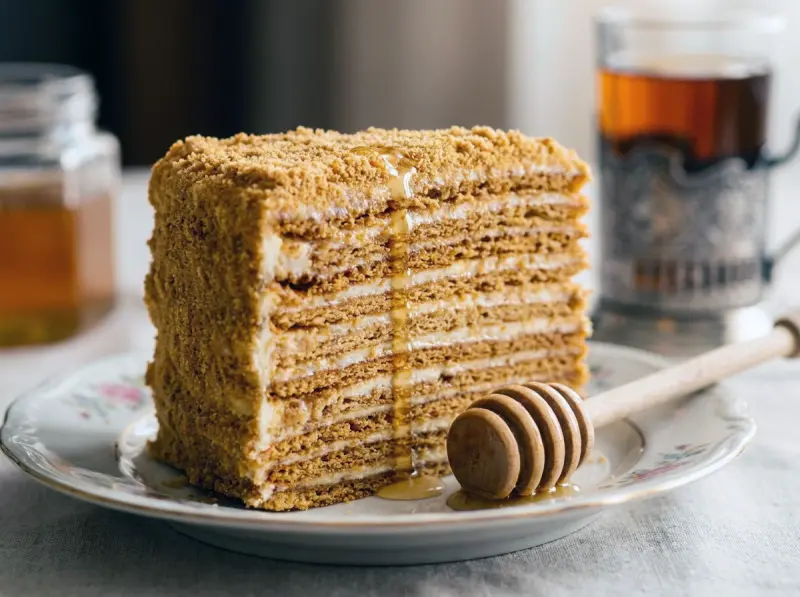
Medovik (Russian Honey Cake)
Medovik is Russia's iconic honey cake: eight or more thin caramel-honey layers stacked with tangy sour-cream frosting and left overnight until soft and tender. The secret to its warm caramel aroma is stirring baking soda straight into hot honey, which foams up and lightly caramelizes the batter. Finished with a dusting of the cake's own crumbs. Like anything made with honey, it is not for babies under one year old.
Ingredients
- 150 ghoney
- 500 gflour
- 100 gbutter
- 150 gsugar, for the dough
- 3 pcseggs
- 1.5 tspbaking soda
- 800 gsour cream, 25–30 % fat
- 150 gsugar, for the cream
Method
- In a heavy saucepan over low heat, melt the honey, butter, and sugar together until fully liquid and hot, but not boiling. Heat builds the caramel flavor.
- Take off the heat and stir in the baking soda — never vinegar. It will foam up pale and double in volume; this is what makes the layers light and gives the honey its caramel note.
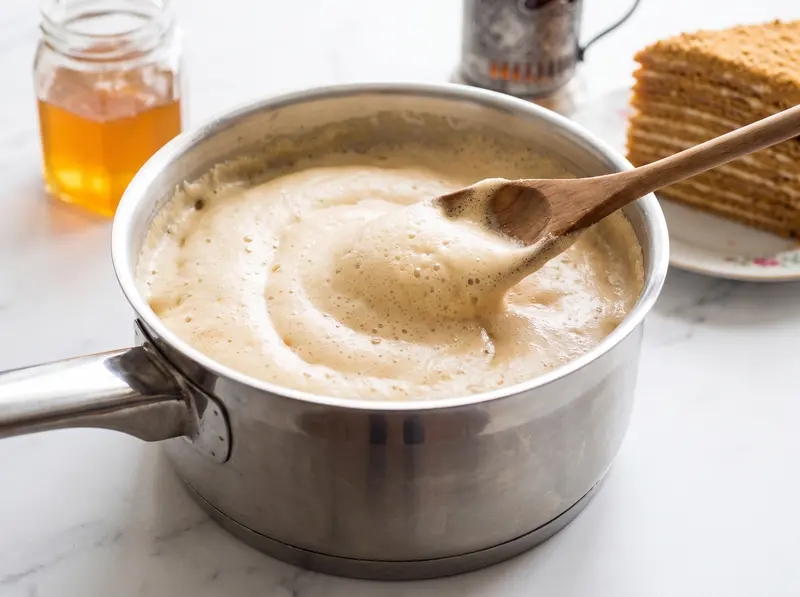
- Let the foamed honey cool for about 5 minutes, until it is warm rather than hot — you should be able to hold a finger in it. Then whisk in the eggs one at a time, so they do not scramble, and work in the flour to a soft, slightly sticky dough. Don't add extra flour or the layers turn hard.
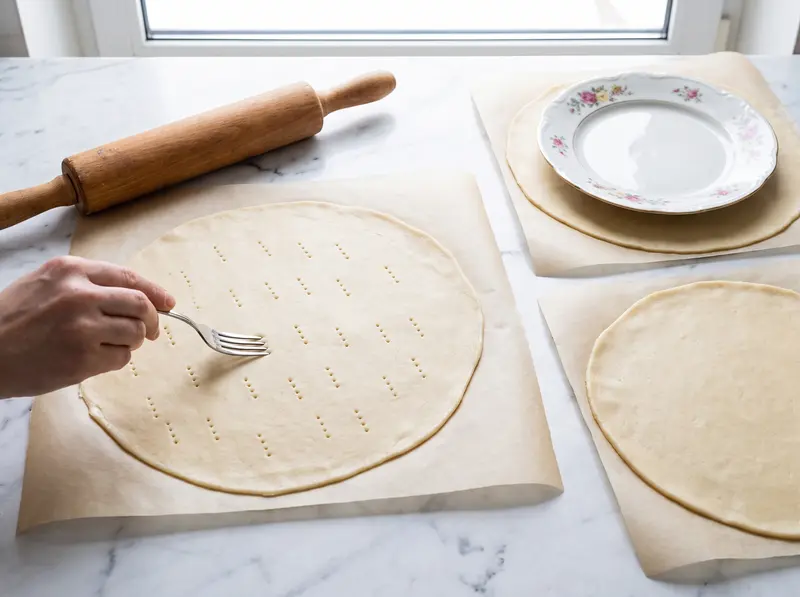
- Divide the dough into 8 equal pieces of about 130 g. Roll each directly on baking paper into a circle about 24 cm across and 2–3 mm thick, using a plate or the base of a 24 cm tin as a guide. Prick with a fork and bake at 180 °C for 3–5 minutes, until evenly golden. Trim each to a neat circle while warm and save the trimmings.
- Make the cream: whisk the cold sour cream with the sugar just until smooth and the sugar dissolves. Don't over-whip or it thins out.
- Stack the layers with a generous spread of cream between each, then coat the top and sides.
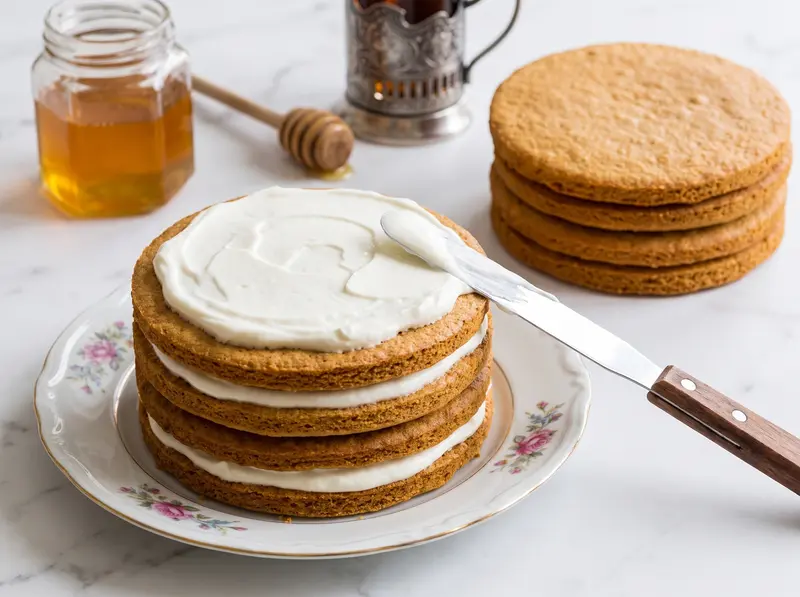
- Blitz the trimmings into crumbs and press them over the top and sides. Refrigerate overnight so the layers soften. Serve cold.
FAQ
When soda meets hot honey it reacts with the honey's natural acids, foaming up and building the caramel flavor and warm amber color that define medovik. Slaking it with vinegar first, as in some old recipes, neutralizes the soda before it hits the batter, so the layers don't rise and stay pale and dense. Add the soda off the heat and stir until the mixture doubles and turns light — that foam is the whole point.
Use thick, high-fat sour cream (25–30 % fat) and keep it cold. Whisk it with the sugar only until smooth — over-whipping breaks it down and thins it out. If your sour cream is thin, hang it in cheesecloth over a bowl for a few hours to drain the whey first, or fold in a little whipped cream for structure. A softer cream soaks the layers better but a firmer one is easier to stack.
At least 6 hours, but overnight (8–12 hours) is standard and worth it. Fresh from the oven the layers are crisp; as they sit, they draw moisture from the cream and turn soft, tender, and almost mousse-like. Cutting too soon gives you separate crunchy layers rather than the melting whole. Assemble the day before you plan to serve it. The same overnight rest is what makes Napoleon cake, the other layered cake of the Soviet holiday table.
Dark, strong honey such as buckwheat or chestnut gives the deepest caramel color and flavor; mild light honey works but the taste is subtler. If you can't use honey, some cooks substitute an equal amount of caramel, dark maple syrup, or muscovado — the texture holds, though it's no longer strictly a honey cake. Whatever you use, it must be warmed for the soda reaction.
Keep it covered in the fridge for up to 3 days; the sour-cream frosting means it must stay cold, and a cut cake should not sit on the table for more than 2 hours. The texture is at its best from about 12 hours to 2 days after assembling, once fully soaked. You can freeze whole or sliced medovik — thaw it in the fridge overnight, and the texture stays close to fresh.
Rate this
Recipes by email
One letter a week: a recipe picked for your taste, plus whatever is new on the site. Unsubscribe in one click.
Welcome gift: Sergei's cookbook (e-book).
By subscribing you agree to the privacy policy.
Tell us what you like to cook (30 seconds) →Keep browsing
More dishes from the Russian archive — picked by overlap with what you're cooking now.
Join the conversation
Comments
No comments yet — be the first!