
Turkish Coffee
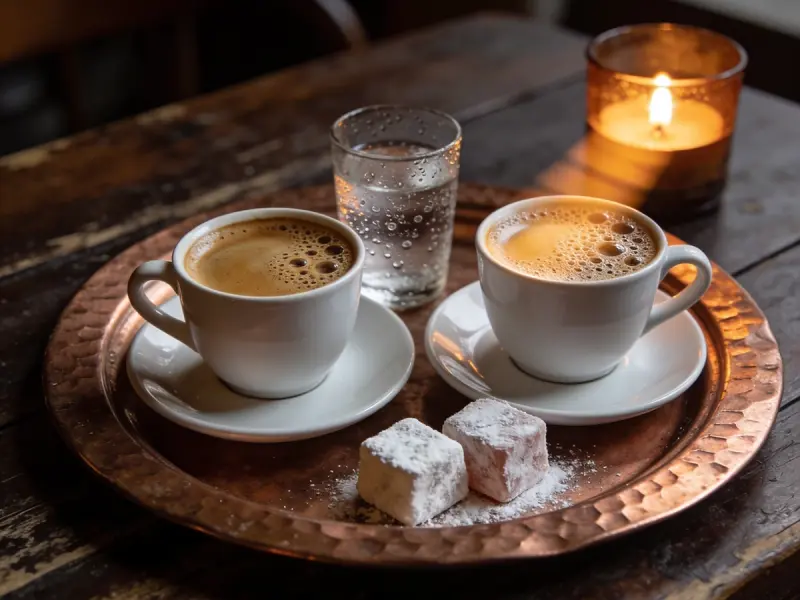
Turkish coffee is not a type of coffee — it's a method. Powder-fine grounds are simmered unfiltered in a small long-handled pot called a cezve, never boiled, and poured straight into the cup without straining. The grounds settle at the bottom. You drink down to them, then stop. The foam that forms on top is not incidental — it's the measure of a well-made cup. Getting it consistently requires a cold water start, low heat, and patience. The process takes about three minutes once you know what to watch for.
Ingredients
- 2 tspvery finely ground Turkish coffee
- 160 mlcold water
- 2 tspsugar
- 2 podsgreen cardamom
- 2 small glasses of cold water
Method
- Measure cold water using your coffee cups. The cups you will serve in are your measuring tool — fill each one with cold water and pour into the cezve. This ensures the ratio is right for your specific cup size. Cold water is important: it gives the coffee more time to heat slowly, which is what allows the foam to develop properly.
- Add the coffee, sugar, and cardamom. Sprinkle the coffee across the surface of the cold water and let it sit for a few seconds so it begins to hydrate. Add sugar if using — this is the only moment to add it; sugar cannot be stirred in after brewing without destroying the foam. Add the crushed cardamom pods or a pinch of ground cardamom if using. Stir everything together with a small spoon until the coffee is fully incorporated. This is the last time you stir.
- Heat low and slow. Place the cezve over the lowest heat your stove allows. Do not leave it. Watch the surface. Within 2 to 3 minutes, a tan-coloured foam will begin to form and slowly rise from the edges toward the center. The foam is delicate — heat that is too high will cause it to boil through and collapse. As the foam rises and approaches the rim of the cezve, remove it from the heat immediately. The coffee should never actually boil.
- Share the foam and pour. Spoon a small amount of foam into each cup first — this ensures each person gets their share of foam regardless of how the pour goes. Return the cezve to low heat for another 30 to 60 seconds until the coffee begins to rise again, then pour slowly into both cups, holding the cezve close to the cup to minimise disturbance. The foam will settle on top.
- Let it rest and serve. Leave the cups undisturbed for at least one minute — the grounds need time to settle to the bottom. Serve with a small glass of cold water on the side: a sip of water before the coffee clears your palate and lets you taste it cleanly. Drink slowly. Stop when you reach the thick sediment at the bottom — it is not meant to be drunk. Serve with a small sweet on the side if you like: Turkish delight, a square of baklava, or a date.
FAQ
A cezve is a small pot with a wide base, narrow neck, and long handle, traditionally made of copper. The shape matters: the wide base heats the coffee evenly, and the narrow neck concentrates the foam so it rises cleanly. You can make a reasonable approximation in the smallest saucepan you own — a milk pan works better than a wide pan. The foam may be less impressive, but the coffee will taste the same. If you plan to make Turkish coffee regularly, a cezve is worth buying; they are inexpensive and widely available online.
Once the coffee is poured into the cup, stirring breaks the foam completely — and the foam is both the aesthetic and textural centrepiece of Turkish coffee. Sugar added before heating dissolves into the brew and integrates fully into the flavor without any post-pour stirring. There is no workaround: if someone asks for sugar after you have already started heating, you have to start a new batch for them. This is why the traditional question before brewing is not 'would you like coffee?' but 'how sweet would you like your coffee?'
Finer than you probably expect — closer to flour or talcum powder than to espresso grind. If you rub it between your fingers, you should not feel individual particles. At this fineness, the grounds form a layer on the bottom of the cup as the coffee cools, which is the correct result. Coarser grinds do not settle properly, produce less foam, and result in a gritty texture throughout the cup. Most supermarket coffee grinders cannot reach this level. Buy pre-ground Turkish coffee, or use a grinder with a dedicated Turkish setting.
Turkish coffee has four traditional sweetness designations. Sade means plain — no sugar, the coffee's natural bitterness fully present. Az şekerli means slightly sweet — roughly one teaspoon per cup. Orta means medium sweet — about two teaspoons per cup. Çok şekerli means very sweet — three or more teaspoons, common at weddings and celebrations. The sweetness level is determined before brewing and cannot be adjusted after. In Turkish culture, asking a guest their preference before making coffee is standard hospitality.
Cold water served alongside Turkish coffee is not decorative. Turkish coffee is intense and concentrated; a sip of cold water before drinking clears the palate and allows you to taste the coffee more clearly on a clean tongue. It also helps with the strength — Turkish coffee is powerful, and water moderates its effect. In Turkey, the water is always included in the service. If you are serving Turkish coffee to guests for the first time, include the water; it is part of the experience.
Keep browsing
More dishes from the Turkish archive — picked by overlap with what you're cooking now.


Recipes by email
One letter a week: a recipe picked for your taste, plus whatever is new on the site. Unsubscribe in one click.
Welcome gift: Sergei's cookbook (e-book).
By subscribing you agree to the privacy policy.
Tell us what you like to cook (30 seconds) →
Join the conversation
Comments (1)
Варю так каждый день уже лет 10. Единственое что кардамон кладу целый стручок а не молотый — аромат совсем другой. И воду обязательно холодную, не из под крана тёплую