


Southern Cornbread (Cast Iron Skillet)
Southern cornbread is the defining quick bread of the American South — a flat, dense, crumble-textured bread made from yellow or white cornmeal (traditionally stone-ground), buttermilk, and a little flour, baked in a pre-heated, well-seasoned cast-iron skillet slicked with bacon grease or butter. The screaming-hot skillet is the entire technique: the moment batter hits the hot fat, the outside layer of batter seizes and begins to fry, forming the characteristic crackling, dark-gold crust that no baking tin can replicate. The skillet goes into the oven as it heats and stays there for at least 20 minutes, so it is fully hot by the time the batter is mixed. The interior is tender, slightly tangy from buttermilk, and dense without being heavy. True Southern cornbread is not sweet — the North-South cornbread debate, still prosecuted with great passion across the United States, centers on sugar: Southern tradition holds that sugar has no place in cornbread. This recipe takes no position, but notes the matter in the FAQ.
Ingredients
- 240 gfine or medium-ground yellow cornmeal
- 60 gplain flour
- 1 tspbaking powder
- 0.5 tspbicarbonate of soda
- 1 tspfine salt
- 1 tbspsugar
- 2 eggs
- 360 mlfull-fat buttermilk
- 60 mlneutral oil or melted butter
- 2 tbspbacon grease, lard, or butter
Method
- Preheat the skillet. Place a 25 cm (10-inch) cast-iron skillet in the oven and preheat to 230°C (450°F). The skillet must be in the oven from the very beginning — it needs at least 20 minutes to reach full temperature. A hot skillet is the entire secret to crust formation. Do not use a cold skillet and do not use a non-cast-iron tin — the result will be pale, soft, and disappointing.
- Mix the dry ingredients. In a large bowl, whisk together the cornmeal, flour, baking powder, bicarbonate of soda, salt, and sugar (if using). Whisk thoroughly so the leavening is evenly distributed — uneven distribution causes the bread to rise unevenly.
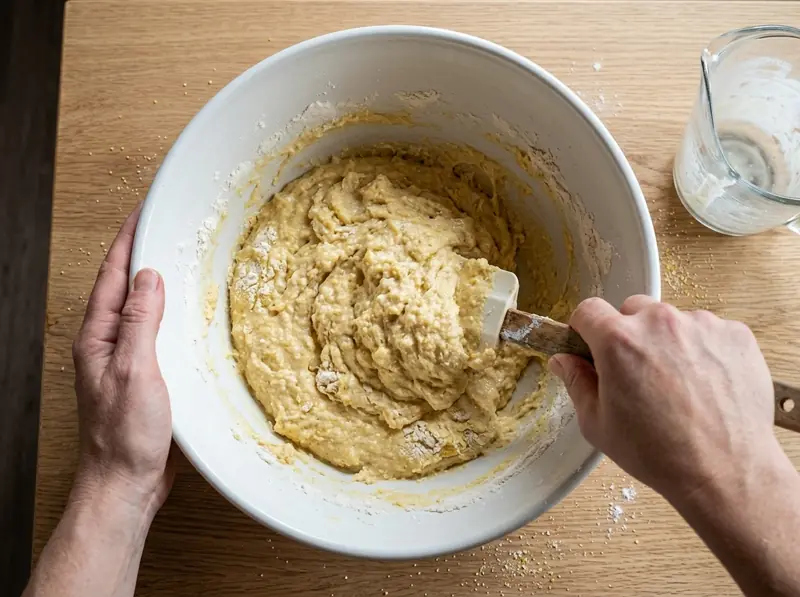
- Mix the wet ingredients and combine. In a separate bowl or jug, whisk together the eggs, buttermilk, and oil. Pour the wet ingredients into the dry ingredients. Stir with a spatula or wooden spoon until just combined — 10 to 12 strokes maximum. The batter should look lumpy, rough, and slightly wet. Do not overmix. Overmixing develops gluten from the wheat flour, producing a tough, dense, cake-like cornbread rather than the correct crumbly, tender texture.
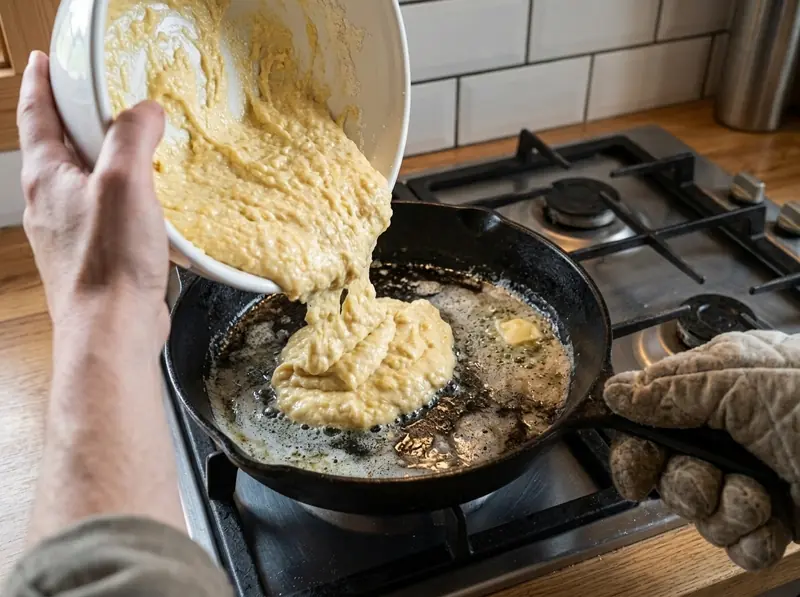
- Fat the skillet and pour the batter. Carefully remove the screaming-hot skillet from the oven using thick oven gloves. Add the bacon grease or butter to the skillet and swirl immediately to coat the bottom and sides — the fat will sizzle and smoke. Pour the batter into the hot fat immediately. You should hear a loud sizzle and see the batter begin to set and bubble around the edges at once. Pour quickly and return to the oven within 30 seconds.
- Bake. Bake at 230°C (450°F) for 20 to 25 minutes until the top is a deep golden brown, the edges have pulled away from the sides of the skillet, and a skewer inserted in the center comes out clean. The crust on the bottom and sides — the defining characteristic — should be a very dark, crackling gold when you peek under the edge. Cool in the skillet for 5 minutes, then run a knife around the edge and invert onto a board. Serve cut into wedges, warm, with cold butter melting into the crumb.
Cooked it? Rate the recipe
FAQ
The sugar debate is the most reliably heated discussion in American regional food. Southern cornbread tradition, particularly in the Deep South, holds that sugar has no place in cornbread. Authentic Southern cornbread is savory: it is meant to accompany beans, collard greens, and pot liquor, and sweetness would undermine these pairings. The natural sweetness of well-ground cornmeal is considered sufficient. Northern-style cornbread (associated with New England, the Midwest, and the urban North) adds sugar and sometimes more flour, producing a sweeter, more cake-like bread that is closer to a corn muffin. Neither version is wrong — they are different products that reflect different regional tastes and culinary uses.
Cast iron differs from aluminium, stainless steel, and ceramic baking tins in one critical way: thermal mass. Cast iron is extremely dense and holds heat exceptionally well. When pre-heated for 20 minutes in a 230°C oven, the skillet accumulates enough thermal energy to instantly sear the bottom and sides of the batter the moment it makes contact. This causes the exterior batter to set and fry before the starch has had time to steam — the same physics behind a good sear on meat. The result is the characteristic crackling, dark-gold crust that exists nowhere but the contact surfaces. A regular baking tin does not have the thermal mass to produce this effect; it heats slowly and evenly, steaming rather than searing the batter, producing a pale, soft result without the crust.
Cornmeal is sold in three main grinds: fine (the texture of plain flour), medium (like coarse sand), and coarse (gravelly, irregular). Fine-ground cornmeal produces a softer, more uniform crumb close to cake — this is what most commercial cornbread uses and what many modern recipes specify. Stone-ground cornmeal (sold as 'stone-ground' or 'coarse-ground') retains more of the outer bran and germ of the corn kernel, producing a grittier, more distinctly corn-flavoured bread with a textured crumb. This recipe is written for fine or medium-ground cornmeal; coarse meal makes the bread gritty. It absorbs more liquid than fine-ground, so if substituting coarse for fine in this recipe, add 2 to 3 tablespoons more buttermilk.
Yes — though buttermilk contributes both flavor (mild tang, slight acidity) and chemistry (the acid reacts with the bicarbonate of soda to produce bubbles for lift). If you do not have buttermilk: pour 360 ml of whole milk into a measuring jug, add 1.5 tablespoons of white wine vinegar or lemon juice, stir once, and leave for 5 minutes. The milk will curdle slightly — this is the intended result. This makeshift buttermilk works functionally in this recipe. Whole-milk yoghurt thinned to buttermilk consistency with milk or water also works. Sour cream diluted with milk (half-and-half) is another effective substitute. Do not use low-fat or non-fat milk — the reduced fat produces a drier crumb.
Cornbread's primary role in Southern cooking is as a companion to long-simmered dishes that produce liquids — pot liquor from collard greens, the broth of a bean pot, the gravy of a stew — because cornbread is ideal for soaking up liquid without dissolving. Classic pairings: pinto beans or black-eyed peas cooked with pork; collard greens cooked with ham hocks; chicken and dumplings; chilli (a Northern adoption that is now universal); beef or pork barbecue. Cornbread is also eaten for breakfast across the South, sliced and fried in butter. Day-old cornbread is the base for traditional Southern cornbread dressing, the stuffing served at Thanksgiving in the American South. The full recipe for that dressing is cornbread stuffing, and the chilli pairing has its own page: vegan chili.
Keep browsing
More dishes from the American archive — picked by overlap with what you're cooking now.


Recipes by email
One letter a week: a recipe picked for your taste, plus whatever is new on the site. You can stop the letters in one click.
Welcome gift: Sergei's cookbook (e-book).
By signing up for the newsletter you agree to the privacy policy.
Tell us what you like to cook (30 seconds) →
Join the conversation
Comments
No comments yet — be the first!