The two variables that make or break Southern cornbread are the temperature of the skillet and not overmixing the batter. On the skillet: it must be at full oven temperature — 220°C — before the batter goes in. This means it has been in the oven for at least 20 minutes, not just that the oven has reached temperature. The skillet is a thermal mass; it takes time to heat through. A skillet that is merely warm produces a pale, soft-sided loaf. On mixing: count your strokes and stop. Ten to twelve strokes is enough to combine the batter; every additional stroke develops gluten and toughens the crumb. The batter must look wrong — lumpy, rough, too wet — before going into the oven. Trust it.
Bacon grease is the most flavourful fat for the skillet — keep the drippings from your next fried bacon breakfast in a small jar in the fridge. Two tablespoons of bacon grease in the skillet produces a crust with a faint smoky, porky depth that butter alone cannot replicate. If you use butter, it burns at the edges of the skillet at high heat, producing dark, slightly bitter patches — not unpleasant, but different. For jalapeño and cheddar cornbread: fold 60 g of grated sharp cheddar and 1 to 2 finely diced pickled jalapeños into the batter just before pouring into the skillet.
Southern Cornbread (Cast Iron Skillet)
By Sergei Martynov
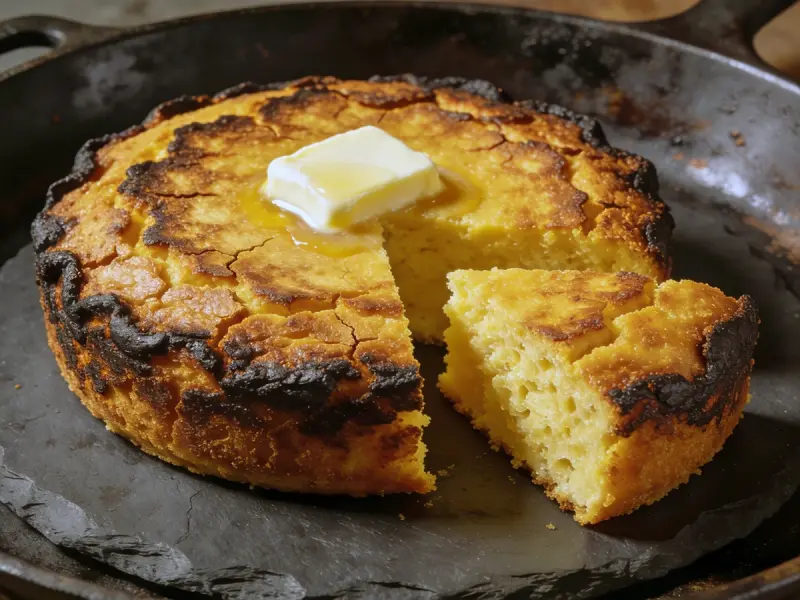
Southern cornbread is the defining quick bread of the American South — a flat, dense, crumble-textured bread made from stone-ground yellow or white cornmeal, buttermilk, and a little flour, baked in a pre-heated, well-seasoned cast-iron skillet slicked with bacon grease or butter. The screaming-hot skillet is the entire technique: the moment batter hits the hot fat, the outside layer of batter seizes and begins to fry, forming the characteristic crackling, dark-gold crust that no baking tin can replicate. The interior is tender, slightly tangy from buttermilk, and dense without being heavy. True Southern cornbread is not sweet — the North-South cornbread debate, still prosecuted with great passion across the United States, centres on sugar: Southern tradition holds that sugar has no place in cornbread. This recipe takes no position, but notes the matter in the FAQ.
What you'll need
Ingredients
- 240 g
See recipes with fine or medium-ground yellow cornmealfine or medium-ground yellow cornmeal (stone-ground preferred)
i - 60 g
See recipes with plain flourplain flour (all-purpose)
i - 1 tsp
See recipes with baking powderbaking powder
i - 0.5 tsp
See recipes with bicarbonate of sodabicarbonate of soda (baking soda)
i - 1 tsp
See recipes with fine saltfine salt
i - 1 tbsp
See recipes with sugar — omit entirely for authentic savoury southern stylesugar — omit entirely for authentic savoury Southern style
i - 2
See recipes with eggseggs, lightly beaten
i - 360 ml
See recipes with full-fat buttermilkfull-fat buttermilk, room temperature
i - 60 ml
See recipes with neutral oil or melted butter — for the batterneutral oil or melted butter — for the batter
i - 2 tbsp
See recipes with bacon greasebacon grease, lard, or butter — for the cast-iron skillet
i
How to make it
Instructions
- 1
Preheat the skillet. Place a 25 cm (10-inch) cast-iron skillet in the oven and preheat to 220°C (425°F). The skillet must be in the oven from the very beginning — it needs at least 20 minutes to reach full temperature. A hot skillet is the entire secret to crust formation. Do not use a cold skillet and do not use a non-cast-iron tin — the result will be pale, soft, and disappointing.
- 2
Mix the dry ingredients. In a large bowl, whisk together the cornmeal, flour, baking powder, bicarbonate of soda, salt, and sugar (if using). Whisk thoroughly so the leavening is evenly distributed — uneven distribution causes the bread to rise unevenly.
- 3
Mix the wet ingredients and combine. In a separate bowl or jug, whisk together the eggs, buttermilk, and oil. Pour the wet ingredients into the dry ingredients. Stir with a spatula or wooden spoon until just combined — 10 to 12 strokes maximum. The batter should look lumpy, rough, and slightly wet. Do not overmix. Overmixing develops gluten from the wheat flour, producing a tough, dense, cake-like cornbread rather than the correct crumbly, tender texture.
- 4
Fat the skillet and pour the batter. Carefully remove the screaming-hot skillet from the oven using thick oven gloves. Add the bacon grease or butter to the skillet and swirl immediately to coat the bottom and sides — the fat will sizzle and smoke. Pour the batter into the hot fat immediately. You should hear a loud sizzle and see the batter begin to set and bubble around the edges at once. Pour quickly and return to the oven within 30 seconds.
- 5
Bake. Bake at 220°C (425°F) for 20 to 25 minutes until the top is a deep golden brown, the edges have pulled away from the sides of the skillet, and a skewer inserted in the centre comes out clean. The crust on the bottom and sides — the defining characteristic — should be a very dark, crackling gold when you peek under the edge. Cool in the skillet for 5 minutes, then run a knife around the edge and invert onto a board. Serve cut into wedges, warm, with cold butter melting into the crumb.
Frequently Asked Questions
Should cornbread have sugar in it — what is the North-South debate?
The sugar debate is the most reliably heated discussion in American regional food. Southern cornbread tradition — particularly in the Deep South states of Georgia, Alabama, Mississippi, Louisiana, Arkansas, and Tennessee — holds that sugar has no place in cornbread. Authentic Southern cornbread is savory: it is meant to accompany beans, collard greens, and pot liquor, and sweetness would undermine these pairings. The natural sweetness of well-ground cornmeal is considered sufficient. Northern-style cornbread (associated with New England, the Midwest, and the urban North) adds sugar and sometimes more flour, producing a sweeter, more cake-like bread that is closer to a corn muffin. Neither version is wrong — they are different products that reflect different regional tastes and culinary uses.
Why must you use a cast-iron skillet and not a regular baking tin?
Cast iron differs from aluminium, stainless steel, and ceramic baking tins in one critical way: thermal mass. Cast iron is extremely dense and holds heat exceptionally well. When pre-heated for 20 minutes in a 220°C oven, the skillet accumulates enough thermal energy to instantly sear the bottom and sides of the batter the moment it makes contact. This causes the exterior batter to set and fry before the starch has had time to steam — the same physics behind a good sear on meat. The result is the characteristic crackling, dark-gold crust that exists nowhere but the contact surfaces. A regular baking tin does not have the thermal mass to produce this effect; it heats slowly and evenly, steaming rather than searing the batter, producing a pale, soft result without the crust.
What is the difference between fine-ground and coarse-ground cornmeal and which should you use?
Cornmeal is sold in three main grinds: fine (the texture of plain flour), medium (like coarse sand), and coarse (gravelly, irregular). Fine-ground cornmeal produces a softer, more uniform crumb close to cake — this is what most commercial cornbread uses and what many modern recipes specify. Stone-ground cornmeal (sold as 'stone-ground' or 'coarse-ground') retains more of the outer bran and germ of the corn kernel, producing a grittier, more distinctly corn-flavoured bread with a textured crumb. Stone-ground is what Southern grandmothers used and produces the most authentic flavour. It absorbs more liquid than fine-ground, so if substituting coarse for fine in this recipe, add 2 to 3 tablespoons more buttermilk.
Can you make cornbread without buttermilk?
Yes — though buttermilk contributes both flavour (mild tang, slight acidity) and chemistry (the acid reacts with the bicarbonate of soda to produce bubbles for lift). If you do not have buttermilk: pour 360 ml of whole milk into a measuring jug, add 1.5 tablespoons of white wine vinegar or lemon juice, stir once, and leave for 5 minutes. The milk will curdle slightly — this is the intended result. This makeshift buttermilk works functionally in this recipe. Whole-milk yoghurt thinned to buttermilk consistency with milk or water also works. Sour cream diluted with milk (half-and-half) is another effective substitute. Do not use low-fat or non-fat milk — the reduced fat produces a drier crumb.
What is cornbread traditionally served with in Southern cooking?
Cornbread's primary role in Southern cooking is as a companion to long-simmered dishes that produce liquids — pot liquor from collard greens, the broth of a bean pot, the gravy of a stew — because cornbread is ideal for soaking up liquid without dissolving. Classic pairings: pinto beans or black-eyed peas cooked with pork; collard greens cooked with ham hocks; chicken and dumplings; chilli (a Northern adoption that is now universal); beef or pork barbecue. Cornbread is also eaten for breakfast across the South — sliced and fried in butter, or crumbled into a glass of cold buttermilk, which sounds alarming and tastes remarkable. Day-old cornbread is the base for traditional Southern cornbread dressing, the stuffing served at Thanksgiving in the American South.


Join the conversation
Comments
Loading comments…