
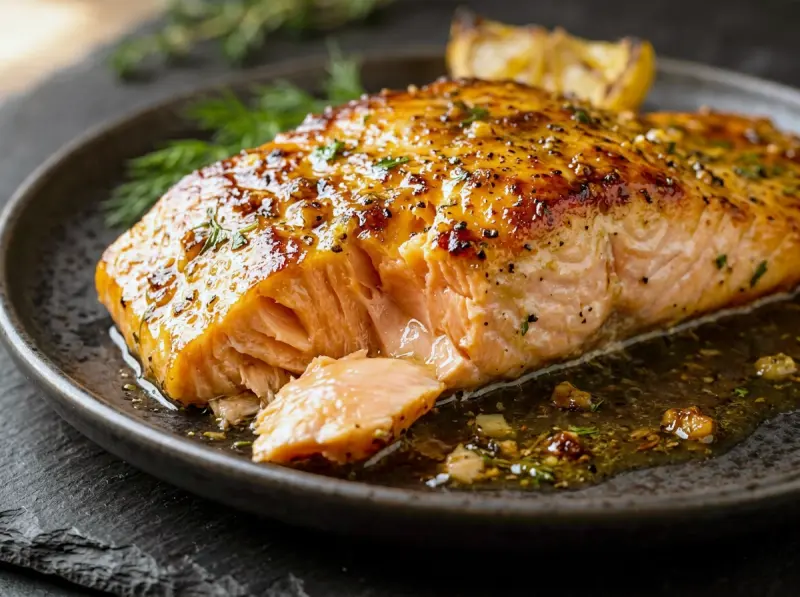
Salmón al Horno
Filetes de salmón untados con mantequilla al ajo, mostaza de Dijon y un poco de azúcar moreno, horneados a temperatura moderada hasta que el centro esté apenas opaco. Listo en 25 minutos.
Ingredientes
- 4 filetes de salmón, de 150–180 g cada uno
- 30 gmantequilla
- 1 limón
- 3 dientesde ajo
- 1 cdamostaza de Dijon
- 1 cdtaazúcar moreno
- 1 cdtapimentón ahumado
- 1 cdtasal
- 0.5 cdtapimienta negra
- 2 cdaseneldo o perejil fresco
Preparación
- Saca el salmón del frigorífico 15 minutos antes de cocinarlo. Sécalo completamente con papel de cocina: la humedad de la superficie impide que se dore. Precalienta el horno a 190°C.
- Derrite la mantequilla y mezcla con el ajo picado, la mostaza de Dijon, el zumo de medio limón, el pimentón ahumado, el azúcar moreno, la sal y la pimienta. Este es tu glaseado.

- Coloca los filetes con la piel hacia abajo en una bandeja forrada o en una fuente de horno. Unta el glaseado generosamente por encima y por los lados de cada filete. Corta en rodajas la otra mitad del limón y coloca una rodaja sobre cada pieza.

- Hornea 12–15 minutos según el grosor. Un filete de 2,5 cm tarda unos 13 minutos. El salmón está listo cuando la carne se vuelve rosada mate y la parte más gruesa se separa fácilmente al presionar con un tenedor. Temperatura interna en la parte más gruesa: 63°C es la recomendada para un pescado totalmente cocido. Si lo prefieres más jugoso, sácalo a 57–60°C, con el centro aún algo translúcido, pero no para embarazadas, niños ni personas mayores, que deben quedarse en 63°C.

- Saca del horno y deja reposar 2 minutos: el salmón sigue cocinándose con el calor residual. Esparce el eneldo o el perejil fresco por encima y sirve enseguida con los jugos de la bandeja por encima.
Preguntas
190°C durante 12–15 minutos para un filete de 2,5 cm. A 220°C+ el exterior se cocina rápido y casi no queda margen antes de que se seque. A 190°C el salmón sigue jugoso aunque te pases 1–2 minutos. La guía más fiable es un termómetro: 63°C en la parte más gruesa es la temperatura recomendada para un salmón bien cocido. De 57 a 60°C queda más jugoso, con el centro algo translúcido; es una elección para quien lo prefiere así, no para embarazadas, niños ni personas mayores. Por encima de 65°C empieza a secarse. Sin termómetro: presiona el centro con un tenedor, las capas deben separarse fácilmente y verse rosadas mate, no transparentes.
Es albúmina, una proteína soluble que se coagula y es expulsada de las fibras musculares con el calor. Completamente normal y seguro. A más temperatura y más tiempo de cocción, más albúmina. Para minimizarla: hornea a 190°C (no 220°C+), no lo cocines en exceso, y opcionalmente pon en salmuera 10 minutos antes (1 cdta de sal en 500 ml de agua fría). La salmuera desnaturaliza la albúmina previamente y aparece mucho menos durante la cocción.
Hornea con la piel hacia abajo, sin quitarla antes. La piel protege la carne delicada del calor directo, ayuda a que el filete se cocine de manera más uniforme y retiene la humedad. Tras el horneado, la piel se separa fácilmente: desliza una espátula por debajo. Quitar la piel antes es quitar la protección natural y da un resultado más seco. En el horno la piel está apoyada sobre el papel y queda blanda; para piel crujiente, cocina el filete con la piel hacia abajo en una sartén bien caliente.
Mantequilla + limón + ajo es el clásico que nunca falla. La mostaza de Dijon funciona muy bien para el salmón al horno: se adhiere bien, forma un ligero glaseado y no domina el sabor del pescado. Miel + salsa de soja + ajo produce una costra caramelizada estilo asiático. Regla importante: aplica cualquier marinada ácida (con limón) justo antes del horno — dejar el salmón en una marinada ácida más de 15–20 minutos cambia la textura de la superficie. La versión con miel está en el salmón con miel y ajo.
Tres comprobaciones visuales. Color: un salmón bien hecho es rosado mate en todo el grosor, con el centro algo más oscuro, casi translúcido. Uniformemente pálido significa que se ha pasado. Textura: presiona suavemente la parte más gruesa con un tenedor; las capas deben separarse con facilidad sin deshacerse del todo. Jugos: un poco de líquido blanquecino y translúcido en los lados indica que está listo. Un punto clave: el salmón sigue cocinándose 1–2 minutos fuera del horno por el calor residual, así que déjalo reposar 2 minutos en la bandeja. Un termómetro que marque 63°C en la parte más gruesa es el objetivo seguro.
Valora
Recetas en tu correo
Un correo a la semana: una receta elegida a tu gusto y lo nuevo del sitio. Puedes dejar de recibirlo con un clic.
De regalo: el libro de recetas de Sergei (e-book).
Al pulsar el botón aceptas la política de privacidad.
Cuéntanos qué te gusta cocinar (30 segundos) →Sigue explorando
Más platos del archivo — elegidos por su solapamiento con lo que estás cocinando ahora.
Únete a la conversación
Comentarios (2)
Не знаю как блюдо, но фотки можно жрать!
The residual heat continues cooking the salmon fillets for 2-3 minutes after you remove it from the pan. I pull my baked salmon when it looks slightly underdone in the center — it finishes perfectly on the plate.