
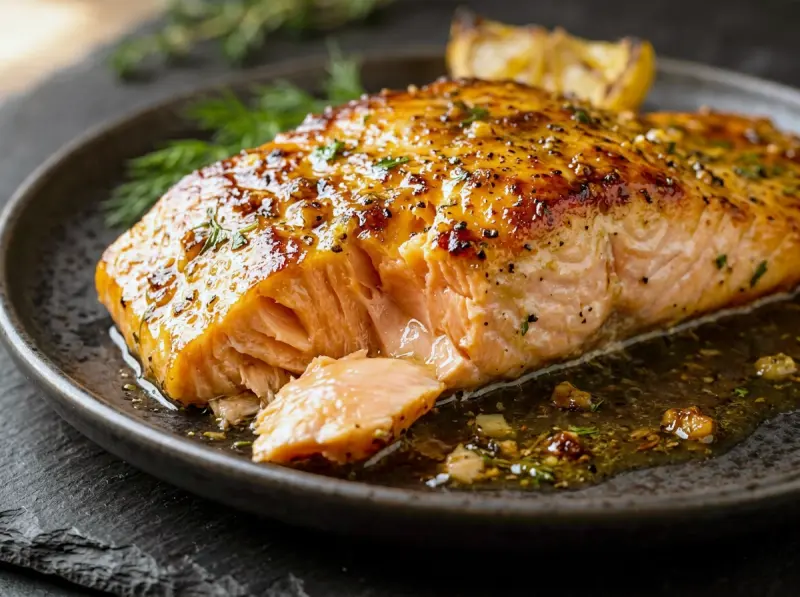
Baked Salmon
Salmon fillets brushed with garlic butter, Dijon mustard and a touch of brown sugar, baked at moderate heat until the center is just barely opaque. Done in 25 minutes and nearly impossible to get wrong if you watch the temperature.
Ingredients
- 4 salmon fillets, 150–180 g each
- 30 gbutter
- 1 lemon
- 3 garlic cloves
- 1 tbspDijon mustard
- 1 tspbrown sugar
- 1 tspsmoked paprika
- 1 tspsalt
- 0.5 tspblack pepper
- 2 tbspfresh dill or parsley
Method
- Take the salmon out of the fridge 15 minutes before cooking. Pat the fillets completely dry with paper towels — surface moisture prevents browning. Preheat the oven to 190°C (375°F).
- Melt the butter and stir in the minced garlic, Dijon mustard, juice of half the lemon, smoked paprika, brown sugar, salt and pepper. This is your glaze.

- Place the fillets skin-side down on a lined baking sheet or in a baking dish. Brush the glaze generously over the top and sides of each fillet. Slice the remaining half of the lemon and lay a slice on each piece.

- Bake for 12–15 minutes depending on thickness. A 2.5 cm thick fillet takes about 13 minutes. The salmon is ready when the flesh turns matte-pink and the thickest part flakes easily when pressed with a fork. Internal temperature at the thickest point: 63°C (145°F) is the recommended temperature for fully cooked fish. If you like it moister, take it out at 57–60°C (135–140°F), with the very center still slightly translucent — but not for pregnant women, children or older people, who should stay at 63°C.

- Remove from the oven and rest for 2 minutes — the salmon continues cooking from residual heat. Scatter fresh dill or parsley over the top and serve immediately with the pan juices spooned over.
FAQ
190°C (375°F) for 12–15 minutes for a 2.5 cm thick fillet. Higher temperatures (220°C+) cook the exterior fast but leave almost no margin before the fish dries out. At 190°C the salmon stays moist even if you leave it 1–2 minutes longer. The most reliable guide is a thermometer: 63°C (145°F) at the thickest part is the recommended temperature for fully cooked salmon. 57–60°C (135–140°F) gives a moister fish with a slightly translucent center, a choice for those who like it that way — not for pregnant women, children or older people. Above 65°C it starts drying. Without a thermometer: press the center with a fork — the layers should separate easily and look matte-pink, not transparent.
The white substance is albumin, a soluble protein that coagulates and is pushed out of the muscle fibres as the fish heats up. It is completely normal and safe to eat. The higher the temperature and the faster the cooking, the more albumin appears. To minimise it: bake at a moderate temperature (190°C rather than 220°C+), don't overcook, and optionally brine the salmon for 10 minutes before baking (1 tsp salt dissolved in 500 ml cold water). The brine partially denatures the albumin in advance, so far less of it appears as a white layer on the surface during cooking.
Bake skin-side down and do not remove the skin beforehand. The skin serves three purposes: it protects the delicate flesh from the direct heat of the pan, helps the fillet cook more evenly, and holds in moisture. After baking, the skin separates cleanly from the flesh — just slide a spatula underneath. Removing the skin before baking takes away the fish's natural barrier and consistently produces a drier result. In the oven the skin lies against the parchment and stays soft; for crispy skin, cook the fillet skin-side down in a hot skillet instead.
Butter + lemon + garlic is the classic that always works: butter adds richness and helps browning, lemon cuts the fattiness and brightens the flavor, garlic adds depth. Dijon mustard is excellent specifically for baked salmon: it adheres well to the surface, forms a light glaze and doesn't overpower the fish. Honey + soy sauce + garlic produces a caramelized Asian-style crust. One important rule: apply any acidic marinade (one containing lemon juice or vinegar) immediately before the oven — not in advance. Leaving salmon in an acidic marinade for more than 15–20 minutes starts denaturing the surface protein and changes the texture before the heat has even started. The honey version is in honey garlic salmon.
Three visual checks. First: color — correctly baked salmon is matte-pink throughout, with a slightly darker, almost translucent center. Uniformly pale throughout means it is overcooked. Second: texture — press the thickest part gently with a fork. The layers should flake apart easily but not fall apart completely. Third: juices — a small amount of whitish, translucent liquid appearing at the sides indicates the fish is ready. One critical point: salmon continues cooking for 1–2 minutes after it comes out of the oven from residual heat, so rest it on the tray for 2 minutes. A thermometer reading of 63°C at the thickest point is the safe target.
Rate this
Recipes by email
One letter a week: a recipe picked for your taste, plus whatever is new on the site. Unsubscribe in one click.
Welcome gift: Sergei's cookbook (e-book).
By subscribing you agree to the privacy policy.
Tell us what you like to cook (30 seconds) →Keep browsing
More dishes from the American archive — picked by overlap with what you're cooking now.
Join the conversation
Comments (2)
Не знаю как блюдо, но фотки можно жрать!
The residual heat continues cooking the salmon fillets for 2-3 minutes after you remove it from the pan. I pull my baked salmon when it looks slightly underdone in the center — it finishes perfectly on the plate.