
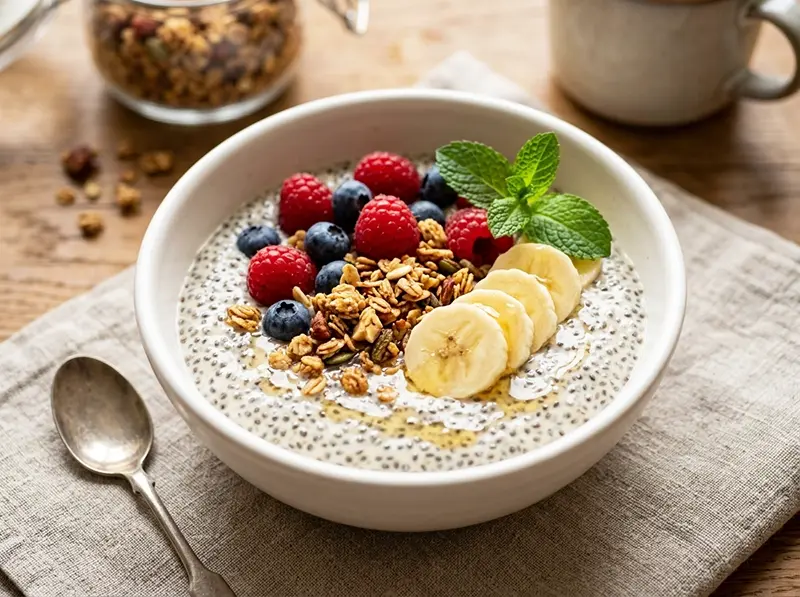
Overnight Chia Pudding
Five minutes of actual work, and breakfast is waiting for you in the fridge by morning. Chia seeds absorb ten times their weight in liquid overnight, transforming into a thick, creamy pudding with no cooking whatsoever. I use a simple ratio — two tablespoons of chia seeds to 150ml of liquid — and the result is somewhere between tapioca pudding and panna cotta. Sweeten with maple syrup or honey, add a splash of vanilla, and top with whatever fruit is in season. It keeps for three days in the fridge, so I usually make a double batch on Sunday night.
Ingredients
- 4 tbspchia seeds
- 300 mlmilk
- 1-2 tbspmaple syrup or honey
- 0.5 tspvanilla extract
- 1 pinchsalt
Method
- In a jar or container with a lid, combine 4 tablespoons of chia seeds, 300ml of milk, the sweetener, vanilla extract, and a pinch of salt. Stir well with a fork — really well. The goal is to separate every seed so none clump together at the bottom.
- Wait 5 minutes, then stir again. This is important — chia seeds start gelling immediately and will clump into a solid mass at the bottom if you skip this second stir. Break up any clumps you see.
- Cover the jar and refrigerate for at least 4 hours, but overnight (8–12 hours) is ideal. The seeds need time to absorb the liquid fully and swell into a soft, gel-like texture.
- In the morning, give it a good stir. If the pudding is thicker than you like, add a splash of milk (2–3 tablespoons) and stir until it reaches your preferred consistency. Some people like it thick like Greek yogurt, others prefer it pourable.
- Top with fresh berries, sliced banana, a drizzle of honey, granola, coconut flakes, nut butter, or anything you enjoy. The pudding itself is a neutral base — it takes on whatever flavor you layer onto it.
FAQ
Chia seeds are tiny black or white seeds from the Salvia hispanica plant, originally from Mexico and Guatemala. They're available in most supermarkets — check the health food aisle, baking section, or near the oatmeal and granola. They're also widely available online. If you truly cannot find them, ground flaxseed (also called flax meal) is the closest substitute — use the same 2:1 ratio (2 tablespoons to 150ml liquid). The texture will be slightly grittier and less gel-like, but it works. Basil seeds (sabja/tukmaria) also gel similarly and can be used as a 1:1 replacement.
Clumping happens when the seeds aren't stirred enough in the first 10 minutes. Chia seeds start gelling on contact with liquid, and if a group of seeds touches, they gel together into a blob. The fix: stir vigorously with a fork right after combining (not a spoon — a fork separates seeds better), then stir again after 5 minutes, and once more after 10 minutes. Three stirs in the first 10 minutes prevents clumping almost completely. If your pudding is already clumpy, you can blend it with an immersion blender or regular blender — it won't be as pretty but the texture will be smooth.
The standard ratio is 2 tablespoons of chia seeds to 150ml of liquid (or roughly 1:4 by volume). Too thin means you used too much liquid or didn't wait long enough — give it the full 8 hours. Too thick means you used too many seeds — add milk 1 tablespoon at a time until it reaches the right consistency. The type of milk matters too: full-fat coconut milk makes the thickest pudding, almond milk makes the thinnest. Adjust the ratio slightly based on your milk choice. If you're scaling up, stick exactly to the ratio — chia pudding doesn't forgive eyeballing.
Chia pudding keeps well in the fridge for up to 4 days in a sealed container. After that, the texture starts breaking down and it can develop an off taste. For weekly meal prep, make a batch Sunday night and eat through Wednesday or Thursday. Don't add fresh fruit toppings until you're ready to eat — fruit releases juice and makes the pudding watery. The base pudding (seeds, milk, sweetener) stores perfectly. If it thickens too much after a day or two, just stir in a splash of milk before eating.
Each gives a noticeably different result. Full-fat coconut milk (from a can, not the carton) produces the richest, most dessert-like pudding — thick, creamy, almost like panna cotta. Oat milk is a great middle ground: creamy, slightly sweet, and neutral enough to let toppings shine. Whole dairy milk makes a classic, protein-rich pudding. Almond milk is the lightest and thinnest — it works but the pudding won't be as creamy. If you want the indulgent version, coconut milk is the answer. For everyday breakfast, oat or dairy milk is the most balanced choice.
Rate this
Recipes by email
One letter a week: a recipe picked for your taste, plus whatever is new on the site. Unsubscribe in one click.
Welcome gift: Sergei's cookbook (e-book).
By subscribing you agree to the privacy policy.
Tell us what you like to cook (30 seconds) →Keep browsing
More dishes from the American archive — picked by overlap with what you're cooking now.
Join the conversation
Comments (1)
The beauty of this overnight chia pudding is zero cooking — just smart preparation. I measure out the chia seeds and milk into individual jars on Sunday, and I have breakfast ready for the entire week.