
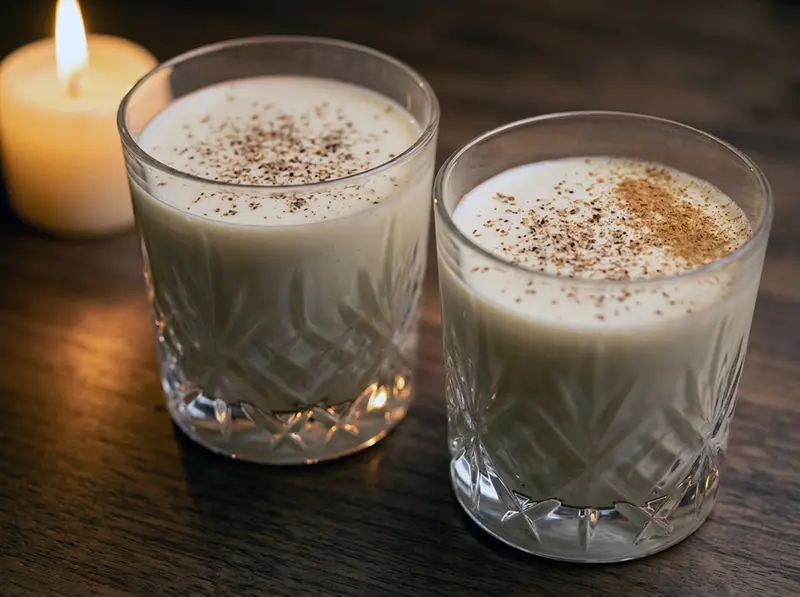
Homemade Eggnog
Egg yolks cooked into a thin custard with milk, cream, nutmeg, and vanilla, then chilled until thick. Store-bought eggnog is sweet and shelf-stable; this is something different — rich from real eggs, fragrant from freshly grated nutmeg, and thick enough to coat the back of a spoon. The technique is exactly the same as making crème anglaise. If you've made that before, you already know how to make eggnog.
Ingredients
- 6 large egg yolks
- 100 ggranulated sugar
- 480 mlwhole milk
- 240 mlheavy cream
- 0.5 tspfreshly grated nutmeg
- 1 tspvanilla extract
- 1 pinch of fine salt
- 120 mlbourbon, dark rum or brandy
Method
- Whisk yolks and sugar. Put the egg yolks and sugar into a medium bowl. Whisk vigorously for 2 to 3 minutes until the mixture is pale yellow, smooth, and thick enough that the whisk leaves a visible trail. This step matters: undissolved sugar will create a gritty texture in the finished eggnog, and yolks that haven't been properly aerated will give a flat, heavy result. Set the bowl aside near the stove within easy reach.
- Heat the milk and cream. Combine the milk, cream, nutmeg, and salt in a medium heavy-bottomed saucepan. Heat over medium heat, stirring occasionally, until the mixture just begins to steam and small bubbles appear at the edges — about 4 to 5 minutes. Do not let it boil. At this point, the liquid should be hot enough to temper the eggs but not so hot that it scrambles them on contact. If it starts bubbling actively, pull it off the heat for 30 seconds before proceeding.
- Temper the eggs. This is the step that prevents scrambled egg in your eggnog. Ladle about 120 ml of the hot milk into the egg yolk mixture in a slow, steady stream, whisking constantly and fast. The goal is to raise the temperature of the eggs gradually. Add another ladleful and whisk again. Once you've added about half the hot milk, the egg mixture is warm enough to combine safely. Pour the egg mixture back into the saucepan with the remaining milk, whisking as you pour.
- Cook to 71°C. Return the saucepan to medium-low heat. Stir constantly with a wooden spoon or heatproof spatula, scraping the bottom and sides of the pan. Cook until the custard thickens enough to coat the back of the spoon — when you run your finger across the back of the spoon, it should leave a clean line. On a thermometer, this is 71 to 74°C (160 to 165°F). Do not let it boil or the eggs will scramble. Remove from heat immediately once it thickens. Strain through a fine-mesh sieve into a clean bowl or pitcher to catch any cooked egg bits.
- Cool, chill, and serve. Stir in the vanilla extract. Let the eggnog cool to room temperature, stirring occasionally to prevent a skin from forming. Then cover and refrigerate for at least 3 hours, preferably overnight — the flavor deepens and the texture thickens considerably as it chills. Before serving, stir well and taste. Add bourbon, rum, or brandy now if using — stir in and taste again. Ladle into glasses over ice or serve straight from the fridge. Grate fresh nutmeg generously over each glass.
FAQ
Cooking is strongly recommended. Tempering and cooking the yolks to 71°C eliminates salmonella risk while also giving a better result than raw eggnog — the cooked custard is silkier and thicker, and holds together cleanly in the fridge. If you want to skip cooking entirely, use pasteurized eggs. The alcohol in spiked eggnog provides some protection against bacteria, but it's not reliable enough to skip food-safety precautions, especially for children, elderly, or pregnant guests.
Store-bought eggnog contains starch, carrageenan, and artificial flavoring, and can sit on a shelf for months. Homemade is eggs, milk, cream, sugar, and nutmeg, full stop. The texture of homemade is lighter and drinkable rather than pourable-but-thick; the flavor is actually eggy and fragrant with real spice. The single biggest practical difference is freshly grated nutmeg: pre-ground nutmeg from a jar smells like very little. Fresh nutmeg on a microplane smells like the whole point of the drink.
Bourbon, dark rum, and brandy are the traditional choices. Bourbon gives vanilla and caramel notes that work well with the spices. Dark rum is sweeter and rounder. Brandy is drier and more subtle. Add it after the eggnog has fully chilled, not into the hot custard — adding alcohol to hot liquid drives off the aromatic compounds. Start with 30 ml per serving and adjust to taste. Eggnog with alcohol actually improves after a day or two in the fridge: the spirit softens and the flavors merge.
For richer, thicker eggnog: use more yolks (up to 8 for this recipe), increase the cream-to-milk ratio, or cook the custard a little longer. For lighter eggnog: replace some cream with milk, or beat the egg whites separately to stiff peaks and fold them in before serving — this gives a frothy, punch-like texture that's less rich. The most reliable formula for a classic thick result is 2 parts cream to 1 part milk. Adding whipped cream on top at serving adds richness without changing the body of the drink.
Without alcohol: 3 to 4 days refrigerated in a sealed jar. With alcohol (50 ml or more per serving): up to 1 week — the spirit acts as a preservative and the flavor continues to improve. Making it ahead is not just acceptable, it's recommended: fresh eggnog is a bit rough around the edges, and a night in the fridge lets the custard set, the spices settle, and the flavors unify. If the eggnog separates slightly after storage, whisk it briefly before serving — it comes back together easily.
Rate this
Recipes by email
One letter a week: a recipe picked for your taste, plus whatever is new on the site. Unsubscribe in one click.
Welcome gift: Sergei's cookbook (e-book).
By subscribing you agree to the privacy policy.
Tell us what you like to cook (30 seconds) →Keep browsing
More dishes from the American archive — picked by overlap with what you're cooking now.
Join the conversation
Comments (1)
I always chill the glasses for homemade eggnog — 15 minutes in the freezer transforms the drinking experience. The frost on the glass keeps everything at the perfect temperature through the last sip.