
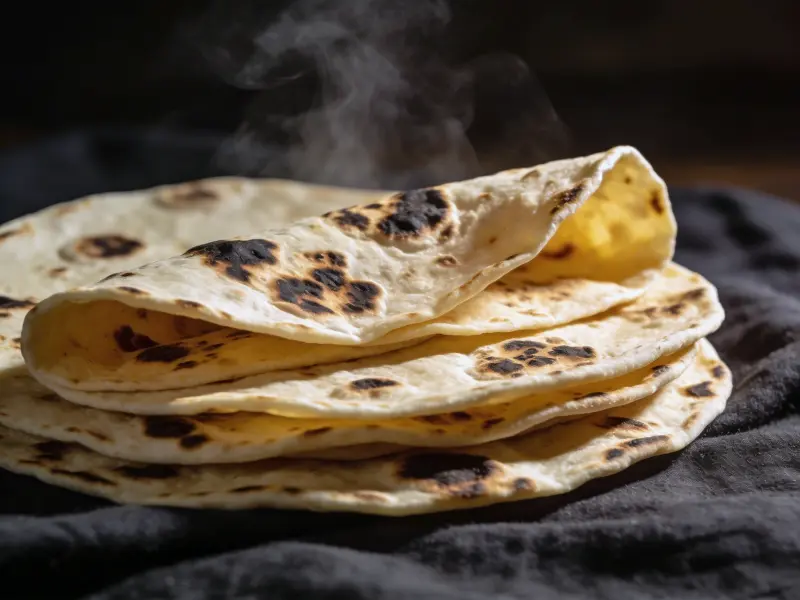
Flour Tortillas (Tortillas de Harina)
Tortillas de harina are the defining bread of Northern Mexico — particularly Sonora, where the Sonoran Desert's wheat-growing tradition produced a flatbread entirely different from the corn tortillas of central and southern Mexico. Made from just flour, lard, salt, and hot water, they are rolled thin and cooked on a dry, screaming-hot comal until dark blisters (leopard spots) appear and the tortilla puffs with steam. The result is soft, pliable, slightly chewy, and deeply wheaty — the essential wrapper for carne asada, burritos, quesadillas, and tacos. Lard is the defining ingredient: it coats the flour proteins, preventing excessive gluten development, and produces a tender, flexible tortilla that stays soft even when cold. Vegetable shortening is a practical substitute; butter gives richness but less pliability.
Ingredients
- 400 gplain flour
- 1 tspfine salt
- 0.5 tspbaking powder
- 80 glard
- 220 mlhot water
Method
- Make the dough. Whisk together the flour, salt, and baking powder in a large bowl. Add the lard and rub it into the flour with your fingertips, working quickly, until the mixture resembles coarse, damp sand — no large lumps of fat remaining. Make a well and pour in the hot water all at once. Use a fork or wooden spoon to stir until a shaggy dough forms, then turn out and knead by hand for 2 to 3 minutes until smooth and soft. Hot water partially gelatinises the starch, producing a more pliable, extensible dough from the start. The dough should be soft — softer than bread dough — and not sticky. If it tears when stretched, knead 1 more minute.
- Rest the dough. Divide the dough into 8 equal portions (about 90 g each). Roll each into a smooth ball. Place on a lightly floured surface, cover with a damp kitchen towel or cling film, and rest for 30 minutes. This is non-negotiable: resting allows the gluten to relax so the tortillas can be rolled thin without springing back. A dough rolled immediately will shrink back constantly and produce thick, doughy tortillas.
- Roll the tortillas thin. On a lightly floured surface, flatten a dough ball into a disc with your palm. Using a rolling pin, roll outward from the center, rotating the dough a quarter-turn after each pass. Aim for a 22 to 25 cm (8 to 10 inch) circle, 2 to 3 mm thin — thin enough to be slightly translucent when held to light. Roll thinner than you think is necessary. Do not flour excessively — too much flour makes the tortillas dry and stiff.
- Cook on a screaming-hot comal. Heat a dry, heavy skillet, cast-iron pan, or comal over the highest heat for at least 3 to 4 minutes — it must be very hot. Place the tortilla in the dry pan (no oil, no butter). Cook for 30 to 45 seconds until the underside develops dark blisters (leopard spots) and the top surface looks dry and matte. Flip and cook 20 to 30 seconds until blisters appear on the second side. The tortilla will puff briefly — press gently with a folded cloth to encourage even puffing. Do not overcook: the moment of perfection passes quickly.
- Stack and keep warm. Transfer each cooked tortilla immediately to a stack covered by a clean cloth or in a tortilla warmer. The trapped steam keeps them soft and pliable as they cool. Tortillas cooked and left uncovered for even 2 minutes become dry and crack when folded. Serve warm — or reheat briefly in a dry pan or directly over a gas flame for 5 to 10 seconds per side to restore pliability.
FAQ
Lard produces the most authentic flour tortilla because of how it interacts with the flour. As a semi-solid fat with a particular crystal structure, lard coats the flour proteins (gluten precursors) when rubbed in, physically preventing them from linking into long gluten chains. This inhibition of gluten development is what produces the characteristically tender, flexible tortilla. Animal fats in general, and lard specifically, also have a flavor — a subtle, savory, slightly nutty quality — that is a significant part of authentic Northern Mexican tortilla taste. Vegetable shortening is a reasonable substitute for texture but lacks the flavor. Butter produces a richer flavor but creates a slightly less pliable tortilla because of its higher water content. Liquid oils work but produce a firmer, less flaky result.
Hot water (80 to 90°C) partially gelatinises the starch granules in the flour before any kneading occurs — the same principle as the tangzhong technique in Japanese milk bread. Gelatinised starch absorbs and holds water far more efficiently than raw starch, producing a dough that is more hydrated without being sticky, more extensible without tearing, and easier to roll to a very thin sheet. Warm water simply hydrates the flour without this gelatinisation effect, producing a stiffer dough that fights back when rolled. The difference in rollability between a near-boiling-water dough and a warm-water dough is significant and immediately apparent.
Flour and corn tortillas are fundamentally different products with different regional traditions, techniques, ingredients, and uses. Corn tortillas are made from masa — dried corn that has been nixtamalised (soaked in an alkaline solution, which transforms the corn's protein and nutrition profile) and ground into a dough — then pressed and toasted. They are the ancient staple of central and southern Mexico, gluten-free, earthy, with a distinct mineral-sweet corn flavor. Flour tortillas originated in Northern Mexico following Spanish wheat cultivation in the 16th century. They contain gluten (wheat flour), are leavened slightly by steam, and have a neutral, wheaty flavor. Flour tortillas are softer, more pliable, and better suited to burritos and quesadillas; corn tortillas are drier, slightly crumbly, and better suited to tacos and enchiladas.
The dark blisters are a direct result of cooking on a very hot, dry surface. When a thin tortilla hits a screaming-hot pan, pockets of steam form instantly between the dough surface and the pan, creating bubbles. The localised high heat from direct contact with the pan surface at the points where the tortilla touches the metal causes the Maillard reaction — the caramelisation of sugars and proteins at the contact points — producing the distinctive dark, slightly smoky spots. A pan that is not hot enough will produce pale, anemic spots with no flavor. The leopard spots are not just visual: they contribute the characteristic slightly smoky, toasty flavor of a properly cooked flour tortilla.
Yes — replace lard gram-for-gram with refined coconut oil at room temperature (solid), or vegetable shortening, or use 60 ml of neutral oil (sunflower, canola) in place of 80 g lard. Reduce the amount slightly when using liquid oil as oil hydrates the flour differently than a solid fat. The resulting tortilla will be somewhat less tender and pliable than the lard version — particularly when cold — but perfectly good when fresh. The flavor will also be slightly less rich. Rub solid fats into the flour as you would lard; for liquid oil, stir it into the flour before adding the water.
Keep browsing
More dishes from the Mexican archive — picked by overlap with what you're cooking now.
Recipes by email
One letter a week: a recipe picked for your taste, plus whatever is new on the site. Unsubscribe in one click.
Welcome gift: Sergei's cookbook (e-book).
By subscribing you agree to the privacy policy.
Tell us what you like to cook (30 seconds) →
Join the conversation
Comments
No comments yet — be the first!