
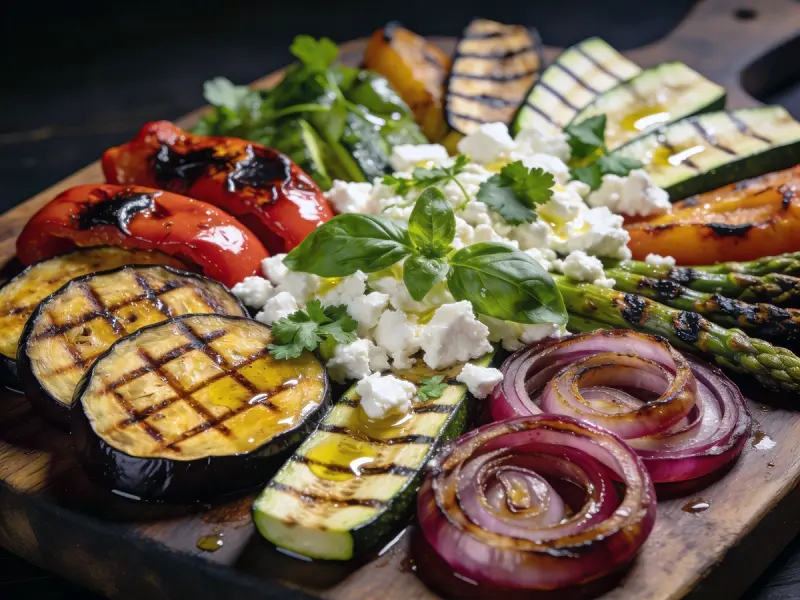
Grilled Vegetable Platter
A grilled vegetable platter is the most underrated item at any barbecue — and the most versatile. Where meat requires precise temperature control and resting times, vegetables are forgiving: they tell you when they are done by releasing from the grates, and they improve with a few minutes of rest, during which the heat equalises and the marinade or dressing soaks in. The technique is the same across all vegetables: oil them generously (oil on the vegetable, not just the grate), grill on medium-high direct heat for the time each vegetable needs, and dress them hot — a vinaigrette applied to hot vegetables is absorbed rather than sitting on the surface. The key to a beautiful platter is timing: eggplant and peppers need the most time; zucchini and asparagus need the least. The trick is to work in sequence, pulling each vegetable as it finishes, and to arrange everything on one platter together so the final dish is warm and accessible.
Ingredients
- 1 large eggplant
- 2 medium zucchini
- 2 red or yellow bell peppers
- 1 red onion
- 200 gcherry tomatoes
- 1 bunchasparagus
- 200 gportobello or large button mushrooms
- 6 tbspextra-virgin olive oil
- 1 tspcoarse sea salt
- 1 tspfreshly cracked black pepper
- 4 garlic cloves
- 1 tspdried oregano
- 3 tbspextra-virgin olive oil
- 2 tbsplemon juice
- 1 tbspred wine vinegar
- 1 tspsumac or ½ tsp smoked paprika
- 1 small bunchfresh basil and flat-leaf parsley
- 100 gfeta cheese
Method
- Prepare the eggplant and toss all vegetables. Eggplant contains moisture that can cause steaming rather than searing on the grill. To prevent this: slice into 1 cm rounds, salt both sides, and leave in a colander for 20 minutes. Pat completely dry with paper towels. Meanwhile, prepare the rest: cut the zucchini lengthwise into 1 cm slices or thick diagonal slices; seed the bell peppers and cut them into quarters; cut the red onion into 1 cm rounds; snap the woody ends off the asparagus; leave the mushrooms whole or halve the large ones; keep the cherry tomatoes whole, on the vine if you have them. The grilling times in step 3 are for pieces of this size. Combine the olive oil, minced garlic, salt, pepper, and oregano in a large bowl. Add all the prepared vegetables and toss thoroughly to coat every surface. The oil on the vegetable surface — not the grill grate — is what prevents sticking and promotes the Maillard reaction.
- Set up a two-zone grill. For charcoal: build a moderate fire concentrated on one side of the grill (medium-high direct, approximately 220°C/430°F). For gas: set one side to medium-high, leave one side lower. The two zones are essential: the high-heat side builds char marks and crust; the lower side finishes vegetables through without burning them. Oil the grates with a paper towel dipped in oil. The grill is ready when a few drops of water evaporate instantly on contact.
- Grill in sequence by cooking time. Work in batches by cooking time — do not crowd the grill or the vegetables will steam. Start with the longest-cooking items. Eggplant rounds: 4 to 5 minutes per side over direct heat until deeply golden and soft through the center. Bell peppers: 4 to 5 minutes per side skin-side down until blistered. Red onion: 4 minutes per side over medium-direct heat. Mushrooms: 3 to 4 minutes per side. Zucchini: 2 to 3 minutes per side. Asparagus: 2 minutes per side, rolling occasionally. Cherry tomatoes: 2 to 3 minutes without moving until blistered. Transfer each vegetable to a baking sheet or platter as it finishes — do not stack hot vegetables on top of each other.
- Make the dressing and finish hot. While the last vegetables are grilling, whisk together the dressing olive oil, lemon juice, red wine vinegar, sumac (or smoked paprika), and a pinch of salt. The key insight: dress the vegetables while still hot. Hot vegetables absorb the dressing into their flesh rather than just sitting in it on the surface, and the acidity of the lemon and vinegar brightens the charred flavor. Toss or drizzle over the hot grilled vegetables. Leave to rest for 5 to 10 minutes before plating — this allows the dressing to penetrate and the textures to settle.
- Arrange the platter. On a large wooden board or deep platter, arrange the grilled vegetables in loose sections by type and color — do not mix them into a mush. Alternate colors: dark eggplant next to bright peppers, green zucchini next to charred asparagus. Scatter the torn fresh herbs over the top. Crumble the feta across the center if using. Drizzle a final thread of good olive oil over everything. Serve immediately or at room temperature within 1 hour — grilled vegetables are excellent warm but genuinely taste better as the dressing soaks in over 15 to 20 minutes.
FAQ
Vegetables stick for the same reason fish and meat stick: insufficient heat, insufficient oil on the surface, and moving them before they have formed a sear crust. The solution is the same for all three. First, oil the vegetable itself generously — oil on the food, not just on the grate, ensures even coverage. Second, make sure the grill is fully preheated and the grates are hot (a drop of water should evaporate instantly). Third, do not try to move a vegetable immediately after placing it — let it cook undisturbed until a char crust forms, which naturally releases it from the grate. A vegetable that resists lifting is not yet ready to flip.
The cut determines how much surface area contacts the grill (more surface = more char) and how evenly the vegetable cooks (uniform thickness = even cooking). Eggplant: 1 cm rounds — thin enough to cook through without burning the exterior, thick enough to hold together on the grill. Zucchini: halved lengthwise or 1 cm diagonal planks — lengthwise gives maximum char surface. Bell peppers: quartered — large flat pieces lay flat on the grates. Red onion: 1 cm rounds with a toothpick to hold rings together. Asparagus: whole spears with ends snapped off. Mushrooms: halved if large, whole if small — stem-side down first. Cherry tomatoes: whole or halved, grilled cut-side down.
Yes — this is one of the best features of a grilled vegetable platter. Grilled vegetables improve significantly with 15 to 30 minutes of resting in the dressing, and they are genuinely excellent at room temperature or even slightly warm, unlike most hot dishes that deteriorate once cold. Grill and dress up to 3 hours ahead and leave covered at room temperature. They can be refrigerated for up to 2 days; remove from the refrigerator 30 minutes before serving to come to room temperature, and add fresh herbs immediately before presenting.
Almost any vegetable can be grilled given the right preparation. Corn on the cob: grill in the husk for 15 minutes total, turning occasionally, then peel and serve with herb butter — this is covered in its own recipe. Romaine lettuce: halved lengthwise, brushed with oil, grilled cut-side down for 2 minutes until lightly charred — served with Caesar dressing. Fennel: sliced into 1 cm slabs, grilled 4 minutes per side — excellent with citrus. Broccoli: cut into large florets, tossed in oil, 3 to 4 minutes per side over medium-high heat. Leeks: halved lengthwise, brushed generously with oil, grilled 5 to 6 minutes until tender. Avocado: halved and pitted, grilled cut-side down 3 to 4 minutes, served with lime.
The key principle is acidity: grilled vegetables benefit enormously from an acidic element that lifts and brightens the charred flavor. Classic options in order of intensity: Ladolemono (Greek olive oil and lemon, perhaps with capers and herbs — included in this recipe); Salsa verde (Italian herb sauce — purée of parsley, capers, anchovies, garlic, and olive oil); Balsamic glaze drizzled over the arranged platter; Tahini sauce thinned with lemon juice; Romesco (roasted pepper and almond sauce); Whipped feta (feta blitzed with olive oil and lemon until smooth). For toppings: crumbled feta (included here), toasted pine nuts, pomegranate seeds, or shaved Parmesan all add texture and richness.
Keep browsing
More dishes from the American archive — picked by overlap with what you're cooking now.
Recipes by email
One letter a week: a recipe picked for your taste, plus whatever is new on the site. Unsubscribe in one click.
Welcome gift: Sergei's cookbook (e-book).
By subscribing you agree to the privacy policy.
Tell us what you like to cook (30 seconds) →
Join the conversation
Comments
No comments yet — be the first!