

Naan Bread
Yeasted flatbread made with yogurt, cooked on a very hot cast-iron skillet until the surface blisters and the edges char. The yogurt softens the dough and relaxes the gluten — without it, the bread would be chewier and more bready. The skillet must be genuinely hot before the dough goes in: that instant heat is what turns the moisture in the dough to steam, inflates the bubbles, and gives the bread its characteristic uneven surface. Brush with butter or ghee immediately off the heat. Makes 6 pieces.
Ingredients
- 320 gplain flour
- 7 ginstant yeast or 2 tsp active dry yeast
- 1 tspsugar
- 1 tspfine salt
- 120 gplain full-fat yogurt
- 100 mlwarm water
- 2 tbspneutral oil or melted ghee
- 40 gbutter or ghee
- 2 tbspchopped fresh cilantro or finely grated garlic, for the topping
Method
- Make and prove the dough. If using active dry yeast: combine yeast, sugar, and warm water in a small bowl and leave for 10 minutes until foamy. If using instant yeast: mix directly with the flour. Combine flour, instant yeast (or the activated dry yeast liquid), salt, yogurt, warm water (if not already used), and oil in a large bowl. Mix until a shaggy dough forms, then knead for 8 minutes until smooth and slightly tacky — it should not stick to your hands but should feel soft. Shape into a ball, oil the bowl lightly, place the dough in, cover with a damp cloth or cling film, and leave in a warm spot for 60 to 75 minutes until doubled in size.
- Divide and rest. Turn the dough onto a lightly floured surface. Divide into 6 equal pieces (about 90 g each). Roll each piece into a smooth ball. Place on a lightly floured tray, cover loosely, and rest for 15 minutes. This short rest relaxes the gluten so the dough rolls out easily without springing back.
- Roll out. Working with one ball at a time (keep the others covered), roll on a lightly floured surface into a teardrop or oval shape about 20 cm long and 3 to 4 mm thick. Naan does not need to be a perfect circle — the irregular shape is part of it. If the dough springs back when you try to roll it, let it rest another 5 minutes.
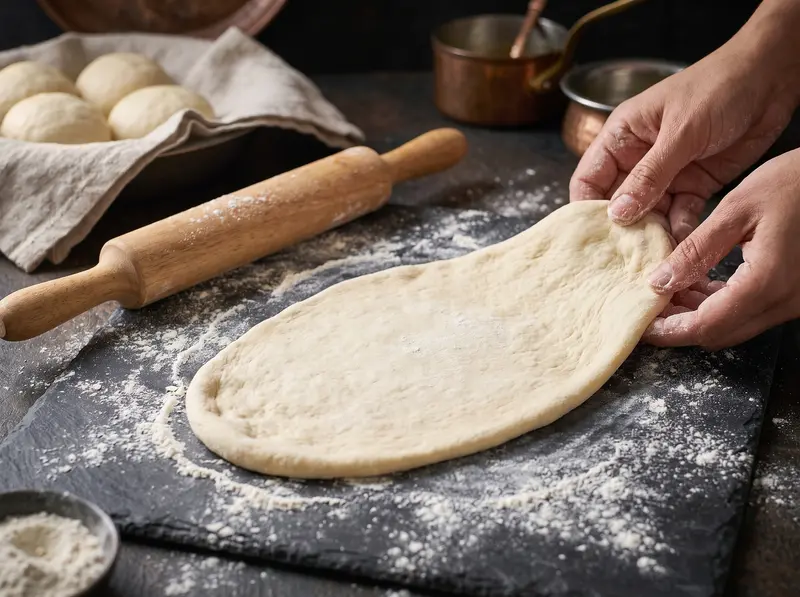
- Cook. Heat a heavy cast-iron skillet or tawa over high heat for at least 3 minutes until very hot — a drop of water should sizzle and evaporate immediately. Place one naan in the dry skillet. Cover with a lid for the first 45 seconds — the steam builds pressure and inflates the characteristic bubbles. Remove the lid, check the underside (it should have dark brown spots), flip, and cook uncovered for 30 to 45 seconds more. Total time per naan: under 2 minutes. The surface should blister and char at the edges.
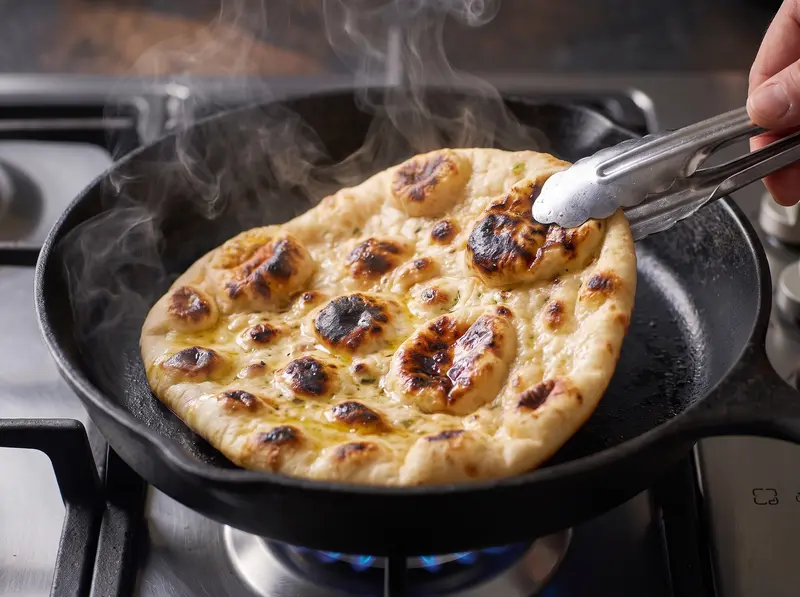
- Finish and serve. Melt the butter or ghee; for garlic naan, stir the grated garlic into the warm butter. Transfer each naan directly to a plate and immediately brush generously with the butter while hot — it soaks in and gives the naan its glossy, soft finish. Scatter chopped cilantro over the top if using. Stack and cover with a clean cloth to keep warm while you cook the remaining pieces. Serve immediately.
FAQ
The bubbles form when moisture in the dough hits intense heat and instantly vaporises into steam. Three reasons naan doesn't puff: First, the pan is not hot enough — the skillet must be genuinely smoking before the dough goes in; a drop of water should evaporate the instant it lands. Second, the dough is rolled too thick — 3 to 4 mm is the target. Third, the yeast was not properly activated or the dough didn't rise fully. Covering the skillet with a lid for the first 45 seconds traps steam and builds the internal pressure that inflates the bubbles.
Both work but produce different results. Yeasted naan is the traditional version: light, airy, with a characteristic chew and mild sourness from fermentation. It requires 1 to 1.5 hours of proving. Quick naan with baking powder is ready in 20 to 30 minutes, is flatter and denser, with no flavor depth — closer to a thick flatbread. If time is short, a teaspoon of baking powder plus half a teaspoon of baking soda mixed into the flour gives a passable result. Instant yeast (fast-action yeast) is a good middle ground: add it directly to the flour without proofing, cutting rise time to 45 to 60 minutes.
Yogurt does three things in naan dough: the fat adds richness and softness, the acidity relaxes the gluten structure so the bread is soft rather than rubbery, and it contributes a characteristic mild tang. Substitutes: kefir (best substitute, similar acidity); sour cream at 10 to 15% fat (richer flavor); milk plus 1 teaspoon of lemon juice or vinegar, mixed and left 5 minutes to curdle slightly; plant-based yogurt for a vegan version. Without any dairy, the naan will still work but will taste more like plain bread and be slightly less tender.
Naan is best eaten warm straight from the skillet. For storage: wrap in foil at room temperature for up to 2 days or refrigerate for up to 5 days. To freeze: stack cooled naan with parchment paper between each piece and freeze for up to 3 months. To reheat: 30 to 60 seconds on each side in a dry hot skillet is the best method — it comes close to freshly made. Alternatively, wrap in foil and heat in a 180°C oven for 5 minutes. A microwave for 20 seconds under a damp paper towel also works but softens rather than crisps the bread. A light sprinkle of water before reheating in a skillet helps prevent drying out.
They are distinct breads. Naan is yeasted (or leavened with baking powder), soft and chewy, made with dairy (yogurt), cooked on the hot wall of a tandoor — the dairy content is what makes it different from the others. Chapati is unleavened whole-wheat flatbread, very thin, no fat, the everyday bread of the Indian subcontinent — much simpler and lighter than naan. Pita is a Middle Eastern yeasted flatbread baked in a hot oven so steam inflates an internal pocket; it is drier than naan. Lavash is an Armenian and Middle Eastern flatbread, extremely thin, made with or without yeast, dry and crisp in the flat baked form. Naan is the only one of the four traditionally made with dairy, giving it its characteristic softness and flavor.
Rate this
Recipes by email
One letter a week: a recipe picked for your taste, plus whatever is new on the site. Unsubscribe in one click.
Welcome gift: Sergei's cookbook (e-book).
By subscribing you agree to the privacy policy.
Tell us what you like to cook (30 seconds) →Keep browsing
More dishes from the Indian archive — picked by overlap with what you're cooking now.



Join the conversation
Comments (2)
I tried baking naan in the oven for years before switching to a dry cast-iron skillet on the stovetop. Night and day difference. The direct contact heat creates those signature brown spots and blisters in about 90 seconds. The yogurt in this dough is not optional — it gives the bread that slight tang and keeps it soft even after it cools. Brush melted butter on immediately while it is still hot enough to sizzle.
El naan en sartén de hierro es una revelación!! Nunca lo había hecho así y queda mejor que el del horno. La masa con yogur es súper suave. Pongo mantequilla y ajo cuando sale de la sartén, mientras está caliente. Ya no compro naan en el supermercado, este es otro nivel completamente.