
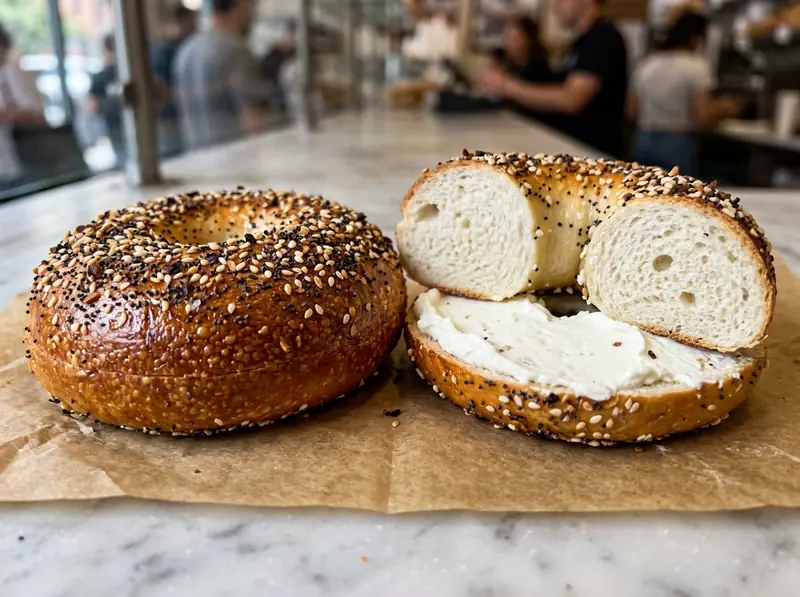
New York-Style Bagels
A New York bagel is a ring of stiff wheat dough that is boiled and then baked — the New York take on a bread of Ashkenazi Jewish origin. The dough is lean, with no fat and no eggs: only bread flour, water, yeast, salt and barley malt syrup. With 58% water it is much stiffer than ordinary bread dough and has to be kneaded until smooth and elastic. After a night in the refrigerator, which builds flavour, the bagels are shaped and boiled for a minute a side in water with malt syrup, to which this home version adds a spoonful of bicarbonate of soda for a darker crust; the boil gelatinises the starch on the surface, sets the crust and gives the dense chew that separates a bagel from a roll. They are then baked in a hot oven until deep golden-brown and shiny. Seeds or 'everything' seasoning go on while the bagels are still wet from the pot, and they are eaten split with cream cheese and smoked salmon, or warm with nothing at all. Start the day before: the work and the oven take about 70 minutes, but the dough also rises for an hour, spends 8 to 24 hours in the refrigerator and rests for 30 to 45 minutes once shaped.
Ingredients
- 500 gbread flour
- 7 ginstant yeast
- 10 gfine salt
- 1 tbspbarley malt syrup, for the dough (or honey)
- 290 mlwarm water
- 2 tbspbarley malt syrup, for the boiling water (or honey)
- 1 tbspbicarbonate of soda, for the boiling water (optional)
- 4 tbsptoppings: sesame seeds, poppy seeds or everything bagel seasoning
Method
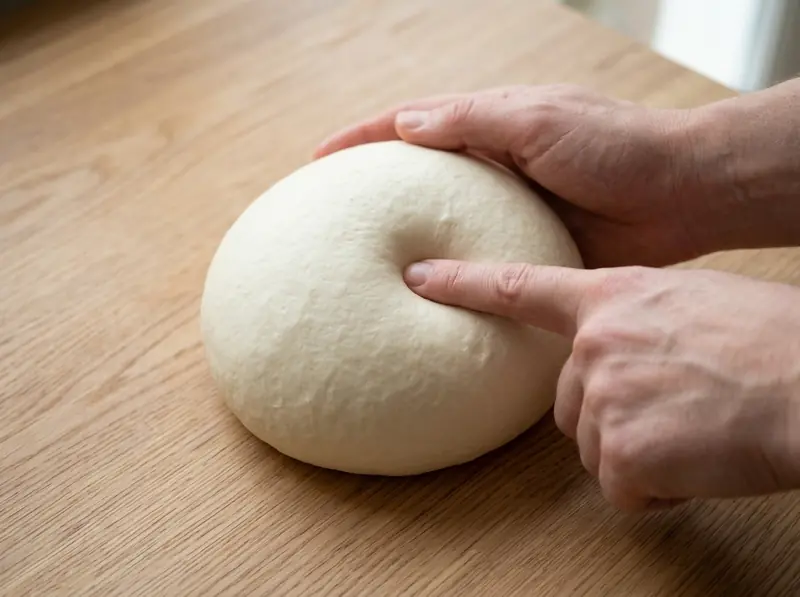
- Knead a stiff, strong dough. Mix the flour, yeast and salt in the bowl of a stand mixer. Stir 1 tbsp barley malt syrup into the warm water (30–35°C, barely warm on the wrist) until dissolved. With the dough hook on low speed, pour the water into the flour a little at a time. Raise the speed to medium and knead for 10 to 12 minutes. Bagel dough is meant to be stiff and dry: it should not stick, and it feels much tighter than bread dough. It is ready when it is completely smooth and elastic and a dent made with a finger springs straight back. That well-developed gluten is where the chew comes from. By hand, allow 15 to 20 minutes of hard kneading.
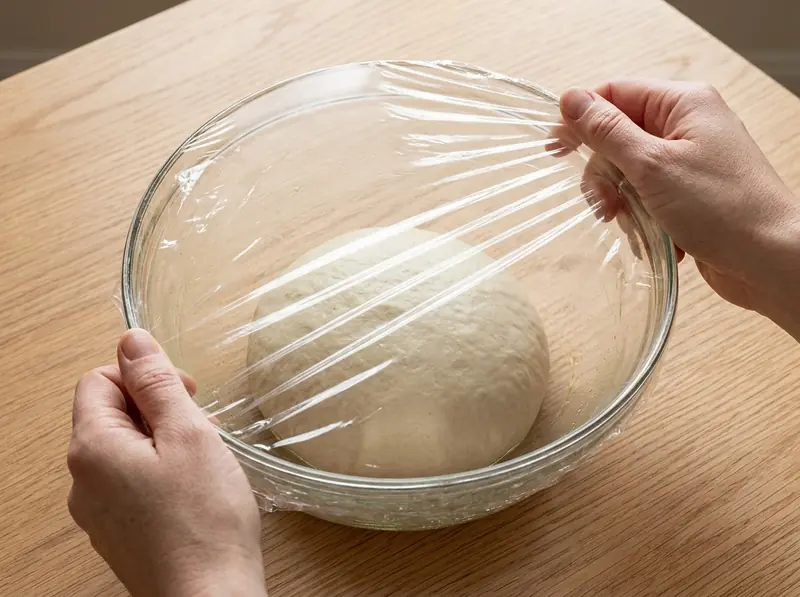
- Rise, then refrigerate overnight. Shape the dough into a ball, put it in a lightly oiled bowl and cover tightly. Leave at room temperature for 1 hour, until slightly puffed. Then refrigerate for at least 8 and up to 24 hours. The cold night matters more for flavour than any other step: the dough slowly builds up acids and aromas that a short warm rise cannot produce. Cold dough is also easier to shape.
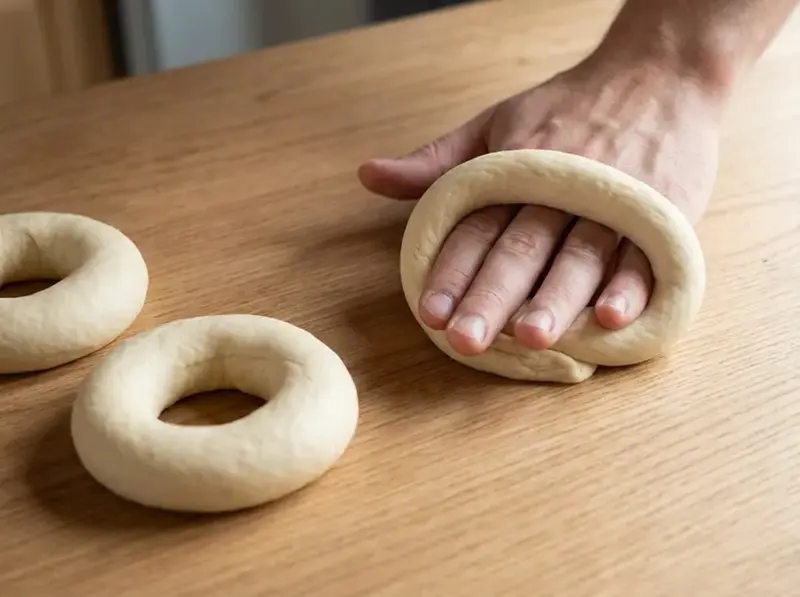
- Shape the bagels with the rope method. Take the dough out of the refrigerator and divide it into 8 equal pieces of about 100 g. Roll each piece on an unfloured surface into a rope about 25 cm (10 inches) long. Wrap the rope around your hand so that the two ends overlap by about 4 cm in your palm. Roll the overlap back and forth under your palm on the work surface to seal it; this gives an even ring that keeps its shape. The ring should be 9 to 10 cm across. Alternatively, push your thumb through the centre of a ball of dough and stretch it gently into a ring. Set the bagels well apart on two baking sheets lined with parchment, cover, and leave at room temperature for 30 to 45 minutes, until slightly puffed. Switch the oven on to 230°C (450°F) as soon as the bagels are covered, so that it is fully hot when they come out of the pot.
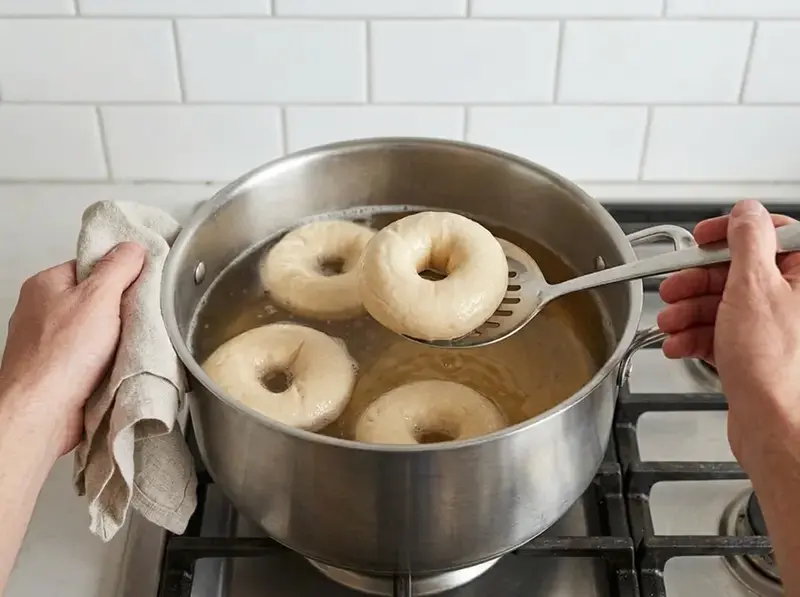
- Boil. Bring about 2.5 litres of water to a boil in a large, wide pot. Add 2 tbsp barley malt syrup and, if you are using it, the bicarbonate of soda, and stir; with the soda the water foams up for a moment. Turn the heat down to a steady, lively simmer. Lower the bagels in gently, 3 or 4 at a time. Boil for 60 seconds, turn them over with a slotted spoon and boil for another 60 seconds. They sink at first and should float within about 10 seconds, then puff up as they cook. Lift them out with the slotted spoon, let them drain for a moment and put them back on the parchment. Do not skip the boil: it is the step that makes a bagel a bagel.
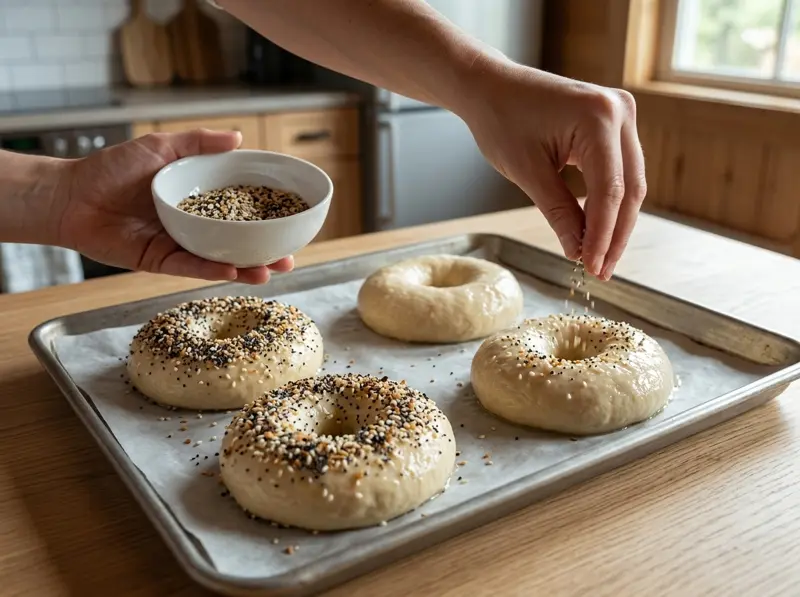
- Top and bake. As each batch comes out of the water, sprinkle the wet bagels generously with the toppings. No egg wash is needed: the seeds stick to the damp, tacky surface. Bake both sheets at once on the two middle racks of the hot oven at 230°C (450°F) for 20 to 25 minutes, swapping the sheets and turning them front to back halfway through, until the crust is a deep golden-brown and a bagel sounds hollow when tapped on the bottom. If your oven takes only one sheet, bake them one after the other. Cool on a wire rack for at least 15 minutes before slicing, because the crumb sets as it cools. Eat them the same day, while the crust is at its best.
FAQ
A New York bagel differs from most others in three ways. The dough is made from strong bread flour with little water (58% in this recipe), so it is very stiff and bakes into a dense, resistant crumb. The dough is fermented cold and slowly, which gives it far more flavour than a quick warm rise. And the bagels are boiled in water with barley malt syrup before baking, which gelatinises the starch on the surface and produces a shiny, chewy crust. Many factory bagels skip the pot and are baked in steam-injection ovens instead; they come out fluffier and softer, closer to a roll with a hole.
Barley malt syrup is a thick, dark syrup made from sprouted barley. Its main sugar is maltose, and it tastes malty and only mildly sweet, with a faint bitterness. In New York bagels it does two jobs: in the dough it gives the typical bagel flavour, and in the boiling water it helps the crust brown and shine in the oven. Honey is the closest practical substitute, a little sweeter and without the malt note; dark brown sugar also works. Honey is not a vegan ingredient: with malt syrup these bagels are vegan, with honey they are not. Use the same amounts: 1 tbsp in the dough and 2 tbsp in the water. Barley malt syrup is sold in health food shops and online.
Boiling is what makes a bagel a bagel. In simmering water the starch on the surface of the dough absorbs water, swells and sets into a thin gel. That layer does three things. It fixes the ring shape before the bagel goes into the oven. It limits how much the bagel can expand as it bakes, which keeps the crumb dense and tight. And it is the surface that turns into the shiny, chewy crust in the heat of the oven. Bagel dough baked without boiling is just a bread roll with a hole.
New York and Montreal bagels are the two main North American styles. A New York bagel is larger and puffier, made from a salted, egg-free dough with barley malt, boiled in water with malt and baked in a standard bakery oven; the crumb is dense and chewy and the crust shiny. A Montreal bagel is smaller, thinner, denser and sweeter, with a larger hole. Its dough contains egg and malt but no salt, it is boiled in honey-sweetened water and it is always baked in a wood-fired oven. The usual Montreal topping is sesame seeds. Each city is convinced that its own bagel is the real one.
The classic toppings, put on before baking, are sesame seeds, poppy seeds, coarse salt or 'everything' seasoning — sesame, poppy, dried onion, dried garlic and salt together. A plain bagel with no topping is just as classic. The best-known filling is cream cheese, plain or mixed with chives, herbs or vegetables, spread thickly on both cut halves. The New York deli order is lox and a schmear: cream cheese, Nova lox (cold-smoked salmon), thin slices of red onion, capers and a squeeze of lemon. Bagels are also eaten with butter, with egg and cheese for breakfast, or with tuna or chicken salad.
Keep browsing
More dishes from the American archive — picked by overlap with what you're cooking now.
Recipes by email
One letter a week: a recipe picked for your taste, plus whatever is new on the site. Unsubscribe in one click.
Welcome gift: Sergei's cookbook (e-book).
By subscribing you agree to the privacy policy.
Tell us what you like to cook (30 seconds) →
Join the conversation
Comments
No comments yet — be the first!