
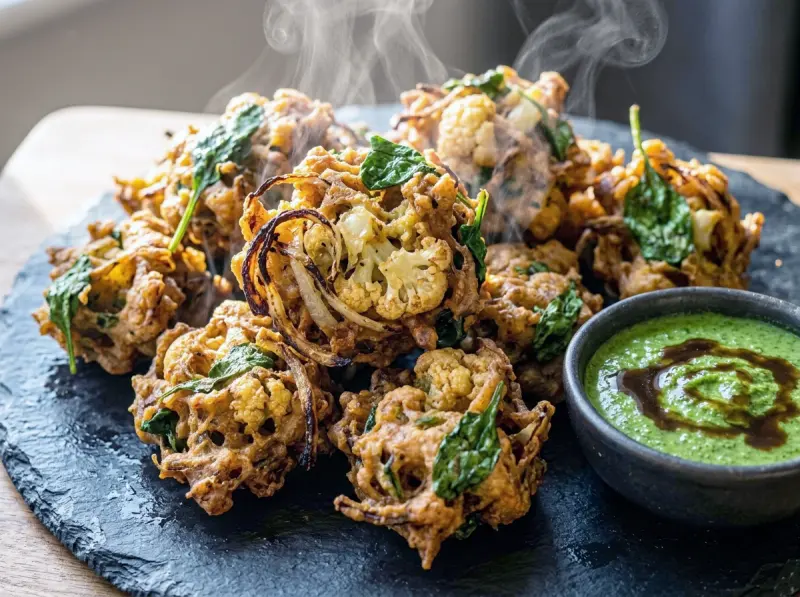
Pakora
Crispy spiced fritters made by coating vegetables in a thick chickpea flour batter and deep-frying until audibly crunchy. The batter starts deliberately thick — when vegetables are added, the salt draws out their moisture and the batter reaches the right consistency on its own. The mix rests for 15 to 20 minutes before frying. Rice flour in the batter adds crunch and keeps the pakoras from soaking up oil. The vegetables here are onion, cauliflower and spinach; potato is another classic choice. Serve immediately with the quick mint-coriander chutney below and, if you have it, shop-bought tamarind chutney.
Ingredients
- 120 gchickpea flour
- 30 grice flour
- 1 tspground cumin
- 1 tspground coriander
- 0.5 tspturmeric
- 0.5 tspKashmiri chilli powder or mild chilli powder
- 0.5 tspgaram masala
- 1 tspfine salt
- 1 tbspfresh ginger, grated
- 60 mlcold water
- 1 large onion, halved and thinly sliced
- 150 gcauliflower, broken into very small florets
- 80 gbaby spinach leaves, whole
- 1 lneutral oil for deep-frying
- 1 large handfulfresh mint, for the chutney
- 1 handfulfresh coriander, for the chutney
- 1 green chilli, for the chutney
- 2 tbsplemon juice, for the chutney
Method
- Make the thick batter. Combine chickpea flour, rice flour, cumin, coriander, turmeric, Kashmiri chilli, garam masala, salt, and grated ginger in a large bowl. Whisk together. Add 60 ml of cold water and stir to a thick, stiff paste — it should look much too thick at this stage. That is correct.
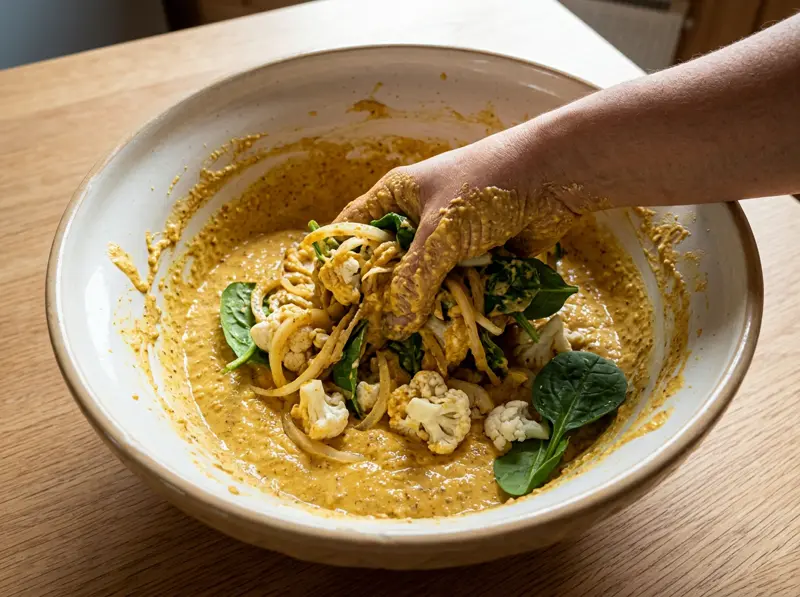
- Add the vegetables and rest. Add the onion, cauliflower florets, and spinach to the thick batter. Mix well with your hands or a spoon, pushing the batter into all the surfaces of the vegetables. The salt will begin drawing moisture from the onion immediately. Leave to rest for 15 to 20 minutes. After resting, the batter will have thinned noticeably. It should now coat and cling to the vegetables rather than pool at the bottom of the bowl. If it still seems very stiff, add water a tablespoon at a time. If it has gone too thin, add a tablespoon of chickpea flour.
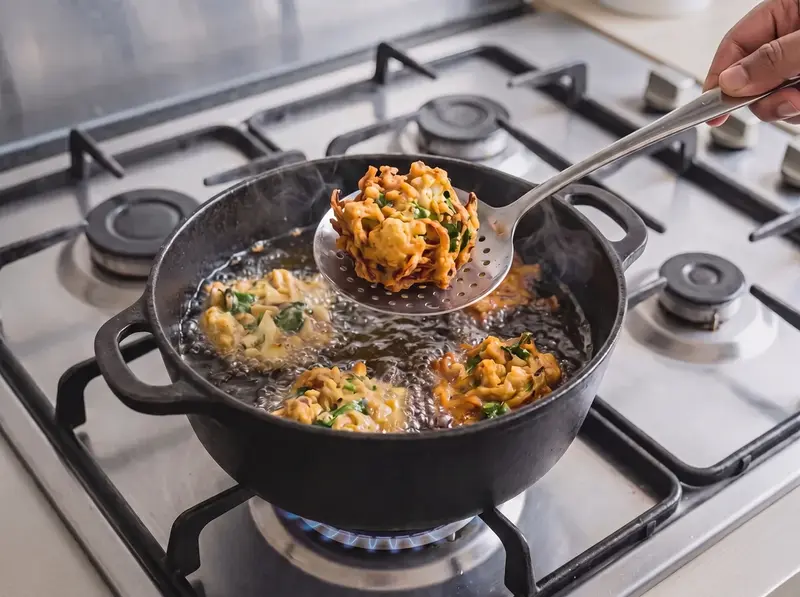
- Heat the oil. Pour 1 litre of oil into a deep heavy pot 18 to 20 cm across — that gives a layer about 3 to 4 cm deep, enough for the pakoras to float freely. The oil should fill the pot no more than halfway. Keep a lid within reach. Never leave hot oil unattended and keep water away from it; if the oil catches fire, turn off the heat and cover the pot with a lid — never pour water on it. Heat over medium heat to 170 to 175°C (340 to 350°F). Test: drop a small blob of batter in — it should sink slightly, then rise and begin sizzling within 2 to 3 seconds. If it sinks and stays on the bottom, the oil is too cold. If it immediately shoots to the surface, too hot.
- Fry in batches. Using two tablespoons (or lightly oiled fingers), lower rough mounds of batter (about 2 tablespoons each) into the oil, close to the surface and away from you — do not shape them too neatly, the irregular edges become the crispiest parts. You should get about 16 pakoras — four per serving. Fry 4 to 5 pakoras at a time. Cook for 4 to 5 minutes, turning once or twice, until deep golden-brown and crispy all over; break the first one open to check that the batter in the middle is cooked, not pasty. Do not rush: medium heat gives the inside time to cook through while the outside crisps. Remove with a slotted spoon and drain on a wire rack, not paper towels — the rack lets steam escape beneath.
- Serve immediately. Pakoras are at their best within 5 to 10 minutes of coming out of the oil. Serve with the quick mint-coriander chutney below and, if you have it, shop-bought tamarind chutney for dipping. To make the chutney: blend a large handful of mint, a handful of coriander, 1 green chilli, a pinch of salt, and 2 tablespoons of lemon juice with 2–3 tablespoons of water. Pakoras also pair well with a cup of masala chai.
FAQ
Five rules for crispy pakoras. First: the batter must be thick — not runny pancake batter, but a stiff mix that clings to the vegetables. Thin batter slides off and fries to a flat, oily shell. Second: add rice flour or cornflour to the chickpea flour — it adds crunch and keeps the pakoras from soaking up oil. Third: oil at 170 to 175°C — too hot burns outside before inside cooks; too cool and the pakoras absorb oil. Fourth: do not crowd the pot — each batch of cold vegetables lowers the oil temperature. Fifth: drain on a wire rack, not paper towels — paper traps steam under the pakoras and softens the bottom.
Besan (also called gram flour) is flour milled from split brown chickpeas (chana dal). It has about twice the protein of wheat flour and no gluten, and a nutty flavor that is central to the taste of pakoras. Substitutes: regular all-purpose flour works but produces a softer, blander result. Chickpea flour with a smaller share of rice flour, about 4:1 as in this recipe, gives the crispiest pakoras. Cornflour (cornstarch) can replace the rice flour but should not replace the chickpea flour entirely. Chickpea flour is now widely available in supermarkets and online.
Almost any vegetable suitable for frying works. Classic: onion (the best — becomes sweet and crispy), potato (thin slices or julienne), cauliflower (very small florets), spinach (whole leaves or roughly chopped). Also good: eggplant (thin rounds), courgette, green pepper, corn kernels, cabbage. The rule: cut everything thin and uniformly so it cooks through before the outside burns. Watery vegetables like tomato or cucumber release too much liquid and make the batter runny — avoid them or pat very dry before adding. Onion is special: it releases water under salt and loosens the batter for you.
Yes, intentional. The batter starts very thick because salt draws moisture out of the vegetables as they sit in the mix. After 15 to 20 minutes of resting, the vegetables release enough liquid to bring the batter to the right coating consistency — you didn't need to add much water at all. If you add too much water upfront, the batter becomes runny before the vegetables even go in, and you end up with flat, greasy pakoras. The working batter should cling to the vegetables and hold together when you drop a spoonful, not run off them.
Largely the same thing under regional names. Pakora (or pakoda) is the word across most of India and Pakistan; in southern and western India the same fritters are called bhaji, bajji or bhajia. The onion bhaji of British Indian restaurants is an onion pakora. Cooks make both kinds everywhere: vegetables mixed through a thick batter, as here, or single slices dipped in a thinner one. For a drink alongside, a cup of masala chai is the usual pairing.
Keep browsing
More dishes from the Indian archive — picked by overlap with what you're cooking now.

Recipes by email
One letter a week: a recipe picked for your taste, plus whatever is new on the site. Unsubscribe in one click.
Welcome gift: Sergei's cookbook (e-book).
By subscribing you agree to the privacy policy.
Tell us what you like to cook (30 seconds) →
Join the conversation
Comments
No comments yet — be the first!