

Salsa Macha
Salsa macha is a Mexican chili oil from Veracruz — dried chilies, raw peanuts, sesame seeds, and garlic fried in oil, then coarsely blended into a thick, chunky paste. The name likely comes from macho ('bold' or 'strong'), though some cooks trace it to machacar, the pounding motion used to crush ingredients in a molcajete. Active cooking takes about 25 minutes; the salsa then needs at least an hour of hands-off resting for the flavors to settle before it's ready to eat. It tastes smoky, nutty, and fruity from the dried chilies, with a heat that builds slowly rather than hitting all at once, and keeps in the fridge for up to a week, tasting better after the first day.
Ingredients
- 6 dried guajillo chiles
- 4 dried ancho chiles
- 8 dried chiles de arbol
- 80 graw unsalted peanuts
- 2 tbspsesame seeds
- 5 garlic cloves
- 200 mlneutral oil
- 1 tbspapple cider vinegar or sherry vinegar
- 0.5 tspfine salt
- 0.5 tspdried Mexican oregano (optional)
Method
- Prep the chilies. Remove the stems from all the dried chilies. For guajillos and anchos, also remove the seeds — they contribute bitterness more than heat when fried. For the chiles de arbol, keep the seeds for a hot result or remove for medium. Tear all the chilies into rough pieces, about 2 to 3 cm. Have everything measured and ready before you start — the frying process moves quickly.
- Fry the garlic and peanuts, then the sesame. Pour the oil into a medium saucepan and heat it over medium heat to about 150–160°C, hot enough to sizzle instantly around a garlic clove but not smoking. Add the garlic and peanuts together and fry, stirring frequently, until the garlic turns golden and the peanuts begin to color, 4 to 5 minutes, then lift them out with a slotted spoon onto a plate. Add the sesame seeds to the same oil and fry for just 30 to 60 seconds, stirring constantly, until golden; sesame burns fast and slips straight through a slotted spoon, so set a fine-mesh sieve over a bowl and pour the oil through it to catch the seeds, then return the strained oil to the pan.
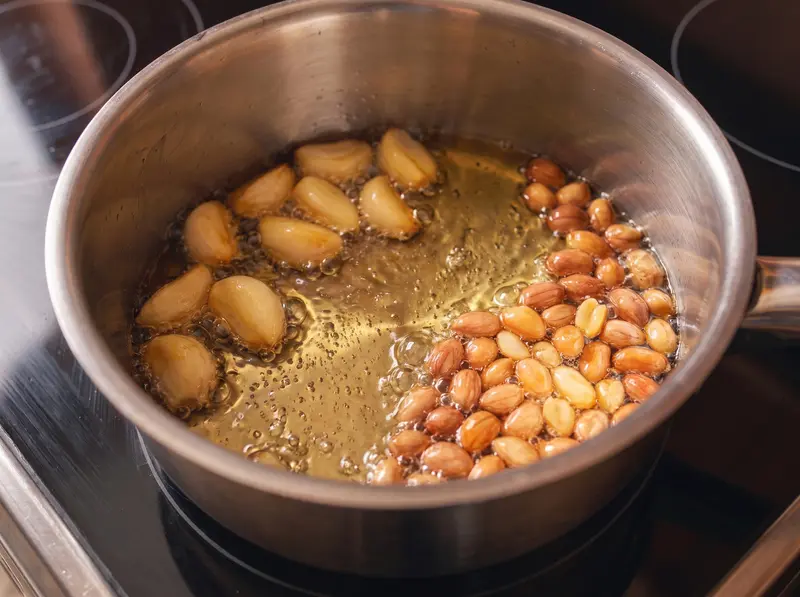
- Fry the chilies. Add all the torn dried chilies to the same oil, still around 150–160°C. This is the most time-sensitive step — dried chilies fry in 30 to 60 seconds and go from fragrant and puffed to acrid and burnt with alarming speed. Stir constantly. You want them to darken slightly and become fragrant. As soon as they start to puff and smell toasty, remove the pan from the heat and let the chilies continue in the residual heat for another 30 seconds. Transfer the chilies and all the oil to a heatproof bowl or blender jug.

- Blend. Add the fried garlic, peanuts, and sesame to the chili oil. Add the vinegar, salt, and oregano if using. Let everything cool for 5 to 10 minutes — blending very hot oil in a sealed blender can be dangerous. Pulse to a coarse texture. Salsa macha should not be smooth — you want visible flecks of chili skin, roughly chopped peanuts, and sesame seeds throughout.

- Rest and store. Taste and adjust salt and vinegar if needed. Transfer to a clean glass jar. Let it sit at room temperature for at least an hour before serving — the flavors come together as it rests, and the salsa is noticeably better from one day to the next. After that hour, move it to the fridge: garlic in oil should not sit out for long. Keep it under a thin layer of oil and use within a week; for longer storage, freeze it in small portions. Take it out 20 minutes before use so the oil loosens.
FAQ
Both are oil-based condiments built around fried chili and garlic, but they come from different culinary traditions. Chili crisp is a Chinese condiment made with dried chilies, garlic, and often fermented black beans or numbing peppercorns — sharp, pungent, and sometimes tongue-tingling. Salsa macha is Mexican, from Veracruz: dried chilies, peanuts, sesame, and vinegar, giving it a fruitier, nuttier, smokier profile. Same basic format, completely different flavor.
Yes. Pasilla adds a raisin-like depth, morita and chipotle bring smokiness, and mulato leans earthy and almost chocolatey. The general principle: one or two mild, fruity chilies as the base (guajillo, ancho, pasilla) plus one or two hot chilies for heat (árbol, piquín). Always use dried chilies here — fresh ones don't fry the same way and turn soggy instead of crisp.
Smell is the most reliable indicator: chilies fried correctly smell smoky, earthy, and slightly fruity, while burned ones turn sharp, acrid, and bitter. Visually, they should darken from dull red-brown to a vibrant brick red and puff up slightly within 30 to 60 seconds in oil at 150–160°C. Dark brown or black patches mean they've gone too far, and there's no saving a batch once that happens — start over with fresh chilies rather than trying to mask the bitterness.
Yes — replace the 80 g of peanuts with extra sesame seeds or pumpkin seeds, or leave nuts out completely. The texture turns a bit thinner without peanuts, but the chili-forward flavor holds up fine. Keep the rest of the recipe as written, including the full 200 ml of oil, since that's what carries the texture once the solids are reduced.
Fried eggs are the most common use — spoon it into the pan before cracking in the eggs, or drizzle it over them once cooked, the same way you'd finish chili oil eggs. Beyond breakfast, it works on tacos, grilled chicken or fish, rice bowls, avocado toast, soup, and roasted vegetables — anywhere you'd reach for a table sauce like chimichurri but want a nuttier, spicier edge. As a marinade, rub it onto chicken thighs, let them sit for an hour, and grill.
Rate this
Recipes by email
One letter a week: a recipe picked for your taste, plus whatever is new on the site. Unsubscribe in one click.
Welcome gift: Sergei's cookbook (e-book).
By subscribing you agree to the privacy policy.
Tell us what you like to cook (30 seconds) →Keep browsing
More dishes from the Mexican archive — picked by overlap with what you're cooking now.


Join the conversation
Comments (1)
Сальсу мачу я впервые попробовал в Веракрусе, и с тех пор держу банку в холодильнике постоянно. В отличие от китайского chili crisp, здесь главный вкус — не жгучесть, а ореховая глубина от арахиса и тёмных чили (гуахильо, анчо). Два правила: масло должно быть нейтральным (не оливковым), а чили жарятся всего 30-60 секунд — пригоревшие чили превращают всё блюдо в горечь без возврата. Кладу на яичницу, тако, запечённую цветную капусту, даже пиццу.