
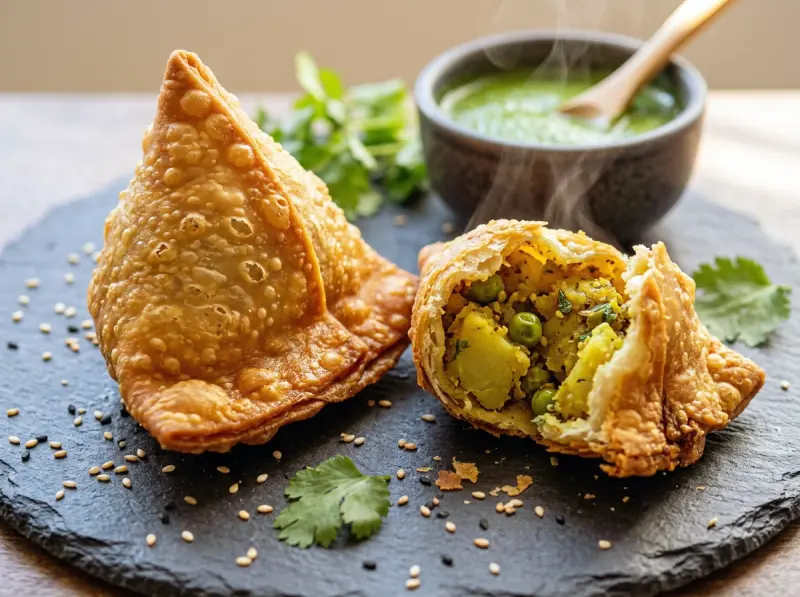
Samosa
Flaky, crispy pastry cones filled with spiced potato and peas, deep-fried until dark golden. The dough uses a technique called moyan dena — fat is rubbed into the flour until the mixture resembles wet sand before any water goes in. That step is what makes the crust flaky rather than bready. The filling is mashed potato with green peas, cumin, green chilli, coriander, and amchur powder for the characteristic sour edge. The frying is two-stage: low heat first to set the dough from the inside, then medium heat for color. Serve hot with mint chutney and tamarind chutney.
Ingredients
- 250 gplain flour
- 4 tbspghee or neutral oil
- 0.5 tspcarom seeds
- 0.5 tspfine salt
- 5 tbspcold water, added gradually
- 400 gfloury potatoes, boiled until just fork-tender
- 80 gfrozen or fresh green peas
- 1 tbspneutral oil
- 1 tspcumin seeds
- 1 green chilli
- 1 tspginger
- 1 tspground coriander
- 0.5 tspgaram masala
- 0.5 tspamchur
- 0.5 tspfine salt
- 2 tbspcilantro
- 1 lneutral oil for deep-frying
Method
- Make the dough (moyan dena). Combine flour, carom seeds, and salt in a large bowl. Add the ghee or oil. Using your fingertips, rub the fat vigorously into the flour for 3 to 4 minutes — the goal is to coat every particle of flour with fat. The mixture should look and feel like slightly damp coarse sand. Pinch a handful: it should clump and hold shape without crumbling. If it crumbles, keep rubbing. Add cold water one tablespoon at a time, mixing after each addition, until a stiff, firm dough forms — it should not be soft or sticky. Knead for 2 minutes, wrap tightly, and rest at room temperature for 30 minutes.
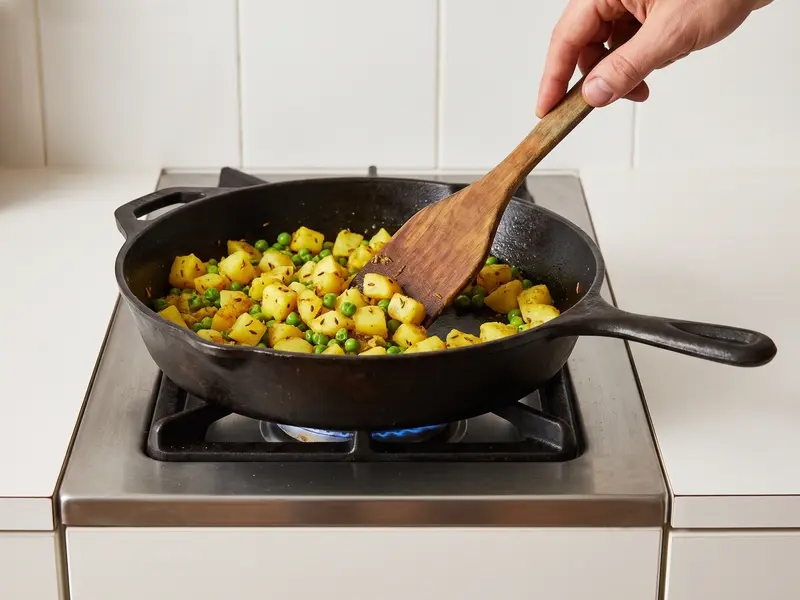
- Make the filling. Heat oil in a pan over medium heat. Add cumin seeds and let them sizzle for 30 seconds. Add the green chilli and grated ginger and cook 30 seconds more until fragrant. Add the peas and cook 2 minutes. Break the boiled potatoes into the pan by hand — not too smooth, you want some texture. Add ground coriander, garam masala, amchur, and salt. Stir and cook for 3 minutes. Remove from heat, stir in the fresh coriander, taste and adjust seasoning. Spread on a plate and let cool completely before shaping. Warm filling makes damp dough.
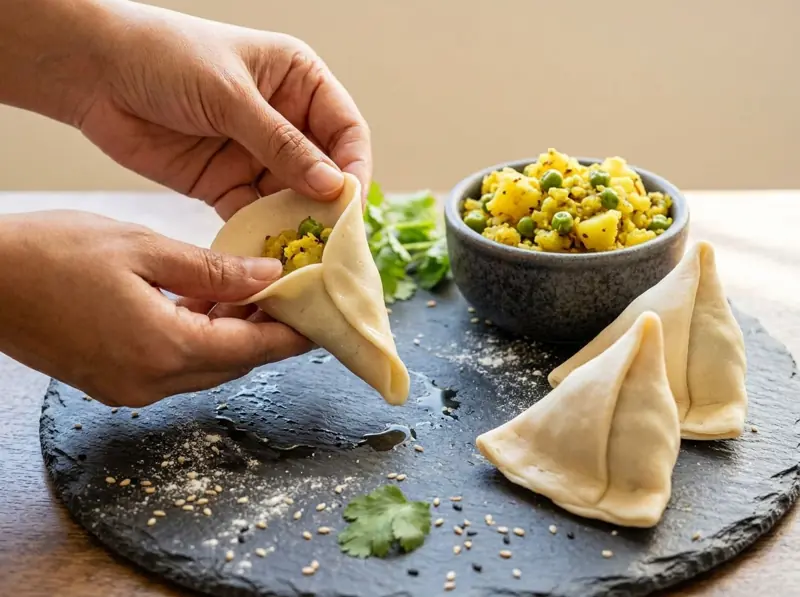
- Shape the samosas. Divide the rested dough into 8 equal balls. On a lightly oiled surface, roll one ball into an oval roughly 15 cm long and 3 mm thick. Cut the oval cleanly in half across the middle — you have two semicircles, each making one samosa. Take a semicircle, moisten the straight edge with water, bring the two corners of the straight edge together with a 5 mm overlap, and press firmly to form a cone. Stand the cone upright in your palm. Fill with 2 heaped tablespoons of cooled filling — no more than three-quarters full. Moisten the inside of the open top edge, bring together, press firmly, and make a small pleat-pinch in the center of the top seam. Set aside seam-side up on a tray. Repeat.
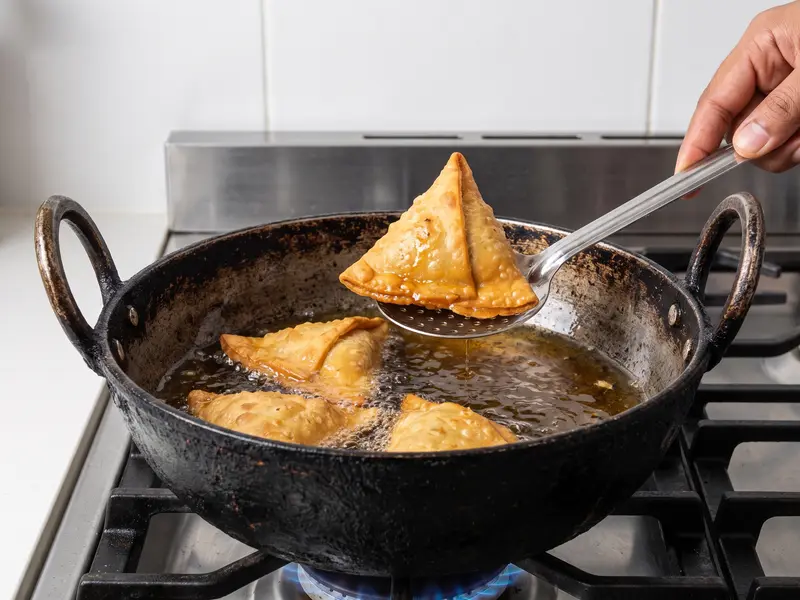
- Fry the samosas. Pour oil into a deep heavy pan to a depth of at least 7 cm and heat to 160°C (320°F) — medium-low. Lower 3 to 4 samosas gently into the oil. The temperature will drop; keep the flame low to medium-low and fry slowly for 8 to 10 minutes, turning occasionally, until the dough has set and is a very pale gold. Then increase the heat to medium and fry for another 3 to 4 minutes until golden-brown and crisp. Drain on paper towels. This two-stage frying is the key: low heat first cooks the inside of the dough without the outside burning; medium heat at the end gives color and crunch without greasiness.
- Serve immediately. Samosas are best eaten hot, within 10 minutes of coming out of the oil. Serve with mint-coriander chutney and tamarind chutney on the side. To make a quick mint chutney: blend a handful of fresh mint, a handful of coriander, half a green chilli, a pinch of salt, a squeeze of lime, and 2 tablespoons of water until smooth.
FAQ
Moyan dena is the technique of vigorously rubbing fat — ghee or oil — into flour with your fingertips until the mixture looks like coarse damp sand, before any water is added. The fat coats every flour particle, preventing long gluten strands from forming when water is added. The result is a flaky, layered, short crust that crisps in oil rather than turning bready and chewy. The test: grab a handful of the fat-flour mixture and squeeze — it should hold shape without crumbling. If it crumbles, there isn't enough fat or the rubbing wasn't thorough enough.
Three main causes. First, blistering from oil that is too hot when the samosas go in — always start at medium-low heat around 160°C; the samosa needs to set slowly, not shock-fry. Second, bursting from wet filling or poor sealing — the filling must be completely cool and dry before shaping, and all seams must be firmly pressed with moistened fingers, with no air pockets trapped inside. Third, dough that is too thin or too soft — the dough should be rolled to 3 mm and feel firm, not elastic. The two-stage frying method (low heat first, medium heat to finish) eliminates most blistering problems.
Amchur is dried unripe mango powder. It adds the characteristic sour, fruity edge to the potato filling without introducing moisture. It balances the starchiness of the potato and the heat of the spices. Substitutes in order of authenticity: 1 teaspoon of lemon or lime juice added to cooled filling; a quarter teaspoon of tamarind paste; or half a teaspoon of chaat masala (which itself contains amchur). Without any of these the samosas will taste good but noticeably less complex. Amchur is widely available at any South Asian grocery.
Roll dough into an oval and cut in half across the middle. Take one semicircle, moisten the straight edge on one side with water, bring both corners of the straight edge together to overlap by 5 mm, and press firmly to form a cone. The cone should stand in your palm without filling. Fill three-quarters full — not more or you cannot seal it. Moisten the open top edge inside, bring together, press firmly, and make one small pleat-pinch at the center of the top seam. That pleat is what holds the classic samosa shape. The most common mistake is overfilling. With practice, the shaping becomes automatic after two or three batches.
You can bake them but the result is different. Baked samosas will not achieve the same flakiness and crunch as fried ones — the fat in the dough behaves differently under dry convective heat versus immersion in hot oil. For the best baked result: brush generously with oil on all sides, bake at 200°C fan for 30 to 35 minutes, turning halfway. An air fryer at 190°C for 12 to 15 minutes gives a better result than a conventional oven. Both produce an acceptable samosa, but expect a drier, less layered crust. The oil brushing step is essential — dry-baked samosas are unpleasant.
Rate this
Recipes by email
One letter a week: a recipe picked for your taste, plus whatever is new on the site. Unsubscribe in one click.
Welcome gift: Sergei's cookbook (e-book).
By subscribing you agree to the privacy policy.
Tell us what you like to cook (30 seconds) →Keep browsing
More dishes from the Indian archive — picked by overlap with what you're cooking now.


Join the conversation
Comments (1)
The dough for these samosas uses a specific ratio of ghee to flour that keeps it flaky without being greasy. Too little fat and the pastry is tough, too much and it falls apart when frying. Rolling the dough thin enough is critical — you should almost be able to see through it. And the filling must be completely cold before you start wrapping. Hot filling makes steam, steam makes soggy samosas. I learned this from watching a street vendor in Old Delhi who made about 500 of these every morning.