
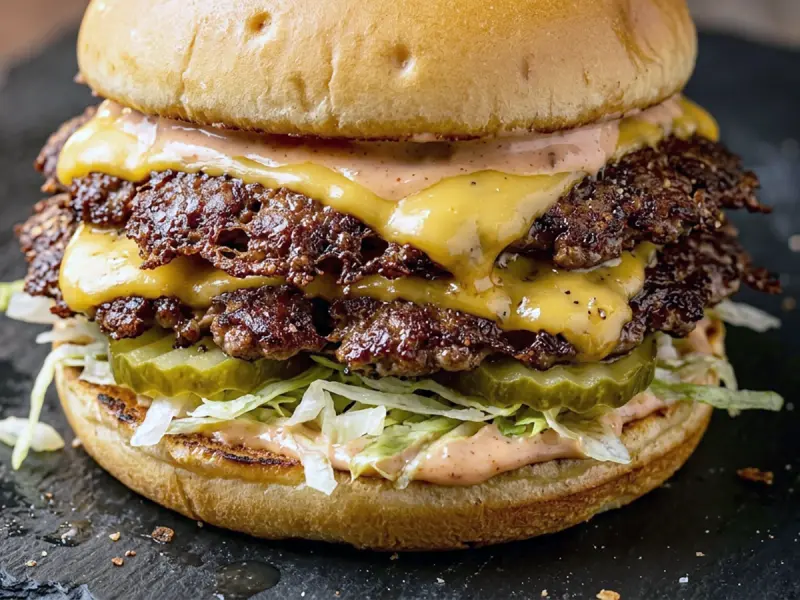
Smash Burger
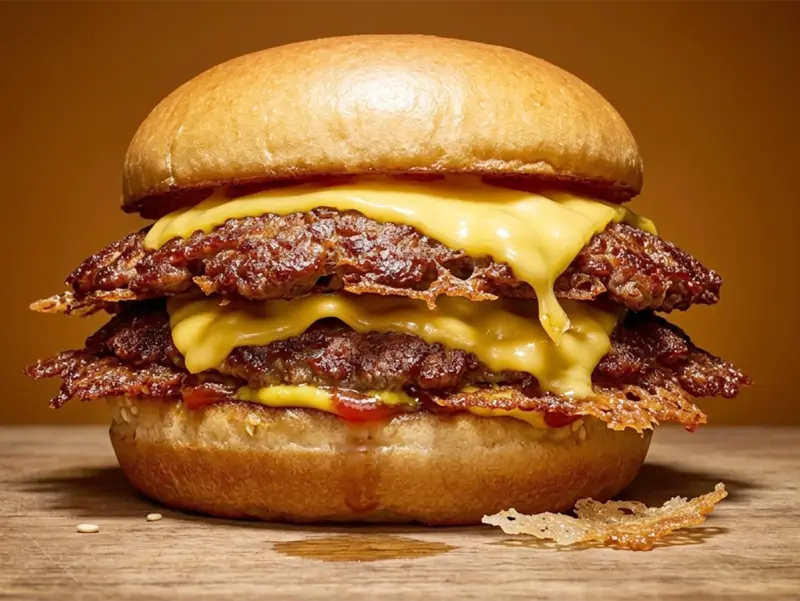
A smash burger is a thin burger made by pressing a loose ball of cold ground beef flat onto a very hot griddle, so that most of the patty turns into crust. Instead of forming a shaped patty and handling it gently, you place a loose ball of cold 80/20 ground beef on a screaming-hot cast-iron griddle or skillet, then press it flat instantly with maximum force. The entire physics of the burger changes: the thin patty achieves near-total surface contact with the hot metal, triggering the Maillard reaction across the full face of the burger rather than just the edges. The result is a hamburger that is almost entirely crust — dark, crispy, lacey-edged, deeply savory — with a thin, juicy interior. American cheese, with its uniquely high moisture content and engineered melt point, is not optional. No other cheese melts completely in the 30 to 45 seconds available between flip and serve.
Ingredients
- 680 gground beef, 80/20 fat
- 1 tspfine salt
- 1 tspcracked black pepper
- 8 slicesAmerican cheese
- 4 potato buns or brioche buns
- 1 tbspneutral oil or clarified butter
- 1 white onion, very thinly sliced
- 60 mlmayonnaise
- 1 tbspketchup
- 1 tbspyellow mustard
- 1 tsppickle brine or apple cider vinegar
- 1 tspgarlic powder
- pickles, shredded iceberg lettuce, tomato
Method
- Make the smash sauce and prep everything before cooking. Whisk together the mayonnaise, ketchup, mustard, pickle brine, and garlic powder. This is the smash burger sauce — a variant of Thousand Island dressing with a sharper edge. Refrigerate. Toast the cut sides of the buns in the dry skillet over medium heat for about a minute until golden, and set them aside before you turn the heat up for the beef. Slice the onion paper-thin if using. Divide the cold ground beef into 8 equal portions of about 85 g — two thin patties per burger. A single 170 g ball smashed to 15 cm would still be over a centimetre thick and would not cook through in the time the crust needs. Roll loosely into balls — do not compress or overwork. The beef must be cold when it hits the pan; warm meat spreads instead of smashing. Have all toppings, the cheese, and the sauce ready before you begin cooking. A smash burger cooks in under 3 minutes per patty — there is no time to find the pickles once you start.
- Heat the griddle to smoking. Place a cast-iron skillet or flat cast-iron griddle over the highest heat your stovetop can produce. Leave it on maximum heat for 5 full minutes. The surface must be between 230 and 260°C (450 to 500°F) — this is approximately the temperature at which a drop of water vaporises instantly on contact. Add a very thin film of oil or clarified butter and allow it to shimmer and just begin to smoke. The cooking surface is the only piece of equipment that matters: it needs to be heavy (for heat retention) and completely flat (for full contact). A flimsy pan will drop temperature the moment the beef lands and produce steamed rather than seared meat.
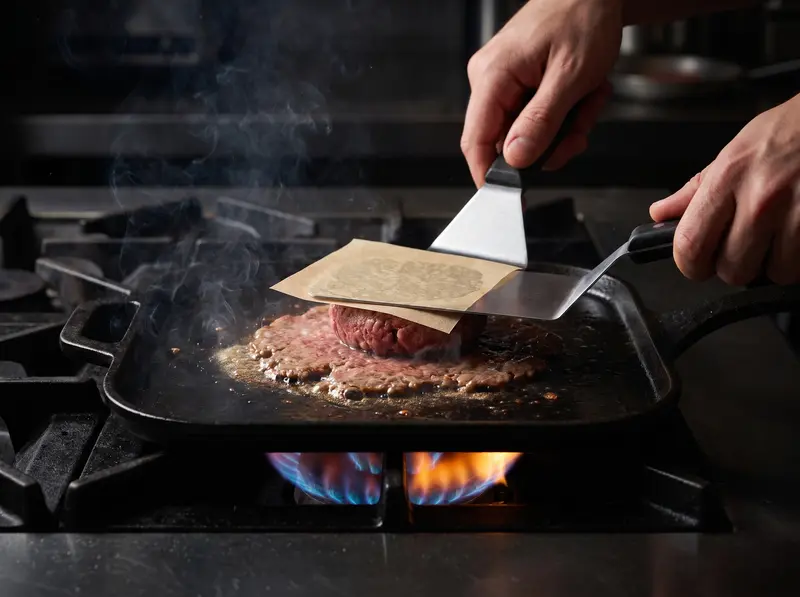
- Smash immediately and decisively. Place one ball of cold beef on the hot oiled surface. Immediately place a small square of parchment paper over the ball. Using the flat underside of a stiff, wide metal spatula — or a heavy flat object like a small cast-iron pan — press straight down with maximum force, holding for 10 seconds. The patty should spread to approximately 12 to 15 cm in diameter. Season the top surface immediately with salt and pepper. If using onion, scatter a small handful of paper-thin slices across the top and press them gently into the meat with the spatula.
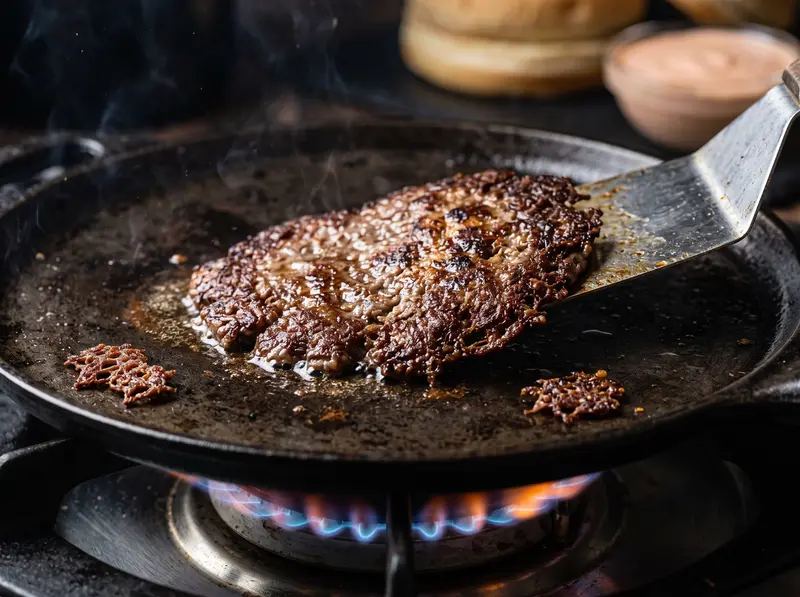
- Cook 90 seconds then flip. Leave the patty completely undisturbed for 90 seconds to 2 minutes. Resist any urge to move, press, or check it. The crust is forming against the hot metal, and interrupting it breaks the sear. The patty is ready to flip when: the edges have gone from pink to gray, a ring of dark brown crust has crept up the sides, and the patty releases easily when you try to slide a spatula under it. Using a thin, rigid metal spatula, scrape firmly under the patty and flip it in one definitive movement — scraping up every bit of the dark crust from the pan is essential, not optional. That crust is where all the flavor lives. Immediately place a slice of American cheese on the flipped patty.
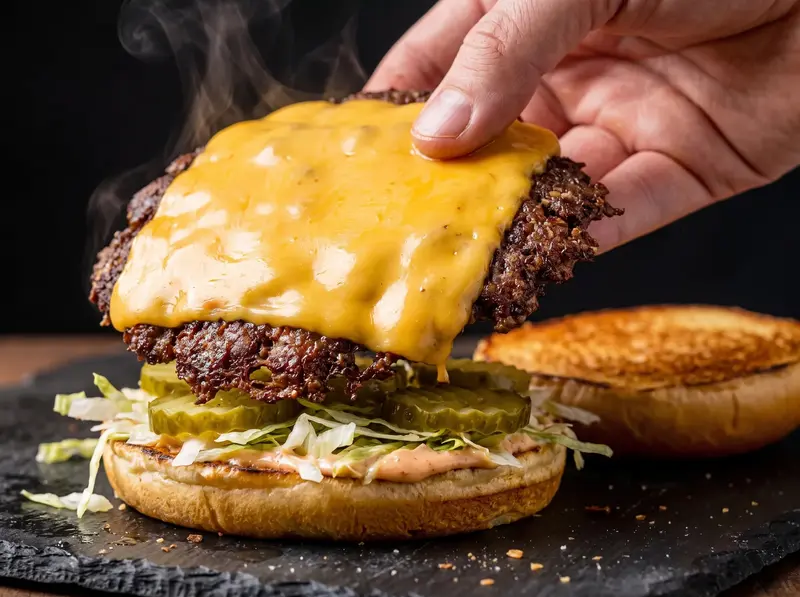
- Finish and assemble. Cook the second side for 30 to 45 seconds — just enough to seal it and melt the cheese completely. The cheese will have melted into a smooth, glossy sheet by the time you lift the patty. Cook the patties two at a time and stack each pair, cheese side up, straight onto a bottom bun, so both slices of cheese end up inside the burger. Assemble while hot: bottom bun, smash sauce, the two patties with their melted cheese, pickles, shredded iceberg lettuce, tomato, top bun with more sauce. Serve within 2 minutes — the crispness of the crust and the juiciness of the interior are at their absolute peak for about 90 seconds after leaving the pan.
FAQ
The smash technique maximises the Maillard reaction — the set of chemical reactions between amino acids and sugars that produces browned flavor compounds when meat is exposed to high heat. A conventional thick patty has a small surface-to-mass ratio: only the two flat faces and the narrow edge contact the pan, leaving most of the meat to cook by internal heat conduction. A smashed thin patty has an enormous surface-to-mass ratio: almost the entire mass of the beef is within a few millimetres of a hot surface, and the entire face of the patty can Maillard. More crust relative to the mass of meat means more flavor per bite. The lacy, craggy edges that form on a smashed patty contain the highest concentration of Maillard compounds.
The 20 percent fat content in 80/20 serves two distinct functions. First, as the patty cooks, the fat renders out of the muscle fibres and onto the hot griddle surface — it contributes to the sear and helps create the crust. Second, the fat that remains in the meat keeps the interior moist despite the brief cooking time at very high heat. Leaner ground beef (85/15 or 90/10) does not have enough fat to render properly. The patty sticks more, tears when flipped, produces a less flavourful crust, and dries out faster. If you are concerned about fat content, eat a smaller smash burger rather than using leaner beef — the flavor difference is substantial.
American cheese is a processed dairy product engineered to melt smoothly and completely at relatively low temperatures without separating into greasy pools and rubbery solids. Real aged cheeses like cheddar, gruyère, or brie contain high amounts of calcium in their protein matrix — this calcium tightens the protein structure when heated, causing the cheese to separate into oil and stringy or grainy solids rather than becoming a smooth fluid. American cheese has a lower calcium content and additional emulsifying salts that allow it to melt in 30 to 45 seconds into a perfectly smooth, glossy sheet at the temperatures used for the smash burger's brief second side. No other common cheese melts this fast or this smoothly. Deli-sliced American (not individually wrapped singles) melts best.
Cast iron is the correct choice for smash burgers. It has the highest heat retention of common cookware materials — when a cold ball of beef is placed on it, it does not significantly drop the surface temperature, maintaining the conditions for rapid Maillard browning. Stainless steel is an acceptable alternative if very heavy and well preheated. Non-stick pans are the wrong choice: they cannot be safely heated to the temperatures required (230 to 260°C), the coating degrades at these temperatures, and they do not retain heat adequately. A large, flat cast-iron griddle (not a ridged grill pan) is ideal because it allows multiple patties and maximum flat contact. A burger press is useful but not required — the flat underside of a heavy spatula or a small cast-iron pan works equally well.
Directly on grill grates, no — the beef will fall through or only contact the narrow bars. On an outdoor grill with a flat cast-iron griddle or a carbon steel flat top set over the burners, yes — and this is the professional approach used by dedicated smash burger restaurants. Preheat the griddle on the grill for 15 minutes on high before cooking. The slight residual smokiness from the grill environment adds a dimension the stovetop cannot provide. Portable flat-top griddles (Blackstone, Camp Chef) placed on a gas grill stand have become extremely popular specifically for smash burgers and produce excellent results.
Rate this
Recipes by email
One letter a week: a recipe picked for your taste, plus whatever is new on the site. Unsubscribe in one click.
Welcome gift: Sergei's cookbook (e-book).
By subscribing you agree to the privacy policy.
Tell us what you like to cook (30 seconds) →Keep browsing
More dishes from the American archive — picked by overlap with what you're cooking now.

Join the conversation
Comments (1)
The key really is pressing HARD in the first 10 seconds, after that dont touch it. I use a proper cast iron press now, worth every penny. Also dont buy lean beef 80/20 is the minimum for flavour.