
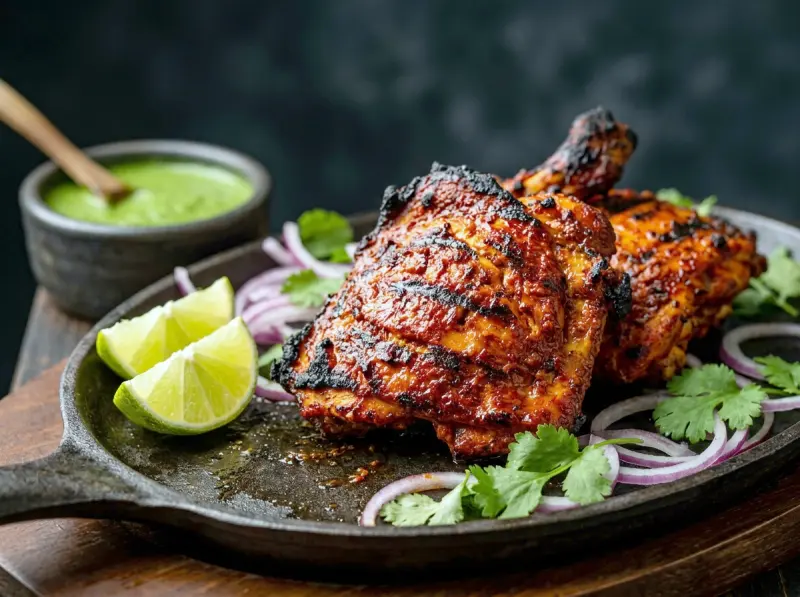
Tandoori Chicken
Bone-in chicken thighs and drumsticks scored deeply, marinated overnight in spiced yogurt, then cooked at high heat until the outside chars and the inside stays completely juicy. No sauce, no gravy — just the marinade working directly against the heat. The red-orange color comes from Kashmiri chilli powder, the flavor from ginger, garlic, garam masala, and kasuri methi. This is the dish that butter chicken and tikka masala are built on top of. On its own it's simpler and better. Serve with pickled onion, lime wedges, and mint chutney.
Ingredients
- 1 kgbone-in chicken thighs and drumsticks, skin removed, deeply scored
- 200 gfull-fat Greek yogurt or strained plain yogurt
- 1.5 tbspKashmiri chilli powder
- 1 tspgaram masala
- 1 tspground cumin
- 1 tspground coriander
- 0.5 tspturmeric
- 1 tbspginger-garlic paste
- 1 tbsplemon juice
- 2 tbspneutral oil or mustard oil
- 1 tspkasuri methi, crushed between palms
- 1 tspfine salt
- 1 red onion
- 2 limes
Method
- Score and marinate. Remove skin from all chicken pieces. Make 3 to 4 deep cuts in each piece, cutting down to the bone — this is not optional. The scores allow the marinade to penetrate past the surface layer and actually reach the muscle. Without them, the inside of a thick thigh tastes of nothing. Combine yogurt, Kashmiri chilli powder, garam masala, cumin, coriander, turmeric, ginger-garlic paste, lemon juice, oil, kasuri methi, and salt in a large bowl. Mix well and taste — it should be assertively seasoned, visibly red-orange, and smell of spice. Add the chicken and massage the marinade into every cut and surface. Cover and refrigerate for at least 6 hours, ideally overnight. Remove from the fridge 30 minutes before cooking.

- Prepare the oven and rack. Position the oven rack in the upper third of the oven. Place a wire rack over a foil-lined baking tray. Preheat the oven to 230°C (450°F). The wire rack is important: it lifts the chicken off the pan so hot air circulates underneath, mimicking the all-around heat of a tandoor. Pat the chicken lightly to remove excess marinade drips that would burn on the pan — but keep a visible coating on the meat itself.
- Roast. Place the chicken pieces on the rack, leaving space between them. Roast at 230°C for 20 minutes. The marinade should be sizzling and the edges starting to darken. Baste with remaining marinade or a brush of oil. Flip each piece and roast for another 15 minutes. The exterior should be well-charred in places — dark brown to black at the thinnest edges, deep red-orange across the main surfaces. An instant-read thermometer should read 75°C (165°F) at the thickest part.

- Char finish. Switch the oven to grill/broil function at maximum heat. Position the chicken close to the heating element and grill for 3 to 5 minutes until the surface is genuinely charred — black in spots, not just browned. Watch closely. This step is what separates good oven tandoori from excellent oven tandoori. The char carries flavor compounds that the rest of the cooking process does not produce.

- Rest and serve. Remove from the oven and rest for 5 minutes — the juices redistribute and the meat firms up slightly. Transfer to a platter. Scatter sliced red onion dressed with a squeeze of lime over and around the chicken. Serve with lime wedges and mint-coriander chutney on the side. The chicken is also excellent cold the next day sliced into wraps or over rice.
FAQ
They are fundamentally different. Tandoori chicken is a dry dish: chicken marinated in yogurt and spices then cooked at high heat in a clay tandoor or oven. No sauce, no gravy — the goal is charred smokiness on the outside and juicy meat inside. Butter chicken is a sauce dish: seared or tandoori-cooked chicken simmered in a creamy tomato-butter sauce. The connection between them is historical — the story is that leftover tandoori chicken was thrown into a tomato gravy and became butter chicken. Tandoori is a grill dish eaten with onion and lime; butter chicken is a curry eaten with rice or naan.
Two reliable approaches. First, very high oven heat: preheat to 230°C and use a wire rack so hot air circulates all around the chicken. Finish under the grill/broiler for 3 to 5 minutes until genuinely charred — black in spots. The Maillard reaction at high heat produces flavor compounds close to what the tandoor achieves. Second, dhungar charcoal smoking: after cooking, place live charcoal in a small metal cup in the center of the platter, pour 2 to 3 drops of ghee over it, cover tightly with foil for 3 minutes. The smoke penetrates the meat and replicates the clay-oven smokiness remarkably closely. Charcoal grilling is the most accurate substitute of all.
Four rules. First, use bone-in thighs and drumsticks only — not breast. Thigh meat can handle high heat without drying; breast cannot. Second, use thick yogurt — Greek or strained. Thin yogurt runs off the chicken before it can protect the meat. The coating should be visible and thick before the chicken goes into the oven. Third, score deeply to the bone — 3 to 4 cuts per piece. Shallow scoring does very little. Fourth, do not overcook: pull at 75°C internal temperature (165°F). Every extra 10 minutes at high heat costs significant juiciness.
The color comes from Kashmiri chilli powder, a variety of dried chilli grown in Kashmir that is deep red and relatively mild. It provides the color without excessive heat. The more you use, the redder the result. Restaurants often add 1 to 2 drops of red food colouring for a more vivid appearance, but this is optional. Without food colouring, a properly made tandoori will be dark orange to reddish-brown — entirely correct and authentic. Substitute for Kashmiri chilli powder: 3 parts mild sweet paprika to 1 part cayenne gets close to both the color and the heat level.
Minimum: 2 hours. Best: 6 to 12 hours (overnight). Upper limit: 48 hours — beyond that the lactic acid in yogurt breaks down the muscle fibres too far and the meat develops an unpleasant soft, mushy texture. For a short marinade: score deeply to compensate — the same penetration achieved in 3 hours without scoring happens in 1 hour with deep scoring. Take the chicken out of the fridge 30 minutes before cooking. Cold chicken going straight into a hot oven cooks unevenly: the outside overcooks before the bone-adjacent meat reaches temperature.
Rate this
Recipes by email
One letter a week: a recipe picked for your taste, plus whatever is new on the site. Unsubscribe in one click.
Welcome gift: Sergei's cookbook (e-book).
By subscribing you agree to the privacy policy.
Tell us what you like to cook (30 seconds) →Keep browsing
More dishes from the Indian archive — picked by overlap with what you're cooking now.

Join the conversation
Comments (3)
The biggest mistake people make with tandoori chicken at home is not scoring the meat deep enough. Shallow cuts do nothing — the marinade needs to reach almost to the bone. I use a sharp knife and make three or four cuts on each piece, then massage the yogurt mixture in by hand. The other thing: your oven broiler is your tandoor. Get the chicken as close to the heating element as possible for those charred edges that make tandoori what it is.
Für ein authentisches Ergebnis muss man zwei Sachen beachten: erstens, das Hähnchen tief einschneiden — nicht nur ritzen, sondern richtig bis zum Knochen. Zweitens, die letzten 3 Minuten unter den Grill schieben für die typischen schwarzen Stellen. Ohne diese Röstaromen ist es nur mariniertes Hähnchen aus dem Ofen. Mit ihnen ist es Tandoori.
Habe das Tandoori Hähnchen gestern zum ersten Mal gemacht und mein Mann hat gefragt ob wir beim Inder bestellt haben. Das Joghurt-Marinade macht das Fleisch so zart, unglaublich. Ich hatte kein Kashmiri Chili und hab normales Paprikapulver genommen — war trotzdem super. Nächstes Mal mariniere ich über Nacht, dann wird es bestimmt noch besser.