
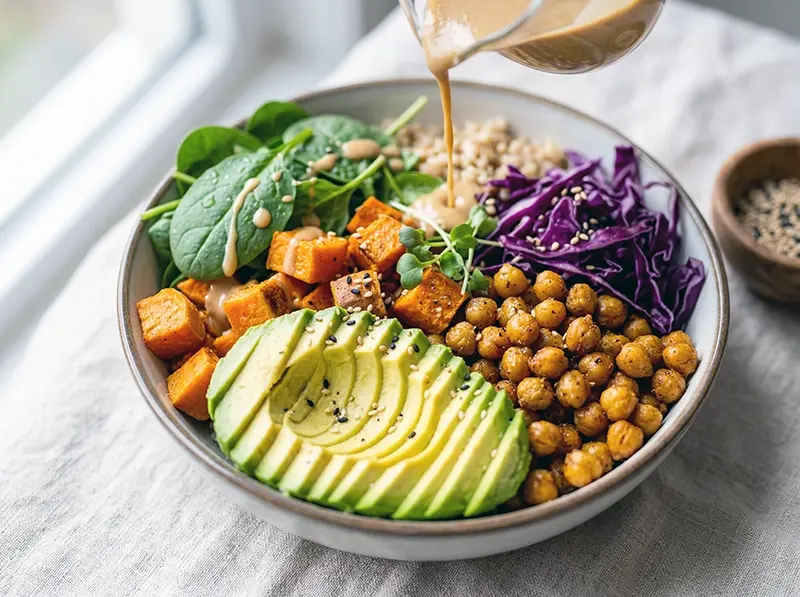
Vegan Buddha Bowl
Quinoa, crispy spiced chickpeas, roasted sweet potato, fresh avocado, and shredded purple cabbage, all brought together with a tahini-lemon dressing. Buddha bowls follow a five-part formula: grain base, plant protein, roasted vegetables, fresh raw vegetables, and sauce. There's no fixed recipe — the whole point is that you can swap nearly every component based on what's in season or what's in your fridge, and the bowl still works. What makes this version reliable: the chickpeas are properly dried before roasting, the sweet potato is cut small enough to caramelize rather than steam, and the tahini dressing is thinned down enough to actually coat everything rather than sitting on top.
Ingredients
- 180 gdry quinoa
- 400 gcanned chickpeas, drained, rinsed, and thoroughly dried
- 1 large sweet potato, cut into 1.5 cm cubes
- 2 tbspolive oil
- 1 tspsmoked paprika
- 1 tspground cumin
- 1 ripe avocado
- 100 gpurple cabbage, finely shredded
- 50 gfresh baby spinach or mixed greens
- 3 tbsptahini
- 2 tbspfresh lemon juice
- 1 garlic clove, grated or very finely minced
- 2 tbspsesame seeds or pumpkin seeds
- 1 tbspsoy sauce or tamari
- 360 mlvegetable stock
Method
- Roast chickpeas and sweet potato. Preheat the oven to 210°C. Dry the chickpeas very thoroughly with paper towels — the drier they are, the crispier they get. Toss them with the remaining 1 tablespoon of olive oil and spread them on one half of a large lined baking sheet. Toss the sweet potato cubes with 1 tablespoon of olive oil, the smoked paprika, and cumin on the other half. Season both with salt and pepper. Roast for 25 to 30 minutes, shaking the chickpeas once halfway through. The sweet potato is done when the edges are caramelized and a knife goes in without resistance. The chickpeas should be dry, slightly shrunken, and shatteringly crisp — if they're still soft, give them 5 more minutes.
- Cook the quinoa. Rinse the quinoa under cold water (reduces bitterness), then cook in 360 ml of vegetable stock rather than water. Bring to a boil, then cover and simmer for 13 to 15 minutes until the liquid is absorbed. Remove from heat and let it steam, covered, for 5 minutes, then fluff with a fork. Cooking in stock adds a background savory note that plain quinoa lacks.
- Make the tahini dressing. Whisk the tahini, lemon juice, grated garlic, soy sauce, and 3 to 4 tablespoons of warm water in a small bowl until smooth. Start with 3 tablespoons of water and add more as needed — the dressing should pour easily and run off a spoon in a thin stream, not in thick globs. Taste and adjust: more lemon juice if flat, a pinch of salt if bland, a tiny drop of maple syrup if too bitter. The dressing should be noticeably well-seasoned because it needs to flavor everything it touches.
- Prepare the fresh components. Shred the purple cabbage as finely as you can — thin shreds eat better than chunky pieces. Toss with a tiny squeeze of lemon juice and a pinch of salt, which softens it slightly without cooking it. Slice the avocado just before assembling so it doesn't brown. Keep the spinach or mixed greens whole or roughly torn.
- Assemble the bowls. Divide the cooked quinoa between two bowls as the base. Arrange the roasted sweet potato, crispy chickpeas, shredded cabbage, avocado slices, and spinach in separate sections rather than mixing everything together — the visual organisation is part of what makes a buddha bowl satisfying to eat. Drizzle the tahini dressing generously over everything, then scatter sesame or pumpkin seeds on top. Serve immediately, with extra dressing on the side.
FAQ
A buddha bowl is built on five elements: a grain base (brown rice, quinoa, farro, bulgur), a plant protein (chickpeas, tofu, tempeh, black beans, lentils), roasted or cooked vegetables (sweet potato, broccoli, cauliflower, beets), fresh raw vegetables for contrast (avocado, cucumber, shredded cabbage, radish), and a sauce that ties everything together (tahini, peanut, miso-ginger). Seeds or nuts add crunch, and fresh greens add brightness. There's no fixed formula — the idea is that any combination produces a nutritionally balanced meal. The one non-negotiable is the sauce: without it, the bowl tastes like separate components rather than a dish.
The key is dryness, not oil. Drain and rinse the chickpeas thoroughly, then spread them on a clean kitchen towel or paper towels and pat completely dry — any surface moisture will steam them rather than roast them. Spread in a single layer on a parchment-lined baking sheet with space between each one. Without oil: bake at 200°C for 30 to 35 minutes, shaking halfway through. With a minimal amount of oil: 1 teaspoon is enough for a full can, and produces slightly crispier results. Season after the first 15 minutes rather than before — seasoning draws moisture out of the chickpeas if applied too early. In an air fryer: 180°C for 15 to 18 minutes, shaking twice.
All three work well, each giving the bowl a different character. Tahini-lemon sauce is the most versatile — neutral enough for any vegetable combination, especially good with roasted sweet potato and chickpeas. Peanut sauce (peanut butter, soy sauce, lime, garlic, ginger, maple syrup) is richer and more assertive — better suited to tofu, edamame, and rice. Miso-ginger (white miso, sesame oil, rice vinegar, fresh ginger) is the most umami-forward of the three, particularly good with greens and tempeh. Whatever sauce you use, thin it to a pourable consistency with water — it should flow easily between all the layers of the bowl rather than sitting on top.
Yes — this is one of the best dishes for weekly meal prep. The trick is to store every component separately. Cooked quinoa, roasted vegetables, and crispy chickpeas keep for 4 to 5 days in the fridge. Tahini dressing keeps for up to a week in a sealed jar. Avocado should be cut the day you eat it — it browns quickly. Assemble the bowl right before eating: reheat the grain and roasted components in a microwave for 1 to 2 minutes, then add the fresh components and drizzle the dressing. For office lunches, pack the dressing and avocado in separate small containers alongside the assembled bowl.
A bowl built on quinoa and chickpeas delivers solid protein numbers. Quinoa contains about 8 g of protein per 100 g cooked and is one of the few plant foods with a complete amino acid profile. Canned chickpeas provide around 15 g per 100 g. Adding 150 g of tofu brings another 12 g. A full bowl with all three components typically lands at 30 to 38 g of protein per serving — comparable to chicken. For more, add 3 tablespoons of hemp seeds (10 g) or pumpkin seeds on top. This makes the buddha bowl one of the more protein-complete vegan meals, suitable for athletic and high-protein plant-based diets.
Rate this
Recipes by email
One letter a week: a recipe picked for your taste, plus whatever is new on the site. Unsubscribe in one click.
Welcome gift: Sergei's cookbook (e-book).
By subscribing you agree to the privacy policy.
Tell us what you like to cook (30 seconds) →Keep browsing
More dishes from the American archive — picked by overlap with what you're cooking now.
Join the conversation
Comments (1)
I make some version of this bowl three times a week for lunch — it is genuinely my most-cooked recipe. The trick I have learned through repetition: roast the sweet potatoes and chickpeas on the same tray but at different spots, because the chickpeas need direct heat to crisp up while the sweet potatoes do better slightly crowded so they steam a bit. And make double the tahini dressing every time. It keeps for a week in the fridge and turns any leftover vegetables into a proper meal.