
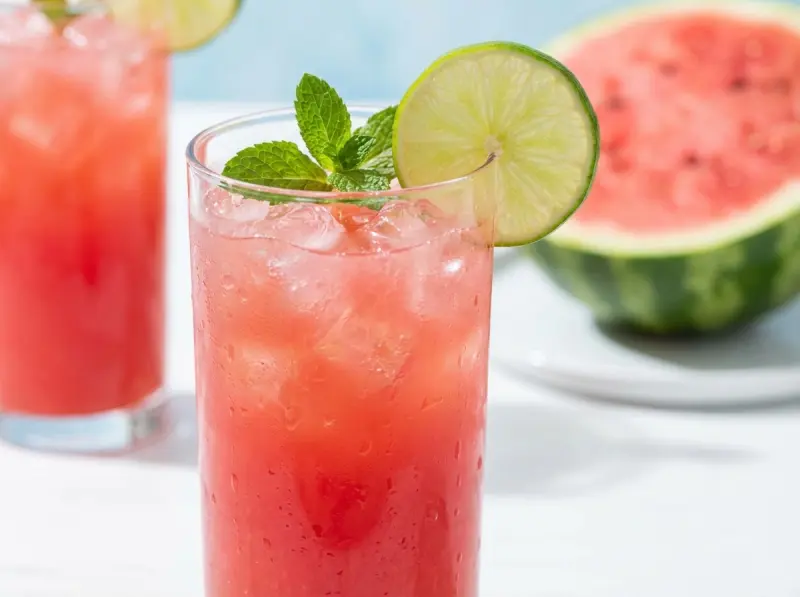
Watermelon Agua Fresca
Agua fresca — Spanish for 'fresh water' — is one of Mexico's most elemental drinks. Street carts and restaurants serve it in great plastic jugs: fruit blended with water, a little sugar, and lime, light enough to be genuinely thirst-quenching rather than just sweet. The watermelon version is the most obvious, and perhaps the best. Ripe watermelon is already 92% water, which means agua fresca is really just concentrating that water and adding a small amount of lime for balance. The result is pinker and more fragrant than anything you could make with juice, and ten times more refreshing than anything from a bottle. Mint is optional in the strict sense, but the combination of watermelon, lime, and fresh mint is one of the better flavor agreements in summer cooking.
Ingredients
- 1.2 kgseedless watermelon flesh
- 500 mlcold water
- 3 tbspfresh lime juice
- 1 tsplime zest
- 2 tbspcaster sugar or honey
- 1 pinchfine salt
- 10 gfresh mint leaves
- 1 lime
Method
- Pick a good watermelon. This recipe lives or dies on the fruit. A ripe watermelon is deep red inside, not pale pink; it smells sweetly floral at the stem end; it feels heavy for its size; and when you tap it, it makes a hollow thud rather than a dense thunk. If the watermelon is not sweet, no amount of sugar will make the agua fresca taste like much. Cut the watermelon into rough cubes, removing the rind. You don't need to be precise — these are going into a blender.
- Blend in batches. Working in batches if necessary, blend the watermelon cubes on high for 60 to 90 seconds until completely smooth and liquid. Add a splash of the water to help the blender if the watermelon is not releasing enough juice on its own. The blended mixture will look very pink and slightly foamy — the foam will settle. Do not add all the water at this stage; add only what the blender needs to run.
- Strain and season. Pour the blended watermelon through a fine-mesh sieve into a large pitcher, pressing the pulp with the back of a spoon to extract maximum liquid. Discard the pulp, or skip this step entirely if you prefer a thicker, more smoothie-like texture. Add the remaining cold water, lime juice, lime zest, sugar or honey, and the pinch of salt. Stir well. Taste and adjust: more lime if it needs brightness, more sugar if the watermelon was bland, more water if it's too intense.
- Add the mint and chill. Lightly bruise the mint leaves between your palms — just enough to release the oils without shredding them — and add to the pitcher. Let the agua fresca rest in the fridge for at least 20 minutes. The mint infuses gently and the flavors come together. Don't leave the mint longer than a couple of hours or it will start to taste slightly bitter and the color will darken.
- Serve. Fill glasses with plenty of ice. Stir the pitcher well before pouring — watermelon agua fresca separates naturally as it sits, with the denser pulp settling at the bottom. Pour over the ice, add a mint sprig and a lime round to each glass. Serve immediately. The agua fresca keeps in the fridge for up to 2 days; stir before each serving.
FAQ
Agua fresca (Spanish for 'fresh water') is a category of traditional Mexican drinks made by blending fruit, flowers, seeds, or grains with water and a small amount of sweetener. The key distinction from juice: agua fresca is significantly diluted with water, making it much lighter and more hydrating. Where juice is concentrated and dense, agua fresca is meant to quench thirst on a hot day — it's closer to very flavourful water than to fruit juice. The fruit-to-water ratio is roughly 1:1 by volume, but this varies by recipe and fruit. Watermelon already contains so much water that the effective ratio is even lighter.
No, but straining changes the result significantly. Strained agua fresca is crystal clear, light, and has the elegance of something you'd be served at a restaurant. Unstrained has more body, more fiber, and a slightly thicker texture — closer to a very thin smoothie than a drink. Both are good. The traditional version sold from Mexican street carts is usually unstrained, and the texture is part of its character. For a dinner party or formal setting, straining looks more polished. For everyday drinking, skip the straining and save time.
Four reliable indicators. First: the field spot — the yellowish patch on the underside where the watermelon rested on the ground. Yellow or cream-coloured means it ripened on the vine; white means it was picked too early. Second: weight — a ripe watermelon feels heavy for its size because of its high water content. Third: the knock test — tap the watermelon with your knuckles. A hollow thud indicates ripeness; a dense thunk means it may be underripe or overripe. Fourth: the stem — a dried, brown stem means the melon was allowed to ripen fully before being picked.
Yes, up to 2 days ahead. The main thing to know: lime juice fades in flavor after a few hours. If making a day ahead, add only half the lime juice at preparation and the rest just before serving. Mint should be removed after 30 minutes of infusion maximum, or it turns bitter — so if making ahead, mint the agua fresca close to serving time rather than at the start. Store in a sealed pitcher in the refrigerator and stir well before each serving, as natural separation is inevitable and completely normal.
Watermelon agua fresca is an excellent cocktail base. For a watermelon margarita: combine 3 parts agua fresca with 1 part tequila blanco and 1/2 part triple sec; serve in a salt-rimmed glass over ice. For a lighter version, add 1 part vodka or blanco rum per 4 parts agua fresca. For a sparkling version, replace half the water in the recipe with sparkling water added just before serving — add it gently so you don't lose the carbonation. A few tablespoons of mezcal instead of tequila adds a smoky note that goes unexpectedly well with watermelon.
Keep browsing
More dishes from the Mexican archive — picked by overlap with what you're cooking now.
Recipes by email
One letter a week: a recipe picked for your taste, plus whatever is new on the site. Unsubscribe in one click.
Welcome gift: Sergei's cookbook (e-book).
By subscribing you agree to the privacy policy.
Tell us what you like to cook (30 seconds) →
Join the conversation
Comments (1)
Perfecto para el verano! La pizca de sal es el secreto q nadie te dice. Suena raro pero pruebalo, la sandía sabe mas a sandía