
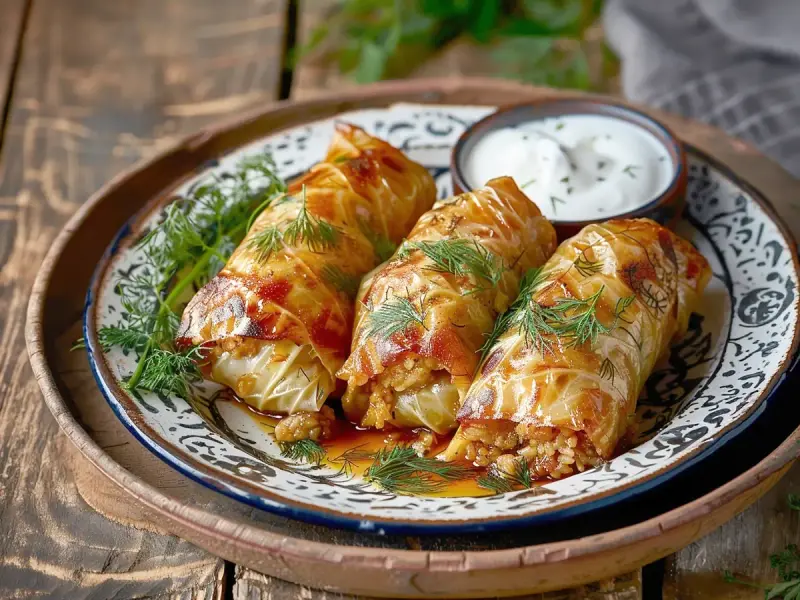
Golubtsy (gefüllte Kohlrouladen)
Zarte Kohlblätter mit Hackfleisch und Reis gefüllt, in Tomaten-Sauerrahmsauce weich geschmort. Ein Klassiker der slawischen Hausmannskost.
Zutaten
- 1 StückWeißkohl
- 300 ggemischtes Hackfleisch
- 100 gRundkornreis
- 2 StückZwiebeln
- 300 gKarotten
- 3 ELTomatenmark
- 100 mlSauerrahm
- 3 StückLorbeerblätter
- 2 ELPflanzenöl
Zubereitung
- Strunk herausschneiden. Kohl in kochendes Wasser tauchen, äußere Blätter ablösen. Dicke Rippe entfernen.

- Reis 10 Min kochen, abgießen. Mit Hackfleisch, einer Zwiebel, Salz und Pfeffer mischen.
- Füllung auf jedes Blatt geben. Seitenränder einfalten, von der Basis zu einer Rolle aufrollen.

- Zweite Zwiebel mit den Karotten in 2 EL Öl weich anbraten. Tomatenmark, 500–700 ml Wasser und Sauerrahm zugeben. Aufkochen, würzen.

- Topfboden mit Kohlblättern auslegen. Rouladen dicht einlegen. Sauce darüber, Lorbeer zugeben. Zugedeckt auf niedriger Hitze 45–60 Min schmoren.
Fragen
Golubtsy fallen aus zwei Gründen auseinander: zu lockere Füllung oder falsche Wickeltechnik. Die Füllung muss fest sein — halbgarer Reis und gut vermischtes Fleisch. Wickeln Sie wie einen Umschlag: die Füllung auf den breiten Rand des Blattes legen, die Seitenränder nach innen falten, dann fest zur schmalen Seite hin einrollen. Die Rollen mit der Naht nach unten in den Topf legen und fest aneinanderdrücken — so öffnen sie sich nicht. Wenn die Blätter steif sind, länger blanchieren (5–7 Minuten) bis sie vollständig biegsam sind.
Ja, es gibt mehrere Alternativen zum klassischen Kohl. Weinblätter (frisch oder eingelegt) geben einen leicht sauren Geschmack — das ist die armenische und griechische Tradition. Wirsingblätter sind zarter und brauchen kein langes Blanchieren. Chinakohl (Napa) ist weicher als Weißkohl und gart schneller. Mangoldblätter oder große Spinatblätter eignen sich für kleine Röllchen. Wenn kein Kohl vorhanden ist — die Füllung in einer Form wie einen Auflauf backen und den Kohl direkt klein geschnitten unter das Fleisch mischen.
Reis ist der Klassiker: geschmacksneutral, bindet die Füllung gut und gibt eine zarte Textur. Rundkornreis (wie Arborio) verwenden — er ist klebriger und die Füllung zerfällt nicht. Buchweizen gibt einen reichhaltigeren, nussigen Geschmack und eine dichtere Textur — sehr beliebt in Russland und der Ukraine. Bulgur oder Perlgraupen funktionieren ebenfalls. Die wichtigste Regel mit jedem Getreide: halbgar hinzufügen, weder roh noch vollständig gekocht — es saugt die Feuchtigkeit im Inneren der Röllchen auf und macht die Füllung nicht trocken.
Auf dem Herd im Topf: zum Kochen bringen, dann bei niedrigster Hitze 50–60 Minuten mit fest geschlossenem Deckel schmoren. Im Ofen: 180°C, 60–70 Minuten mit Alufolie abgedeckt, dann 15 Minuten ohne Folie zum leichten Bräunen. Die Röllchen sind fertig, wenn das Kohlblatt vollständig weich ist und die Füllung bis zur Mitte durchgewärmt ist (70°C innen). Nicht beeilen: halbgarer Reis bleibt hart und das Fleisch innen roh. Die Soße (Tomaten- oder Sauerrahmsoße) sollte die Röllchen immer mindestens zur Hälfte bedecken.
Die Basis einer vegetarischen Füllung ist eine Kombination aus Getreide mit Pilzen oder Hülsenfrüchten. Gebratene Champignons mit Zwiebeln und Reis ergeben eine dichte, aromatische Füllung. Linsen mit Buchweizen und Karotte — eine magerere, aber sehr sättigende Variante. Kichererbsen mit Reis und Paprika funktionieren hervorragend in Tomatensauce. Wichtig: ohne das Fett vom Fleisch 2–3 Esslöffel Pflanzenöl direkt in die Füllung geben und eine kräftige Tomatensauce mit Knoblauch verwenden — sonst schmecken die Röllchen fade.
Bewerten
Rezepte per E-Mail
Ein Brief pro Woche: ein Rezept nach Ihrem Geschmack und alles Neue auf der Seite. Abmelden mit einem Klick.
Als Geschenk: Sergeis Kochbuch (E-Book).
Mit der Anmeldung akzeptieren Sie die Datenschutzerklärung.
Verraten Sie uns, was Sie gern kochen (30 Sekunden) →Weiter stöbern
Weitere Gerichte aus dem Archiv — ausgewählt nach Überschneidung mit dem, was du gerade kochst.

An der Diskussion teilnehmen
Kommentare (2)
Прекрасное блюдо!
Cook the head of white cabbage until it just barely yields to a knife for golubtsy. It continues softening from residual heat for 2-3 minutes. Cooking until fully soft in the pan means mush on the plate.