
Beef Wellington
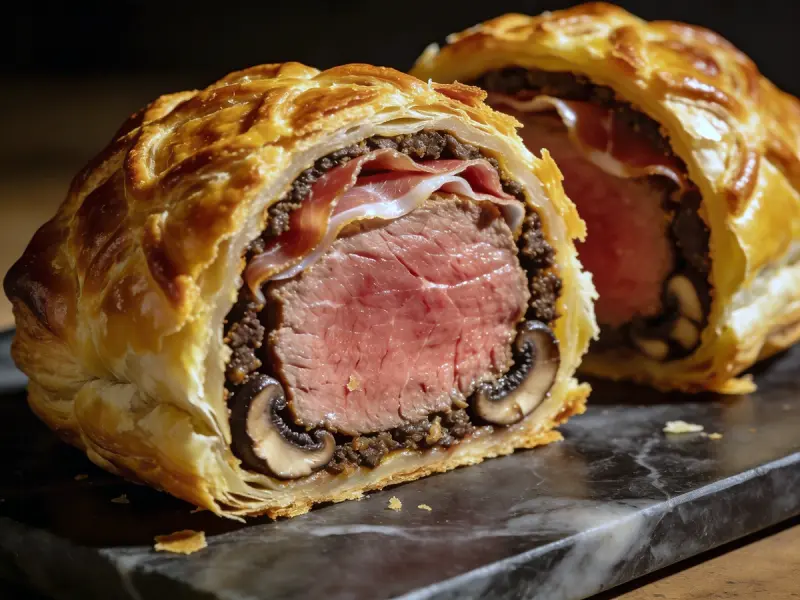
Beef Wellington (also called filet de bœuf en croûte, or bœuf Wellington in French) is a British dinner-party roast: a center-cut beef tenderloin, seared hard, brushed with Dijon mustard, wrapped in mushroom duxelles and prosciutto, then baked inside all-butter puff pastry. Where the name comes from is unclear: some link it to the Duke of Wellington, others see it as an English version of the French filet en croûte. Sliced at the table, it shows a thin dark crust, a layer of dry duxelles and a rosy center. Plan on about an hour and a half of work and oven time, plus at least 70 minutes of chilling between stages and a 15-minute rest: roughly three hours from start to table.
Ingredients
- 800 gbeef tenderloin, center-cut, trimmed and tied into a cylinder
- 2 tbspDijon mustard
- 400 gchestnut or cremini mushrooms
- 2 shallots
- 3 garlic cloves
- 4 sprigs of fresh thyme
- 2 tbspunsalted butter
- 100 mldry white wine or Madeira
- 150 gprosciutto di Parma or Parma ham
- 500 gall-butter puff pastry
- 2 egg yolks, beaten with 1 tbsp milk
- 1 tspflaky sea salt
- 2 tbspneutral oil, for searing
- 2 tspfine salt, for the beef and mushrooms
- 1 tspfreshly ground black pepper
Method
- Sear the beef and chill. Season the tenderloin all over with 1½ teaspoons of the fine salt and the black pepper. Heat a heavy skillet or cast-iron pan over the highest possible heat with the neutral oil until the oil just starts to smoke. Sear the beef on every surface, including both ends, for 45 to 60 seconds each, about 4 to 5 minutes in all, turning as soon as each face is deep brown; take it off then, because the inside must stay completely raw. Lift it out, snip off and discard the string, brush all over immediately with Dijon mustard, and leave to cool completely on a wire rack. Do not wrap warm beef, the steam will ruin the pastry. Refrigerate uncovered for at least 30 minutes.
- Make the mushroom duxelles. Pulse the mushrooms in a food processor in two batches, 10 to 15 seconds each, until the pieces are the size of rice grains, not a purée (or chop them very finely by knife). In the same pan over medium heat, melt the butter and soften the shallots and garlic for 2 minutes. Add the mushrooms, thyme leaves and the remaining ½ teaspoon of fine salt. Cook, stirring frequently, over medium-high heat for 15 to 20 minutes: the mushrooms first release a lot of liquid, and you keep going until it has all cooked off. Add the wine and cook until completely evaporated. Continue until the mixture is dark, dry and almost paste-like; when you press a spoonful against the pan, no liquid should run. Spread on a plate to cool completely. This step is the single most important technique in the recipe: any residual moisture will make the pastry soggy.
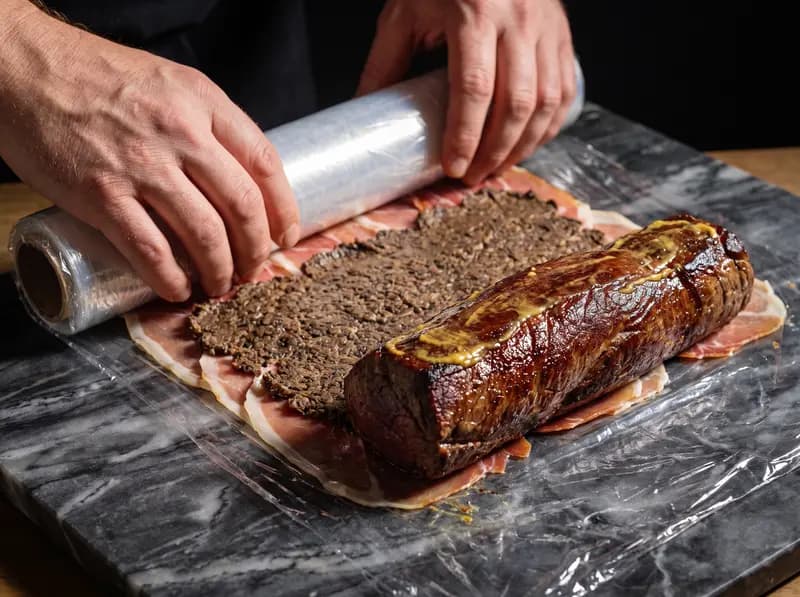
- Wrap in prosciutto and chill. Lay a large sheet of cling film on a work surface. Arrange the prosciutto slices in a slightly overlapping rectangle roughly the length of the beef. Spread the cooled duxelles evenly over the prosciutto. Place the cold, string-free beef at the bottom edge and, using the cling film, roll the prosciutto tightly around the beef, twisting the ends to form a firm, even cylinder. Refrigerate for at least 20 minutes. This cold, firm roll is essential for clean assembly.
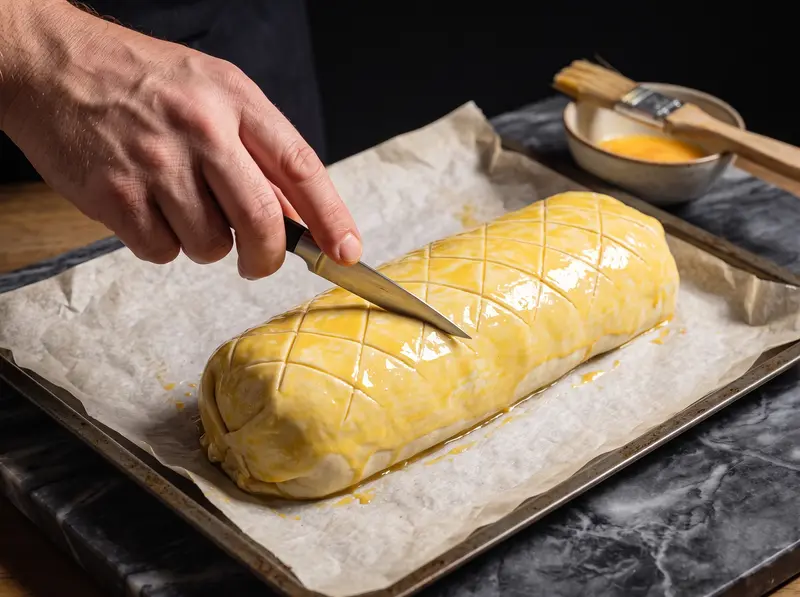
- Wrap in pastry and chill again. Roll the cold puff pastry on a lightly floured surface to a rectangle about 3 mm thick, large enough to wrap the beef with a 5 cm overlap on all sides. Unwrap the cling film from the prosciutto roll and place the roll seam-side-down at one edge of the pastry. Brush the far edges with egg wash, roll the pastry tightly around the beef, and press to seal all seams. Trim the excess from the ends, fold neatly, and press. Place seam-side-down on a baking sheet lined with baking paper. Brush all over with egg wash. Using the back of a knife, score a diagonal pattern across the top. Refrigerate uncovered for at least 20 minutes, or loosely covered for up to 24 hours.
- Bake and rest. Put a heavy baking tray in the oven and preheat it to 200°C (400°F) for at least 15 minutes. Remove the Wellington from the fridge, brush again with egg wash, sprinkle flaky salt over the top, and slide it, with its baking paper, onto the hot tray. Bake for about 30 minutes, checking from minute 25: the pastry must be deeply golden (a pale Wellington is undercooked), and a probe thermometer in the center of the beef should read 46 to 48°C (115 to 118°F) for medium-rare. Remove from the oven and rest on the tray for 15 minutes without cutting; the center climbs to about 52 to 54°C (125 to 130°F) as it rests. Food-safety agencies set 63°C (145°F) plus a 3-minute rest as the safe minimum for a whole cut of beef; medium-rare is below that line, a choice many cooks make with an intact fillet. For children, pregnant women, older people and anyone with a weak immune system, take the Wellington out at 57°C and rest it to 63°C: the center will be light pink rather than red. Slice at the table with a sharp serrated knife; the first cut reveals the dramatic cross-section that defines the dish.
FAQ
Take it out when a probe thermometer in the very center of the beef reads 46 to 48°C (115 to 118°F). The pastry traps heat, so during the 15-minute rest the core keeps climbing to about 52 to 54°C (125 to 130°F), a rosy medium-rare; 55 to 57°C is already medium. The safe minimum that food-safety agencies set for a whole cut of beef is 63°C (145°F) plus a 3-minute rest, so medium-rare is below that line; for children, pregnant women, older people and anyone with a weak immune system, take the Wellington out at 57°C and rest it to 63°C. Slide the probe in through one end at a slight angle, to the geometric center, and avoid piercing the top crust. For an 800 g fillet at 200°C expect roughly 30 minutes, but go by the thermometer and the deep golden pastry, because oven and fillet thickness shift the time by several minutes.
Three things work together. First, the duxelles must be properly dry: cook it past the point where it looks done, until no liquid shows when you press it with a spoon (the same rule applies to the filling of a mushroom Wellington). Second, wrap and bake the Wellington cold, so the pastry sets the moment it meets the heat. Third, preheat a heavy baking tray in the oven for at least 15 minutes and slide the Wellington onto it hot, so the base crisps before steam from the filling can soften it. Some cooks also line the pastry with thin unsweetened crêpes, so they sit between the pastry and the prosciutto and soak up any juices; older recipes use crêpes instead of the ham altogether.
Yes, the fully assembled Wellington (beef wrapped in prosciutto and duxelles, sealed in pastry) keeps in the fridge for up to 24 hours. Wrap it in cling film before the first egg wash, or cover it loosely once the wash has dried. Take it out 15 minutes before baking, brush twice with egg wash 10 minutes apart, and bake as written. The flavors meld overnight, and cold pastry hitting a hot oven puffs better. Do not freeze the assembled Wellington: thawing releases water that spoils the duxelles and softens the pastry.
Use center-cut beef tenderloin (fillet). It has an even cylindrical shape for wrapping and slicing, almost no connective tissue, so it is tender after a short bake, and a mild flavor that lets the duxelles and pastry come through. Sirloin or ribeye are uneven, fattier, and need longer cooking than the pastry can take; tough, cheap cuts belong in a braise such as beef bourguignon instead. For small Wellingtons, wrap 400 to 500 g pieces of tenderloin, bake at 200°C for roughly 15 to 20 minutes, and check the center for 46 to 48°C.
Searing does two jobs. It browns the surface (the Maillard reaction), which gives the thin dark crust you see in the cross-section and a layer of flavor between the beef and the duxelles. It also firms the outside, so the fillet keeps its cylinder shape while you wrap it. Without it, raw beef is soft and hard to wrap, and it spreads out unevenly in the oven. Keep the sear short, about 4 to 5 minutes in total in smoking oil, because you want color and firmness on the surface only; the inside must go into the oven completely raw.
Rate this
Recipes by email
One letter a week: a recipe picked for your taste, plus whatever is new on the site. Unsubscribe in one click.
Welcome gift: Sergei's cookbook (e-book).
By subscribing you agree to the privacy policy.
Tell us what you like to cook (30 seconds) →Keep browsing
More dishes from the British archive — picked by overlap with what you're cooking now.
Join the conversation
Comments (1)
I have made beef wellington for Christmas dinner four years in a row and it still makes me nervous every time. The duxelles must be cooked until completely dry — I mean squeaking against the pan dry. Any moisture turns the pastry soggy from the inside. I spread a thin layer of English mustard on the seared beef before wrapping, and the prosciutto layer acts as a moisture barrier between the mushrooms and the pastry. Rest the wellington for 10 minutes after slicing or the juices flood the plate instead of staying in the meat.