
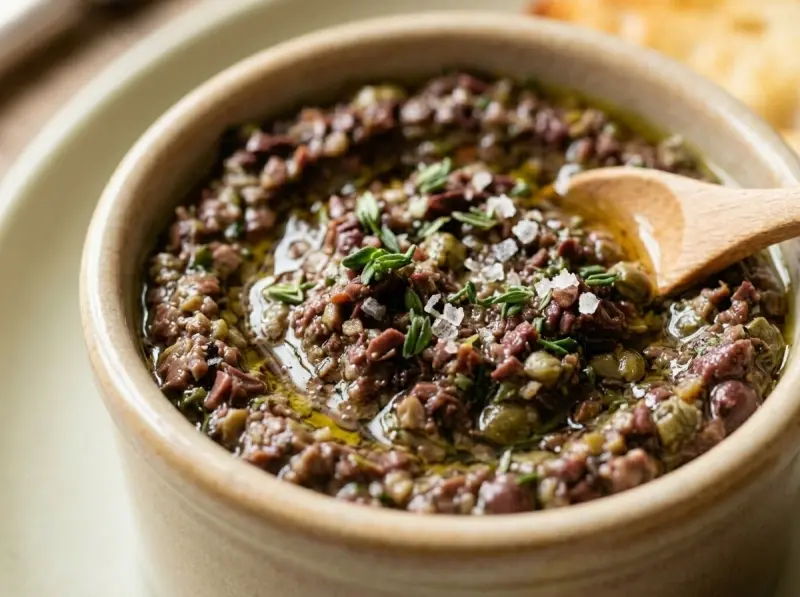
Tapenade de aceitunas
La tapenade de aceitunas es una pasta provenzal de aceitunas negras y verdes picadas, alcaparras y anchoas, ligada con aceite de oliva y zumo de limón. Esta versión añade también cebolla morada, perejil y copos de chile. Extiéndela sobre pan crujiente o sírvela con verduras a la parrilla o pescado. Con un poco basta.
Ingredientes
- 150 gaceitunas kalamata, sin hueso
- 150 gaceitunas verdes, sin hueso
- 40 galcaparras, escurridas
- 40 gcebolla morada, picada fina
- 2 filetes de anchoa
- 2 cdaaceite de oliva
- 2 cdazumo de limón
- 2 cdaperejil fresco o albahaca
- 1/4 cdtapimiento rojo en escamas
Preparación
- Escurre las aceitunas y las alcaparras (seca las alcaparras con papel de cocina y acláralas antes si están muy saladas) y pica las anchoas muy finas. Pica finamente las aceitunas kalamata y las verdes, ponlas en un cuenco y añade las alcaparras, la cebolla morada y las anchoas.

- Vierte el aceite de oliva, el zumo de limón, el perejil o la albahaca y las escamas de pimiento rojo. Mezcla bien.
- Si prefieres una pasta más fina, tritura con 6–8 pulsos cortos, rascando las paredes una o dos veces. Para cuando aún sea una pasta gruesa con trozos de aceituna visibles: dos pulsos de más y queda una crema lisa.

- Sirve con pan crujiente, crackers o utilízalo como untable en bocadillos o pizza.
Preguntas
La tapenade es una pasta provenzal clásica — su nombre viene de la palabra provenzal tapeno que significa alcaparra. Las alcaparras son ingrediente obligatorio: dan la nota salada-ácida característica. La pasta griega de aceitunas es simplemente aceitunas trituradas con aceite. La tapenade es más compleja: alcaparras, anchoas (opcionales), limón, hierbas — una salsa completa.
Las anchoas en la tapenade no se notan como pescado — aportan umami, profundidad y salinidad. Al triturar se disuelven completamente. Es el mismo papel que la salsa Worcestershire en el Caesar. Sin anchoas la tapenade es más plana. Versión vegana: añadir un poco de pasta miso o copos de nori — dan una nota umami similar.
Una tapenade noire clásica se hace con aceitunas negras, así que la kalamata es buena opción: carnosa, de sabor profundo y amargor moderado. Las negras de lata (estilo californiano) son demasiado blandas e insípidas, y a menudo llevan colorante. Las verdes dan otra tapenade, más fresca y aguda, y por eso esta receta mezcla las dos. Compres las que compres, enjuaga las que vengan en salmuera fuerte o la pasta saldrá demasiado salada.
En Provenza se unta en tostadas o pan a la plancha como aperitivo. Se usa como pasta bajo la carne al horno — frotar el cordero o pollo. Diluida con aceite se convierte en salsa para pasta. Se añade en pizza en vez de salsa de tomate. Se sirve con crudités. En la nevera dura 2–3 semanas bajo una capa de aceite. Úntala en pan tostado como una bruschetta o ponla en un cuenco junto al hummus en una tabla de mezze.
En Provenza se hace en mortero — lento, a mano, con textura granulosa desigual. La licuadora es válida pero fácil excederse: el error es convertirla en crema homogénea. La textura correcta es tosca, con trozos. En licuadora usar la función pulse — pulsos de 1–2 segundos, luego mezclar con cuchara, pulso de nuevo.
Valora
Recetas en tu correo
Un correo a la semana: una receta elegida a tu gusto y lo nuevo del sitio. Puedes dejar de recibirlo con un clic.
De regalo: el libro de recetas de Sergei (e-book).
Al pulsar el botón aceptas la política de privacidad.
Cuéntanos qué te gusta cocinar (30 segundos) →Sigue explorando
Más platos del archivo — elegidos por su solapamiento con lo que estás cocinando ahora.


Únete a la conversación
Comentarios (1)
I cut everything for olive tapenade to bite size — nothing that requires a knife or causes an awkward moment. Appetizers should be effortless to eat so the conversation stays uninterrupted.