
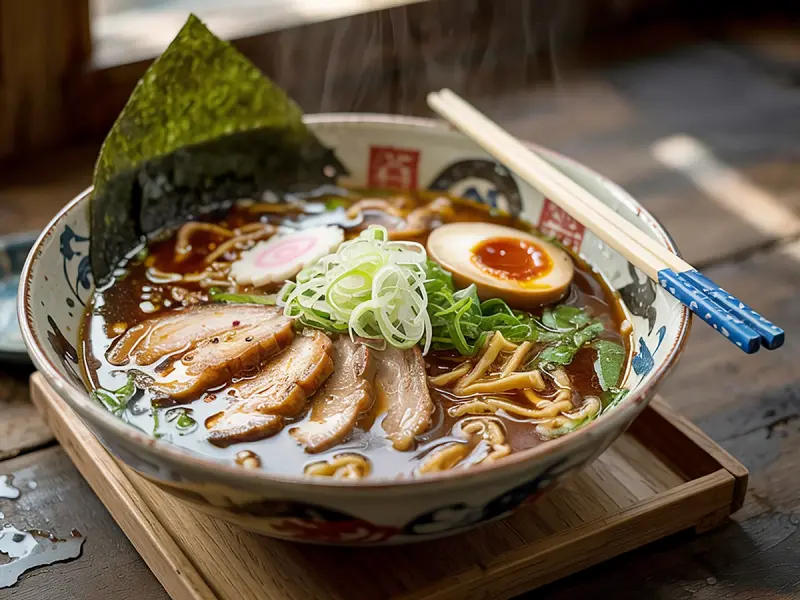
Ramen
El ramen es un plato tradicional japonés que consiste en fideos chinos servidos en un caldo caliente con diversos acompañamientos. Cada región de Japón cuenta con sus propias recetas únicas.
Ingredientes
- 1 kghuesos de pollo o de cerdo
- 2 lagua
- 1 cebolla, cortada por la mitad
- 1 cabezade ajo, partida por la mitad
- 1 rebanadajengibre fresco
- 2-3 cebolletas
- 1 zanahoria
- 1/2 tazasalsa de soja
- 1/4 tazamirin
- 1/4 tazasake
- 1/4 tazadashi, diluido
- 200 gpanceta de cerdo o pechuga de pollo, en lonchas finas
- 4 huevos
- 1 paquetede fideos de ramen
- 1/2 tazabrotes de bambú, en láminas
- 1/2 tazaalga nori, troceada
- opcionalsemillas de sésamo tostadas
1 taza = 240 ml
Preparación
- Enjuaga los huesos bajo agua fría. Colócalos en una olla grande, cúbrelos con agua y lleva a ebullición. Hierve durante 10 minutos, escurre y enjuaga los huesos.
- Devuelve los huesos a la olla, añade 2 litros de agua limpia, la cebolla, el ajo, el jengibre, las cebolletas y la zanahoria. Lleva a ebullición y después cuece a fuego lento durante 4-6 horas (pollo) o 10-12 horas (tonkotsu). Cuela el caldo y mantenlo caliente.

- Para la salsa tare: mezcla la salsa de soja, el mirin, el sake y el dashi en un cazo pequeño. Lleva a ebullición, deja cocer 5 minutos a fuego suave y deja enfriar.
- Dora la panceta de cerdo o la pechuga de pollo hasta que estén bien doradas y córtalas en lonchas finas. Cuece los huevos durante 6 minutos, pásalos por agua fría, pélalos y córtalos por la mitad.

- Cuece los fideos de ramen hasta que estén al dente y refréscalos con agua fría. En cada bol, coloca 1-2 cucharadas de salsa tare, añade los fideos, las lonchas de carne, las mitades de huevo, los brotes de bambú, el alga nori y las cebolletas. Vierte el caldo caliente por encima. Espolvorea con semillas de sésamo tostadas.
Preguntas
La diferencia está en la base del caldo. El shio (sal) es el más ligero y delicado, generalmente con pollo o mariscos; el shoyu (salsa de soja) es parduzco, ligeramente salado y rico en umami, el clásico de Tokio; el miso es rico y ligeramente dulce, originario de Sapporo, se añade al final para preservar su sabor; el tonkotsu es de cerdo, blanco lechoso, cocido por 12+ horas para lograr una textura cremosa y espesa. Para cocinar en casa, el shoyu o el miso son los puntos de partida más sencillos.
Hay dos enfoques honestos. Primero, un caldo combinado: hervir una carcasa de pollo con cebolla, jengibre y ajo durante 1–1,5 horas, luego añadir dashi (kombu y katsuobushi en infusión 5 minutos), miso o salsa de soja y aceite de sésamo. Segundo, comprar un tare (concentrado de condimento) ya hecho y mezclarlo con caldo de pollo casero. El resultado será un 70–80% del ramen de restaurante en unas 2 horas en lugar de 12.
El ramen requiere fideos de trigo alcalinos (hechos con kansui o bicarbonato) — eso es lo que les da su mordida elástica característica y el color ligeramente amarillo. Si no están disponibles, sustitúyalos por fideos de huevo. Los fideos de arroz no son ramen; son demasiado blandos. Un truco útil: hervir fideos de trigo normales en agua con 1 cucharada de bicarbonato de sodio para lograr una textura similar.
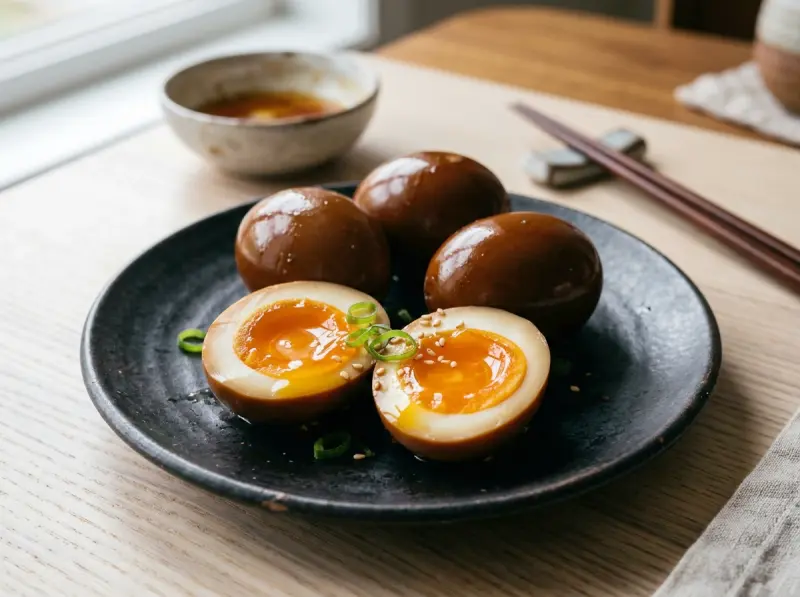
El color marrón proviene del marinado: huevos cocidos blandos (6,5–7 minutos, luego en agua helada) se pelan y sumergen en una mezcla de salsa de soja, mirin, azúcar y agua (1:1:0,5:4) durante al menos 4 horas, preferiblemente toda la noche. La yema debe quedar blanda y casi líquida — ese es el sello de calidad. Una yema firme significa que está demasiado cocido. Prepara 6–8 a la vez: sacados del marinado a las 12 horas, aguantan 3–4 días en la nevera. La receta completa está en huevos para ramen.
El ramen se sazona en el bol, no en la olla — ese es un principio clave. El tare (base de condimento) va en el bol vacío primero, luego se vierte el caldo. Si sigue insípido: añade 1 cucharadita de miso blanco, unas gotas de aceite de sésamo oscuro, un chorrito de salsa de pescado o más salsa de soja. Los aficionados al picante añaden aceite de chile (la-yu). A menudo, una pizca de sal marina en escamas directamente en el bol es suficiente.
Valora
Recetas en tu correo
Un correo a la semana: una receta elegida a tu gusto y lo nuevo del sitio. Puedes dejar de recibirlo con un clic.
De regalo: el libro de recetas de Sergei (e-book).
Al pulsar el botón aceptas la política de privacidad.
Cuéntanos qué te gusta cocinar (30 segundos) →Sigue explorando
Más platos del archivo — elegidos por su solapamiento con lo que estás cocinando ahora.

Únete a la conversación
Comentarios (4)
チャーシューが柔らかくて最高。でも6時間煮込むのは正直しんどい…圧力鍋使えばいいのかな?
スープが本当に美味しい。でも6時間は長すぎる。圧力鍋で2時間にしました。結果は同じくらい良かったです。
Рамен из пакетика и домашний рамен — это как самокат и мотоцикл. Оба едут, но ощущения разные. Бульон тонкоцу варится 12 часов, и нет, никакой скороварки-заменителя не существует. Яйцо маринуется ночь. Если вы не готовы к этому — варите из пакетика, я не осуждаю. Ладно, немного осуждаю.
The broth is everything in ramen — I simmer the bones for a minimum of 4 hours, skimming every 30 minutes for the first hour. That cloudy, collagen-rich liquid is what separates real ramen from instant. You cannot shortcut this step and expect the same result.